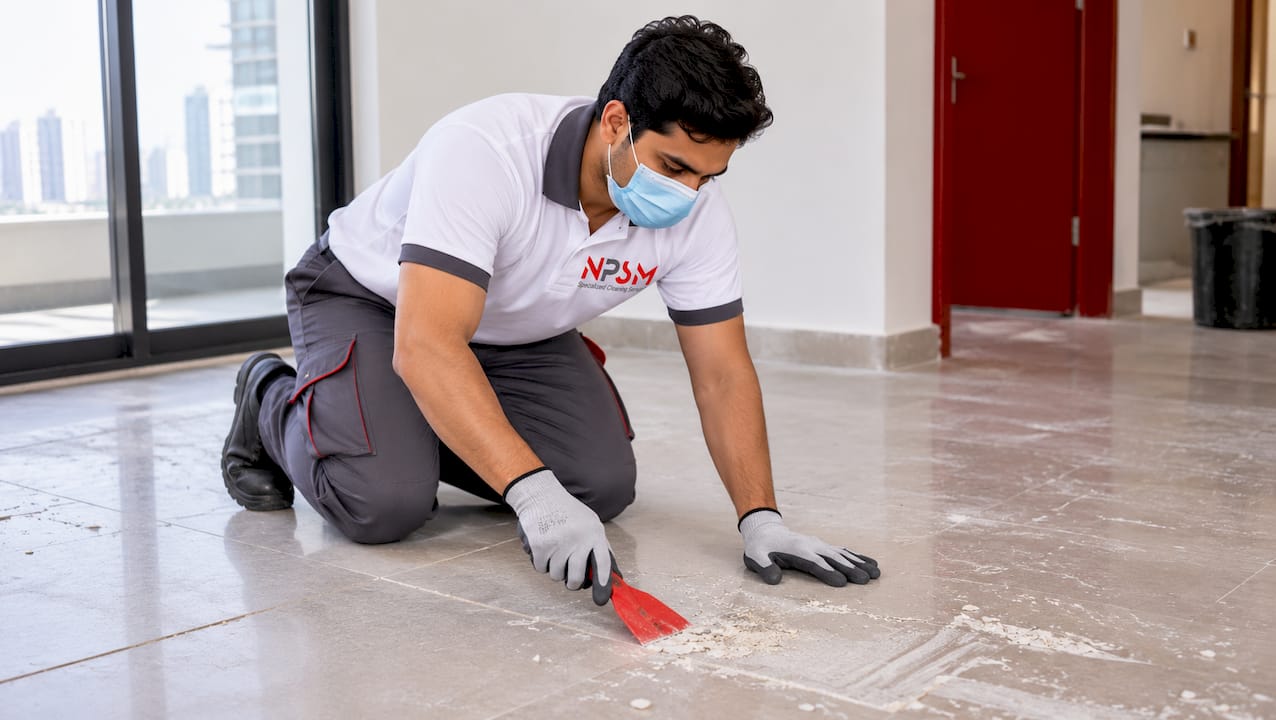
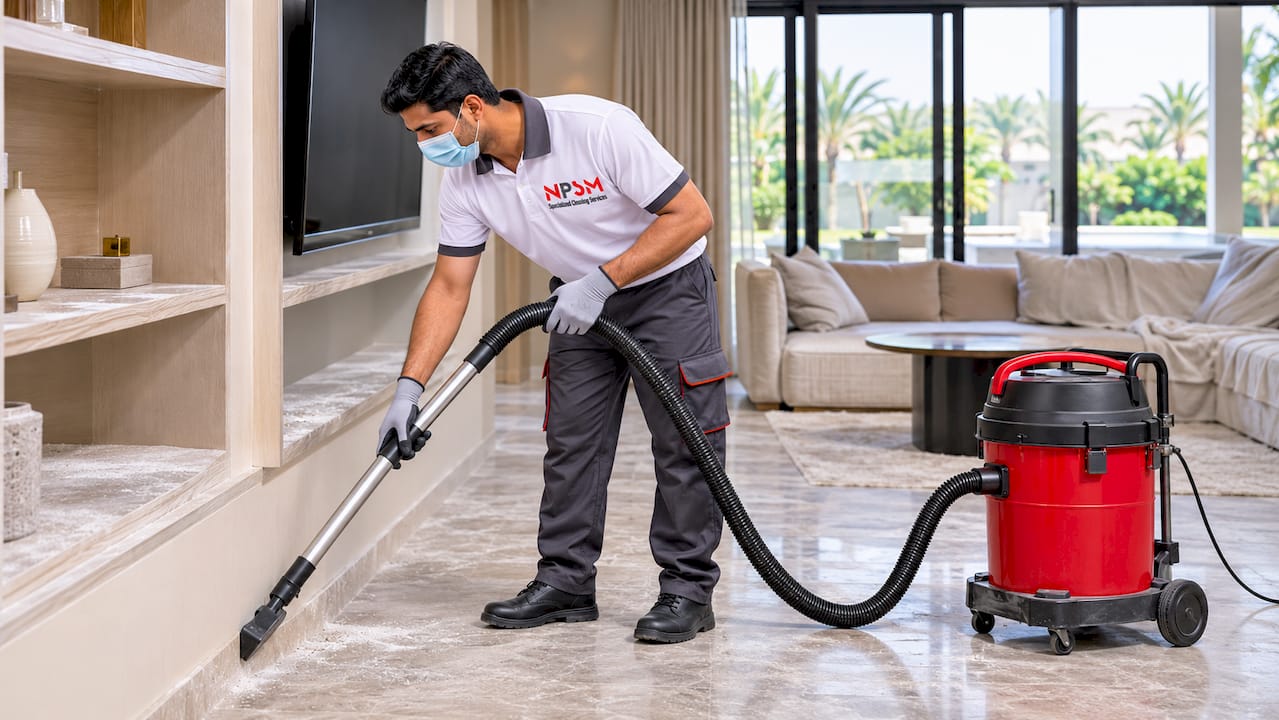
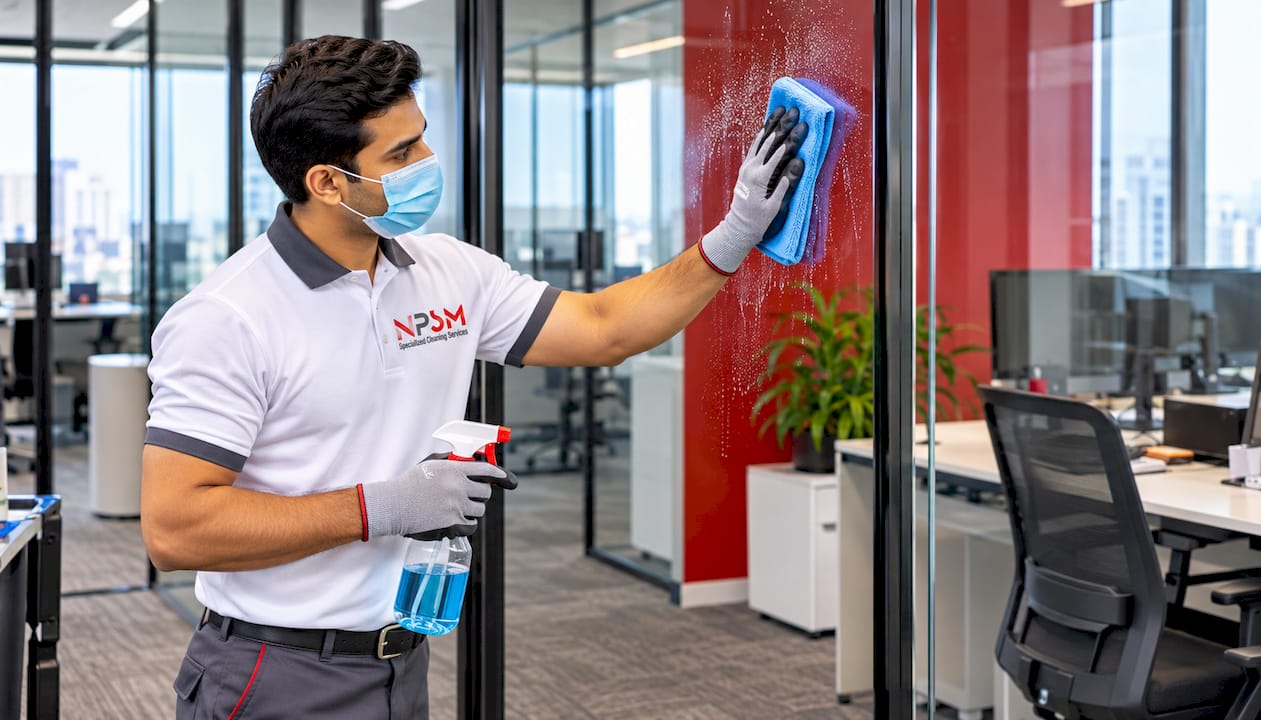
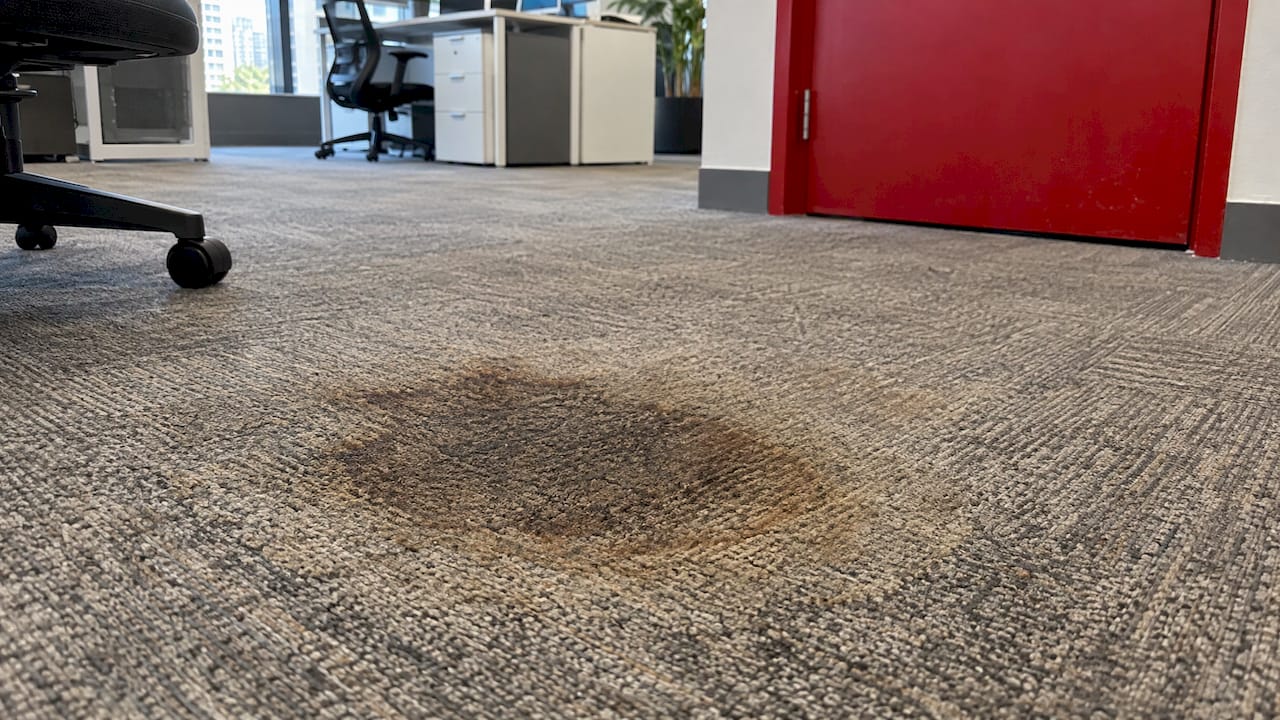
The safest way to remove adhesive residue from tiles is slow and gentle: soften the residue, lift it with a plastic scraper, dissolve what is left with a solvent matched to your tile, then rinse and dry. A fresh smear on glazed porcelain is a small job. Hardened glue across a whole villa or office floor after fit-out is a different one. There the risk is a dulled finish, weakened grout or a patchy surface that costs more to fix than the glue did. This guide gives you the full method, step by step, and shows where each step goes wrong. It also shows when to hand the floor to our team at NPSM Specialized Cleaning, who clean post-construction and move-in tiles in Dubai.
Specializedcleaning
Protect Tiles During Post-Construction Cleaning
For hardened adhesive across a villa or office floor, Specializedcleaning provides post-construction cleaning in Dubai with specialized equipment.
Residue on tile is rarely one thing. A strip of old tile adhesive, a sticker film, tape gum, silicone smears and construction glue each respond to different treatment. Two questions decide your method:
What is the tile? Glazed ceramic and porcelain have a hard, sealed face. Unglazed tile, travertine, slate, marble and other natural stone are porous and absorb whatever you put on them.
How old is the residue? Fresh residue softens with water and mild soap. Hardened adhesive needs a softening step and a solvent.
A makes the same distinction: glazed ceramic and porcelain tolerate more than natural stone, unsealed tile or damaged grout. If you cannot tell which you have, treat the tile as the more delicate type until a hidden corner test says otherwise.
Situation
Typical residue
Starting method
Main risk
Glazed porcelain or ceramic, small smear
Sticker, tape or fresh glue
Warm soapy water, plastic scraper
Scratching from metal tools
Glazed tile, hardened glue
Dried adhesive film
Soften, scrape, alcohol-based remover
Dulling the glaze
Natural stone or unsealed tile
Any adhesive
Gentle methods only, test first
Solvent soaking in, permanent marks
Grout lines
Adhesive or haze in the joints
Minimal liquid, controlled contact time
Weakened or stained grout
Whole floor after renovation
Mixed construction residues
Systematic, area by area
Uneven finish, wasted time
Step 1: Test in a hidden spot
Select an area hidden beneath furniture or behind a skirting board for testing. Apply the cleaner you intend to use, let it sit for the specified duration, then rinse thoroughly. Once dry, examine the tile’s finish and color for any changes. This initial test helps determine the tile’s reaction, allowing you to start with the least aggressive method that works, avoiding the risk of damage from more forceful treatments.
Where it goes wrong: people test while the tile is wet and judge too early. A finish change often shows only when the surface dries. If the sheen or color shifts, stop and change method.
Step 2: Soften with warm water and mild soap
Mix a small amount of mild dish soap into warm, not boiling, water. Dampen a soft cloth, wring it out, then press it on the residue for a few minutes before wiping gently. This method softens fresh spills and light adhesive films safely. Repeat the gentle soak as needed rather than moving immediately to stronger cleaners.
The same advice applies to technique:
Dampen the cloth rather than flooding the floor.
Do not let soapy water sit on the grout for long.
Rinse with a lightly damp cloth and dry.
Where it goes wrong: over-wetting. Water that creeps along grout lines and under tile edges can weaken the bed. On a single tile you can control this. Across a 120 square meter apartment it is hard to do evenly.
Step 3: Lift with a plastic scraper held nearly flat
Use a plastic putty knife, an old card or another non-metal scraper at a shallow angle. A Home to Sight guide recommends gentle scraping with a plastic putty knife, or a fresh razor blade held at a shallow angle, and wiping with a clean damp sponge afterward.
A metal blade is the usual cause of damage. SurfaceFixLab warns that a metal blade can damage decorative or polished porcelain and catch on textured surfaces, and that coarse pads can leave a patch with different reflectivity. Use a razor only on tile you have confirmed is unglazed or heavily glazed, at a very shallow angle.
Where it goes wrong: pressure. The faster you try to work, the harder you push, and the more likely a corner chips or a polished face scuffs. Short, light strokes are slower and safer.
Step 4: Choose a solvent that suits the tile
If soap and scraping leave a film, dissolve it. The right product depends on the surface:
Glazed ceramic and porcelain: isopropyl alcohol or a citrus-based remover, applied to a cloth and wiped on the residue, then rinsed. For glazed wall and floor tile, keep removers off porous grout where possible.
Gummy residue on non-porous tile: a dedicated gel remover. It is applied as a thick layer, left 10 to 30 minutes depending on the adhesive, and is not suitable for porous surfaces such as unsealed natural stone, because it may wash residue deeper into the pores.
Silicone smears: a silicone remover. Apply it undiluted, leave it about 20 minutes, scrape with a spatula and repeat if needed. Test first, as it may dull methacrylate, plastic and coated surfaces.
Natural stone and unglazed tile: avoid harsh chemicals. These tiles absorb solvents, and a poultice, a paste that draws the adhesive out, is the usual approach.
Two rules apply to every product. Read the label, and never mix cleaning products. Bleach and ammonia combined with other cleaners can release dangerous fumes. Ventilate the room, which matters in a closed Dubai apartment with the AC running.
Where it goes wrong: a solvent that suits porcelain can stain travertine or slate for good. The mistake is permanent and cannot be undone with more cleaning.
What about WD-40, oils and kitchen remedies?
People often ask whether WD-40 removes glue. One consumer guide says oil-based products suit porous and painted surfaces, and alcohol-based solvents suit hard, non-porous ones. On glazed tile, an oil leaves a greasy film that you then have to remove with dish soap and warm water. That is an extra step that can spread residue across a larger area. For tile, an alcohol-based or purpose-made remover is the cleaner route. A vinegar and baking soda paste appears in many guides for grout lines, but acid can mark porous tiles if left too long, so keep it away from natural stone.
Step 5: Rinse, neutralize and dry
The final wipe matters as much as the removal. TidyFormula’s guidance is that sticky residue needs two actions, loosening and lifting, and that the clean-water wipe removes both the cleaner and the loosened residue. Leaving either behind creates a film that holds dust and shows up as a dull patch under light.
For a thorough finish on tile and stone, follows solvent use with a pH-neutral cleaner and a rinse. Then:
Wipe with a clean cloth and clear water.
Dry with a soft cloth.
Check the tile from a low angle against a window to catch haze or smears.
The special case of grout lines
Adhesive that has run into a grout joint is the hardest residue to deal with. Solvent left at a grout line can weaken the adjacent sealant, and over-wetting weakens the grout itself. Sealers Plus gives a useful benchmark in its technical sheet: when removing adhesive from ceramic and porcelain, work between 4°C and 32°C and do not let the product dry on the surface. For epoxy grout haze it limits dwell time to 30 minutes with no puddling in the joints.
That temperature range matters in the UAE. Tiles in a sun-exposed room, or a floor near a glass facade in summer, can be hotter than the product allows. Products that dry on the surface leave a worse film than the one you started with.
Grout haze, the cloudy cement film left after grouting, is a related problem with its own timing. Our guide to tile grout haze removal in Dubai explains why the cure period matters before cleaning. Specialist new-surface guidance warns that late removal of grout, silicone and adhesive residues can leave stains that are hard to remove. It also forbids hydrochloric acid and caustic soda on sintered slabs under any circumstances. Check the care sheet of your tile before using any acid.
Heat: use it carefully, if at all
Gentle warmth softens old adhesive, and steam is often suggested for hardened glue on concrete and tile. Too much heat can discolor or warp surfaces, so any heating should be moderate and controlled, and always followed by scraping and a final clean. Never use open flame near adhesive and solvents together. For anyone without a controlled steam setup, the soapy cloth method in step 2 is the safer softening route.
Starting small versus starting a project
A reader fixing a sticker mark on one kitchen tile can follow the steps above and be done in an afternoon. The calculation changes when:
The area is large. Handover cleaning in a villa or apartment means thousands of small decisions about tile, grout and glue.
The tile is valuable or porous. Marble, travertine and imported porcelain are costly to replace, and a wrong solvent is permanent.
The deadline is fixed. Handover, tenant move-in and office opening dates do not wait for a second pass.
Other residues are present. Paint, cement, silicone and adhesive on the same floor need different treatments in the right order.
For these jobs, the method is the same as the one above, repeated carefully over every room, with the test patch done on each tile type. We would rather your floor is checked before treatment than after a mark appears. Our guide on why professional cleaners test paint, cement and adhesive patches explains the reasoning, and our kitchen renovation cleaning guide covers one of the most common places adhesive, grease and dust end up together.
If adhesive is stuck to a surface that is not tile, a guide to safe adhesive cleanup first steps explains why peeling comes before solvents on finished surfaces.
Who needs this in Dubai
The reader who searches for adhesive residue removal usually falls into one of these groups:
Homeowners after renovation: glue, tape and stickers across newly laid tiles before furniture arrives.
Tenants moving in or out: floors that must be left clean for a deposit or handed over to the next occupant.
Property managers: many units, a fixed turnaround and one standard for every floor.
Office and fit-out managers: adhesive from carpet tile, signage and partition work before a business opens.
In each case the tile work is one part of a broader clean-up, which is why it fits best inside a post-construction cleaning job rather than as a stand-alone chore.
How we handle adhesive residue on tile
We are NPSM Specialized Cleaning Services LLC, a Dubai company with over 15 years of experience in residential and commercial cleaning. Adhesive residue on tile comes up inside our post-construction, deep cleaning and move-in/move-out work, and our team is licensed and insured. We offer free consultations and same-day scheduling, so a floor can be assessed before the handover date comes closer.
The services that most often cover this problem are:
Most tile damage we hear about does not come from the adhesive. It comes from the rescue attempt: the metal blade, the wrong solvent, the second and third aggressive pass.
Our approach to adhesive residue is to treat every floor as a set of different surfaces. Glazed porcelain, polished marble, grout lines and skirting edges each get the method that suits them, and the finish is checked as we go, not at the end. That is why we pair experienced people with specialized equipment, and why we prefer to look at a floor before we recommend a plan.
For post-construction and move-in work, the best result comes when residue removal, grout haze treatment and the final deep clean are planned as one job in the right order. That keeps the floor consistent from room to room and keeps the handover on schedule.
Qadir
FAQ
Does WD-40 remove glue residue from tiles?
Oil-based products such as WD-40 can loosen sticky residue, mainly on porous or painted surfaces. On glazed tile they leave an oily film that must be washed off with dish soap and warm water. An alcohol-based remover wiped on with a cloth and rinsed is usually the cleaner choice for hard, non-porous tile.
Will dish soap remove adhesive from a tile floor?
Warm water with a little mild dish soap softens fresh spills and light adhesive films. Press a damp cloth on the residue for a few minutes, wipe gently, rinse and dry. Hardened glue needs scraping with a plastic tool and often a solvent suited to the tile.
How do I get sticky residue off tile without damaging the grout?
Keep liquids on the tile face and limit contact with the joints. Over-wetting weakens grout, and solvent left at a grout line can affect the sealant. Use small amounts, short contact times, then rinse and dry.
Can I use a razor blade on tiles?
A razor held at a shallow angle can work on unglazed or heavily glazed tile, but it can scratch decorative or polished porcelain. Start with a plastic scraper, and use metal only on a tile you have confirmed will tolerate it.
Who should clean adhesive off a whole villa or office floor?
For large areas, natural stone or a fixed handover date, a professional cleaning crew is the practical choice. We assess the floor and agree a plan during a free consultation, as part of post-construction or move-in cleaning in Dubai.
The most reliable way to remove renovation dust is a repeated cycle: HEPA vacuum, damp wipe, then HEPA vacuum again, working from the top of the room to the floor and finishing with the air conditioning system. Sweeping and dry dusting only lift fine particles back into the air. In a Dubai villa, apartment or office, where AC runs most of the year, the ducts and vents matter as much as the floors.
This guide explains the order of work, the tools that keep dust from spreading, the health precautions, and the point at which a specialist team saves you weeks of dust returning.
Specializedcleaning
Get renovation dust under control
Specializedcleaning provides professional post-construction cleaning in Dubai, with specialized equipment for complex cleaning challenges.
Why renovation dust is different from household dust
Renovation dust is made of crushed plaster, cement, sanding residue, tile cutting slurry, wood particles and paint fragments. It is much finer than everyday dust. It floats for hours, settles on every flat surface, then rises again when you walk or open a door.
One US home-care guide warns that construction dust is fine enough to wreck a home vacuum. Standard bags and filters clog or pass the finest particles straight back into the room. That is why a normal weekly clean never seems to finish the job after building work.
Is renovation dust harmful?
It can be harmful. According to health and safety guidelines applicable in Dubai and the UAE, renovation dust may irritate the eyes, nose, and throat, and very fine particles can penetrate deep into the lungs, causing respiratory issues for sensitive individuals. Certain dusts become hazardous if they contain materials such as asbestos, respirable crystalline silica, or lead. To ensure safety, it is essential to adhere to UAE regulations and use professional cleaning services specializing in post renovation dust removal within Dubai, without referencing external country regulations.
If you have children, elderly relatives, or anyone with asthma or other breathing conditions in the home, keep them out of the area until the cleanup is finished. Ask your doctor about specific symptoms.
Before you start: safety and preparation
Get these basics in place before you touch a surface.
Protect yourself. Wear a properly fitted respirator or face mask (not a loose cloth mask), goggles and gloves. In Dubai, these precautions should be followed along with proper ventilation and vacuum extraction.
Ventilate, but control the airflow. Open windows to let airborne dust leave. Do not let the dust drift into rooms you have already cleaned. Close doors to finished rooms.
Cover what is clean. Keep plastic sheeting over cleaned furniture, electronics and fitted wardrobes until the final pass.
Know your materials. Hazardous dust is a matter of what was removed or cut. If you suspect asbestos, lead paint or silica-heavy material in Dubai, stop and ask your contractor or a qualified specialist before cleaning.
Remove bulk debris first. Offcuts, packaging, tile boxes, paint cans and protective film should leave the property before fine cleaning starts.
The cleanup in the right order
Order prevents rework. Dust falls downward, so clean downward.
Step 1: Rough cleaning and bulk removal
Pick up large debris by hand, then remove loose material from floors with a vacuum. Avoid dry sweeping. Guidance for building work in health facilities issued by Dubai Health Authority recommends HEPA vacuuming rather than sweeping to avoid dispersing dust. The same logic applies at home: sweeping throws fine particles into the air.
Step 2: HEPA vacuum everything, top to bottom
Start at the ceiling, light fittings, fan blades, AC grilles and curtain rails. Then move to shelves, window frames and tracks, door frames, skirting boards, cabinet tops and inside drawers. Vacuum upholstery and curtains last. A HEPA-filtered vacuum traps particles that standard machines exhaust.
The House Work guide advises repeating the vacuum pass several times, then wiping top to bottom and mopping floors last. One pass is never enough on a fresh renovation.
Step 3: Wet cleaning
Damp wiping captures what vacuuming leaves. The US Department of Housing and Urban Development’s cleaning chapter says wet cleaning is probably the most effective method of picking up small particles. It also notes that the effort put into cleaning may matter more than the choice of cleaning agent, so you do not need harsh chemicals.
Use clean microfiber cloths, folded and turned often, and change the water as soon as it turns grey.
Wipe walls, doors, switches, windowsills and horizontal surfaces from top to bottom.
Use non-scratch pads and plastic scrapers for paint splatter, silicone and adhesive residue. Metal blades scratch glass, stone and sanitary ware.
Clean glass last on the inside, after the dust is gone, to avoid streaks.
Step 4: The vacuum, wet clean, vacuum cycle on floors
For high-dust jobs on rough or porous surfaces such as unsealed concrete, grouted tile or textured paint, HUD describes a three-phase cycle of vacuum, wet clean and vacuum again. The guidance explains that for rough surfaces a second vacuum pass after wet cleaning increases the chance of reaching a clean result.
On smooth surfaces such as polished porcelain, vinyl or sealed stone, a vacuum followed by a damp mop is usually enough. Do not drag grit across finished floors. Fine cement and tile dust acts like sandpaper on marble, wood and vinyl.
Step 5: Bathrooms, kitchens and fittings
Grout haze, cement film on tiles and silicone smears need the right product for the surface. Test any descaler on a hidden spot first, since acids can etch natural stone. Clean inside kitchen cabinets and drawers, appliance vents and extractor hoods, where dust settles unseen.
Step 6: Final pass
After the surfaces dry, HEPA vacuum the floors again, then damp mop. Let the space ventilate, then run your hand along a high shelf and a skirting board. If a visible film comes off, repeat the wet and vacuum cycle in that room.
Do not forget the AC system
This is the step most people skip, and the reason dust seems to return days after a thorough clean. During renovation, the air conditioning system is often running or exposed. Fine dust enters return grilles, coats filters and settles inside ducts. When you switch the AC on again, it blows that dust back into clean rooms.
The NADCA standard, the reference many duct cleaning contractors follow, says HVAC components contaminated with construction particulate or debris should be cleaned. The same page also lists a newly installed component or duct contaminated with construction dust, components discharging visible dirt into the space, and performance compromised by build-up as reasons to clean.
Practical checks after a renovation:
Look at supply diffusers and return grilles for a grey film or dark streaking.
Check filters in fan coil units, which clog quickly after dusty work.
Notice whether dust reappears on shelves within a day or two of cleaning.
If you see any of these, schedule duct and coil cleaning before you move in or reopen the office. Our guide on duct cleaning after construction explains how it protects the system, and our HVAC duct cleaning service page covers what the work involves.
Tools that keep dust under control
Tool
What it does
Where to use it
HEPA vacuum
Captures fine particles instead of exhausting them
Every surface, floors, upholstery, vents
Microfiber cloths
Hold dust when damp, instead of pushing it around
Walls, sills, cabinets, fixtures
Extension duster or pole
Reaches ceilings, fans, high shelves
Use with a vacuum, not as a dry duster on its own
Detail brushes
Loosen dust from vents, tracks and grilles
Window tracks, AC grilles, door frames
Plastic scrapers and non-scratch pads
Lift paint, adhesive and silicone without scratching
Glass, sanitary ware, tiles
Plastic sheeting and tape
Isolates clean rooms
Doors, vents, furniture
A standard home vacuum is the wrong tool for plaster and cement dust. Sheetrock dust in particular clogs filters quickly.
How long does it take, and why dust keeps returning
A single afternoon of cleaning rarely finishes a renovation. Dust that has settled in ceiling voids, behind cabinets and in ducts releases slowly over days. That is why a second round of cleaning a day or two later is common. We cover the pattern in our guide to why construction dust keeps coming back after cleaning, including a 48 to 72 hour plan for homeowners.
The usual causes:
Dust inside AC ducts and fan coil units.
Dust on high or hidden surfaces, such as the tops of wardrobes, light fittings, and inside false ceilings.
Cleaning done in the wrong order, so dust from upper areas lands on cleaned floors.
Open doors and windows moving dust between rooms.
Carpets, curtains and upholstery that hold fine particles.
Offices need to reopen on schedule, often with carpet tiles, raised floors, workstations and server or comms rooms to protect. Dust in ceiling plenums, AC returns and under carpet edges is the usual culprit. For sensitive environments, our data center cleaning service addresses dust where equipment integrity is at stake. Property teams can also review the common areas missed during post-construction cleaning.
Choose the right level of cleaning
Choose a routine clean if the work was minor, such as repainting one room with sheets down and no sanding.
Choose a deep clean if the job involved sanding, new flooring, joinery or tiling across several rooms. Our guide to post construction cleaning vs deep cleaning explains the difference.
Choose post-construction cleaning with duct cleaning if walls were demolished, plastered or cut, the AC ran during the work, or you are moving in or reopening to staff and customers soon.
Bring in a specialist first if you suspect asbestos, lead paint or heavy silica dust. Do not start cleaning those materials yourself.
What a professional post-renovation clean includes
A proper scope goes beyond wiping surfaces. When you hire a team, confirm it covers:
HEPA vacuuming of ceilings, fittings, walls, joinery and floors in the right order
Damp wiping of all hard surfaces, including window tracks and frames
Removal of paint, adhesive, cement and silicone residue without damaging finishes
Grout and tile cleaning, and floor protection or polishing where needed
Interior and exterior glass
AC grilles, filters and, where needed, duct cleaning
A walk-through at the end to confirm that nothing has been missed
Most renovation dust complaints we hear are not about a lack of effort. They are about order and tools. People clean the floors first, skip the AC, and then wonder why dust is back on the shelves two days later.
Our approach starts from the premise that dust has to be captured, not moved. That means the right vacuums, damp methods, working from the top down, and treating the air conditioning system as part of the cleanup rather than an afterthought. Our teams are licensed and insured, and we offer free consultations and same-day scheduling so a handover or reopening date does not slip.
If you want the job done once and signed off properly, a specialist team combining the right equipment with a clear checklist is the shortest route to a space you can actually use.
Qadir
Book a post-renovation clean in Dubai
NPSM Specialized Cleaning Services LLC has more than 15 years of experience with residential and commercial cleaning in Dubai, from villas and apartments to offices, warehouses and data centers. Our post construction deep cleaning service covers the full order of work described above, and we can pair it with HVAC duct cleaning, floor polishing and carpet shampooing.
Free consultations and same-day scheduling are available. Tell us the property type, the size and the handover or reopening date, and we will recommend the scope. You can start on the Specializedcleaning homepage or review our floor restoration and polishing options for floors that need more than cleaning.
FAQ
What is the best way to clean up dust after building work?
Use a HEPA vacuum and damp microfiber cloths, working from ceilings down to floors. Repeat the vacuum and wipe cycle, and finish with a final floor vacuum and mop. Do not sweep or dry dust, because that puts fine particles back into the air.
Is renovation dust harmful?
It can irritate the eyes, nose and throat, and very fine dust can reach deep into the lungs, according to Dubai Health Authority facility guidelines. Wear a proper respirator and goggles, and keep children and people with breathing conditions away from the area. Dust from materials that may contain asbestos, silica or lead needs specialist assessment.
Do I need duct cleaning after renovation?
Often, yes. The NADCA standard lists contamination with construction dust as a reason to clean HVAC components. If grilles show a dust film, filters clog quickly or dust returns soon after cleaning, have the ducts and fan coil units inspected before you move in.
How long does it take for renovation dust to settle?
It varies with the scale of the work, but dust keeps releasing from hidden spots for days. Plan a second cleaning round after the first, and clean again after the AC has run for a short time.
When should I hire a professional team?
Hire one when the work involved demolition, plastering, sanding or tiling in several rooms, when you have a handover or reopening date, or when the AC system was exposed to dust. A team with HEPA equipment and a checklist finishes faster and avoids damage to floors and fittings.
A good office cleaning checklist splits the work into three tiers: daily tasks (trash, restrooms, pantry, high-touch surfaces, floors), weekly tasks (dusting, glass, deeper floor care, meeting rooms) and monthly or quarterly tasks (carpets, vents, hard-floor restoration, deep cleaning). Below you will find each tier by area, a ready-to-use schedule table, and advice on adapting it to your headcount, your building and Dubai’s dust and air-conditioning load.
Specializedcleaning
Keep Your Office Cleaning on Track
Specializedcleaning provides professional cleaning solutions for Dubai offices, including commercial spaces and HVAC duct cleaning.
Clean high-touch points and restrooms every working day. Clean everything else on a fixed weekly, monthly or quarterly rhythm.
Organize the list by area (reception, workstations, meeting rooms, pantry, restrooms, floors) so each cleaner knows exactly what to finish before leaving.
Scale frequency to occupancy: busy zones need more visits, quiet zones fewer. Restrooms and pantries never drop to zero.
In Dubai, add air-conditioning vents, entrance mats and glass to the routine, because dust and cooling systems affect every surface indoors.
Assign each task to a named person or contractor and have a supervisor sign off each shift.
How to Divide Daily, Weekly and Less Frequent Tasks
The simplest rule: the more people touch or soil something, the more often it is cleaned. Public health guidance follows the same logic. The CDC advises that high-touch surfaces should be cleaned regularly and other surfaces when visibly dirty, and that surfaces should be cleaned before any disinfectant is applied, since dirt can reduce how well disinfectants work. It also notes that busy areas may call for more frequent cleaning or disinfection in addition to cleaning.
Turn that into three tiers:
Daily: anything touched by many hands or exposed to waste, food and water. Restrooms, pantry, door handles, trash, entrance floors.
Weekly: anything that collects dust or grime gradually. Desk edges, shelves, glass partitions, skirting, upholstered chairs, full floor mopping.
Monthly and quarterly: anything that needs equipment or a trained crew. Carpet extraction, hard-floor polishing, air vents, high-level dusting, window frames.
A checklist that mixes all three in one long list gets ignored. Print or publish one sheet per tier and one per area.
Daily Office Cleaning Checklist
These tasks run every working day, ideally after hours or before the first staff arrive. Our own daily janitorial priorities for Dubai offices go deeper on what auditors and facility managers look for.
Reception and Entrance
Vacuum or mop the entrance floor and shake out or vacuum the mats. Dubai’s fine sand arrives on shoes every day.
Wipe the reception desk, visitor pens, tablets and sign-in screens.
Clean glass doors, handles and the intercom or access reader.
Empty bins and straighten brochures and seating.
Workstations and Open Areas
Empty desk-side bins and replace liners.
Wipe shared desks, hot-desk surfaces, phones and shared printers or copiers.
Dust-wipe horizontal surfaces within reach, using a clean cloth for each zone.
Vacuum carpeted walkways and mop hard floors.
Return chairs to position and clear visible spills.
Meeting Rooms
Wipe tables, chair arms, remote controls, whiteboard ledges and markers.
Clear leftover cups and paper, empty bins.
Check that screens and glass walls are free of fingerprints.
Pantry and Kitchen
Clean sinks, counters, taps and the coffee machine exterior.
Wipe microwave, fridge handles and cabinet fronts.
Wash or load shared cups and utensils.
Empty food waste and replace liners before the end of the day.
Refill hand soap and paper towels.
Mop the floor.
Restrooms
Clean and disinfect toilets, urinals, seats, flush handles, taps and basins.
Clean mirrors and counters.
Refill toilet paper, hand soap and paper towels.
Empty bins and sanitary disposal units.
Mop floors with fresh solution.
High-Touch Points Across the Floor
Door handles, elevator buttons, light switches, stair rails, lift lobbies and shared appliance buttons need a daily wipe at minimum. For a risk-based list of these points, see our guide to high-touch office areas in Dubai.
Weekly Office Cleaning Schedule
Weekly tasks catch what daily rounds only skim. Most offices schedule them on a quieter day, often the day before the weekend, so surfaces are fresh for the start of the next week.
Dust high and low: shelves, filing cabinets, window sills, monitor stands, picture frames, skirting boards and the tops of partitions.
Clean glass: internal partitions, meeting-room glass walls, entrance doors and mirrors, edge to edge.
Detail the floors: move chairs and bins to vacuum under desks, mop edges and corners, spot-treat stains on carpet.
Upholstery: vacuum fabric chairs and reception sofas, wipe leather or vinyl seating.
Pantry deep wipe: clean inside the microwave, wipe inside the fridge shelves, remove expired food, descale the kettle and coffee machine as needed.
Restrooms: descale taps and shower heads, scrub grout lines near basins and toilets, wash walls and partitions where splashed.
Waste areas: wash bins inside and out, and clean the trash room floor.
Electronics: wipe keyboards, mice and monitor screens with products suitable for electronics. A lint-free, antistatic cloth such as a dust-free microfiber wiper works well on screens and small devices without leaving fibers behind.
Monthly and Quarterly Tasks
These jobs are the difference between an office that looks clean and one that stays clean. They usually need machines, ladders or trained crews.
Task
Typical frequency
Why it matters
Carpet shampooing or extraction
Every 1 to 3 months, depending on traffic
Removes embedded soil and stains that vacuuming leaves behind
Hard-floor scrubbing and polishing
Monthly to quarterly
Restores shine and protects marble, vinyl and tile from wear
Air-conditioning vent and grille cleaning
Monthly (visible grilles)
Dust-laden grilles are visible to everyone and recirculate particles
Full HVAC duct cleaning
As your facility team or contractor recommends
Supports indoor air quality and equipment performance
High-level dusting (lights, beams, ceiling vents)
Quarterly
Reaches areas daily staff cannot
External and high windows
Monthly to quarterly
Dubai dust and humidity dull glass quickly
Chair and fabric deep cleaning
Quarterly
Lifts odor and stains from upholstery
Full deep clean of the office
Quarterly to twice yearly
Resets every zone to a clean baseline
Frequencies are practical starting points, not rules. Your lease, fit-out materials and building management requirements may set their own minimums.
The Whole Plan at a Glance
Area
Daily
Weekly
Monthly or quarterly
Reception
Floor, mats, desk, glass doors
Dust ledges, spot-clean walls
Upholstery and carpet cleaning
Workstations
Bins, desk wipe, vacuum
Under-desk vacuum, dust shelves
Carpet extraction, chair cleaning
Meeting rooms
Table and remote wipe, bins
Glass, chairs, whiteboards
Carpet and high-level dust
Pantry
Counters, sink, appliances, floor
Fridge and microwave interior
Deep descale, cabinet interiors
Restrooms
Full disinfection and restock
Grout, walls, descaling
Machine scrub of floors and grout
Floors
Vacuum and mop
Edges and corners
Polishing or restoration
Air handling
None
Visible grille wipe
Duct and vent cleaning
How to Adjust the Schedule to Your Office
A 10-person studio and a 200-person open-plan floor should not share a schedule. Three variables matter most.
Headcount and Traffic
More people means faster soiling in restrooms, pantries and entrances. Start with the baseline above and add a mid-day restroom and pantry check once an office passes a certain size or serves visitors. Your cleaning team can tell you after a week of observation where the extra visit pays off.
Occupancy and Hybrid Work
If desks sit empty three days a week, daily full cleans of every zone waste labor. Facility teams increasingly tier frequency by occupancy. PointGrab describes using occupancy data to trigger extra cleaning in busy zones and reduce it in quiet ones, which is a general technique rather than a UAE rule. An example hybrid-office guide from Opora keeps restrooms on a morning detail clean plus at least one mid-day check, while meeting rooms are cleaned before use when booked. The principle is simple: reduce dusting and vacuuming where nobody sits, but keep restrooms and the pantry on a fixed routine.
Building Type and Use
A ground-floor showroom with foot traffic needs entrance floor care several times a day. A tower office with a sealed façade needs more attention to vents and filters. A server room or data room needs a specialist method, not a mop: see our approach to data center cleaning. A fresh fit-out needs a separate handover clean, covered in our guide on preparing an office for handover after fit-out.
Who Does What: Assigning and Tracking the Plan
A checklist only works when someone owns each line. Use this structure:
Name the owner of each area. One cleaner or one team lead per zone, not “the team”.
Set a finish time. Daily tasks done before staff arrive or after they leave.
Define standards, not only tasks. “Restroom cleaned” should mean fixtures disinfected, floor mopped, consumables full.
Sign off every shift. A supervisor initials the sheet or a digital form is completed.
Walk the floor weekly. Spot-check three areas against the list and note misses.
Review monthly. Adjust frequencies where complaints or visible dirt show the plan is off.
Tracking can be a clipboard on the pantry door or software. Some providers describe digital checklists per location that crews tick on a phone, with supervisors seeing completion in real time. Others describe QR or NFC scans at set points to confirm each step was done, with photos if needed. For a small office a signed paper sheet is enough. For multiple floors or sites, a digital log saves time.
The role covers more than mopping. A typical office cleaner cleans offices, common areas and washrooms, sweeps, mops, vacuums and dusts, sanitizes surfaces, collects and disposes of waste, refills hygiene supplies, looks after cleaning equipment and reports faults such as leaks or broken fixtures. Reporting is the most undervalued part of the job: a cleaner who flags a dripping tap or a stained ceiling tile early prevents a costly repair.
Our Perspective
In Dubai offices, we see the same pattern again and again: the daily routine is fine, but the monthly and quarterly work gets forgotten. Carpets go unshampooed, air-conditioning grilles collect dust, floors lose their finish, and nobody owns those jobs.
Our approach is to treat the checklist as a contract document. We combine trained, licensed and insured staff with specialized equipment, so the daily janitorial service and the periodic jobs such as carpet shampooing, floor polishing, deep cleaning and HVAC duct cleaning sit on one schedule. That makes the plan easier to audit and easier to run.
We also start with a free consultation. Walking the premises tells us more about the right frequency than any template, and we can offer same-day scheduling when a need cannot wait.
Qadir
Plan Your Office Cleaning With Us
If you would rather not run the checklist yourself, our office janitorial cleaning services cover daily and monthly contracts for Dubai offices, including office boy and girl staffing, carpet shampooing and floor polishing. We offer free consultations and same-day scheduling, and our staff are licensed and insured.
Choose a daily clean if your office has more than a handful of staff, a pantry, or visitors.
Choose a three-times-weekly clean if the office is small, has hybrid attendance and no food preparation. Keep restrooms on a daily check.
Add a deep clean if you have just moved in, completed a fit-out, or not had a full reset in months. See the contractor deep cleaning checklist for what to verify.
Add floor restoration if polished surfaces look dull despite daily mopping. Marble, vinyl and wood each need a different method.
FAQ
What should a daily office cleaning checklist include?
It should cover trash removal, restroom disinfection and restocking, pantry cleaning, wiping desks and shared equipment, vacuuming and mopping floors, and wiping high-touch points such as door handles and lift buttons. Organize it by area so each cleaner can sign off a zone at a time.
How often should an office be deep cleaned?
Most offices do a full deep clean once or twice a year, with carpets and hard floors serviced more often depending on traffic. Offices in Dubai often add a deep clean after fit-out work or a move. Your cleaning contractor can recommend a rhythm after seeing the space.
Do I need a different cleaning schedule if staff work hybrid?
Yes, usually. Reduce dusting and vacuuming in rarely used zones, and clean meeting rooms before booked use. Keep restrooms and the pantry on a fixed routine regardless of attendance, since they are used whenever anyone is in the office.
Who is responsible for office cleaning, tenants or building management?
Common areas are generally handled by building management, while the tenant is responsible for the leased space. Check your lease for the exact split, then write the in-suite tasks into your own checklist or contractor agreement.
A stain that returns after shampooing is usually not a new stain. It is old soil rising from the carpet backing as the carpet dries (wicking), sticky detergent residue pulling in fresh dirt, or a brown discoloration caused by moisture and slow drying. Each cause has a different fix, and the wrong fix, usually more shampoo, often makes the spot worse. This guide shows how to tell the causes apart, what to do about each one, and how Dubai offices can stop the cycle.
Specializedcleaning
Stop Carpet Stains From Returning
Specializedcleaning provides professional cleaning for commercial spaces, using specialized equipment to address complex cleaning challenges.
Before you treat anything, look at when the stain came back and what it looks like. The timing tells you most of what you need to know.
What you see
When it appears
Most likely cause
The same spot reappears, often with the same outline as the original stain
Hours to a few days, while or after the carpet dries
Wicking
General dullness, gray traffic lanes, spots that darken again
One to three weeks
Detergent residue and rapid resoiling
Yellow or brown patches or halos
As the carpet dries
Browning or yellowing (cellulosic or alkaline)
Pale, cloudy or stiff patches
Right after cleaning
Residue left from spotting or shampoo
In a busy office, one more factor matters: the carpet is walked on again almost immediately. Damp fibers pick up shoe soil quickly, so a carpet that is reopened before it is fully dry can look dirty again within days even when the cleaning itself was sound.
Wicking: the stain that rises from below
The IICRC, the professional standards body for the cleaning industry, defines wicking as the upward or outward movement of water-soluble materials on carpet fiber surfaces during drying. It also highlights that, regardless of the cleaning method, it is not always possible to remove 100% of soil deeply embedded in the carpet fibers. Residual soil at the base of the yarns and on the backing can migrate to the yarn tips, reappearing as stains once the carpet dries, a common issue in Dubai office environments.
That explains the classic pattern in offices:
A coffee spill reaches the backing or pad before anyone notices it.
Surface shampooing lifts the visible part.
As moisture evaporates, the remaining coffee is drawn up the fibers and a ring or patch returns.
Wicking is common under desks, near pantries and by water coolers, where spills are frequent and often soak in before they are cleaned. It is a drying behavior, not proof that the cleaning was careless, and it can usually be corrected.
How to treat wicking
The IICRC’s consumer guidance gives a clear sequence for wicking. Here it is in plain steps:
Let the carpet dry completely. The IICRC advises at least 48 hours before you treat it.
Vacuum slowly with an upright vacuum that has a brush roll, working over the area from three or more directions.
Mist the spot lightly with distilled water and blot gently with a microfiber or white cotton towel. Repeat misting and blotting until the area looks normal again.
Cover the spot with 6 to 10 layers of white paper towel, or a folded white terry cloth towel, and weigh it down with books.
Remove the pad after 6 to 8 hours. The towels draw the remaining soil out of the fibers.
Call a certified technician if the carpet still does not look normal.
The same guidance mentions 3% hydrogen peroxide as an alternative to distilled water, but it is not recommended on wool or natural fibers without testing first. In an office, where carpet types are often unknown or mixed, we would leave that step to a technician.
Detergent residue and rapid resoiling
The second big cause is residue. IICRC lists several reasons carpet can become visibly dirty faster than it should: detergent or soap not rinsed out properly, contaminants tracked in from outside, excess soap left by untrained cleaners or DIY attempts, body oils and lotions, and a carpet that is not thoroughly dry when the space reopens.
Residue works like a thin tacky film. Every footstep deposits fine sand and dust, and the film holds on to it. The typical result is a spot that looks clean for a day, then slowly darkens over a week or two, usually in the same place where you scrubbed hardest or sprayed most product.
In Dubai, the outside environment makes this worse. Fine dust and sand are carried indoors on shoes and through lobbies, and an office carpet carrying even a faint residue picks it up fast. A good entrance mat system and regular vacuuming reduce the load, as we explain in our guide to daily vacuuming versus deep cleaning.
What to do about residue
The fix is the opposite of what most people try. Do not add more spotting product. Instead:
Rinse the area with clean warm water and extract it until the water coming out runs clear.
Dry it quickly with airflow.
Vacuum thoroughly once dry.
If the carpet still resoils fast, ask a professional to do a rinse-focused extraction pass rather than another shampoo.
Keep an eye on spot removers in the office cupboard too. The IICRC guidance warns that non-professional spot remover residue can stay in the carpet, so a bottle of general-purpose cleaner used on every spill can slowly build the very film you are trying to avoid.
Brown spots and yellowing as the carpet dries
The People Also Ask question “Why are brown spots appearing on my carpet?” points to a different issue. Two things are commonly mixed up:
Cellulosic browning. Natural cellulose materials, such as jute backing or natural fibers, carry soluble browning compounds. When a carpet stays wet for a long time, moisture carries those compounds up into the pile. As the water evaporates at the tips, a brown stain is left behind. Slow drying and a high-pH residue make it more likely.
Alkaline yellowing. This as related to natural fibers left in an alkaline state, and separates it from wicking, where hidden spots and soils rise to the surface during drying.
A browning problem is not always permanent. A professional can often correct it with a controlled acidic rinse and thorough extraction, followed by fast drying. Treat it as a job for a technician, particularly on wool or natural-fiber carpets. Home vinegar solutions are a popular suggestion, but they are a risk on natural fibers if you guess the mix or the fiber type, and your office carpet is the wrong place to experiment.
Why the cleaning method matters in a commercial office
Not all cleaning methods effectively address these issues. According to IICRC S100 standard, encapsulation and bonnet cleaning are considered interim methods, suitable for maintaining the appearance of carpets between deep cleans. In contrast, hot water extraction is the restorative standard for commercial carpets, effectively removing embedded soil and residues. For offices in Dubai, where maintaining high hygiene standards is essential, hot water extraction with proper rinsing and drying is recommended to ensure long-lasting cleanliness and prevent recurring stains.
In practice, a sensible office programme uses both:
Method
Best use
Drying time
Watch out for
Vacuuming (daily or several times a week)
Removing dry soil before it embeds
None
Needs a quality vacuum and regular emptying
Encapsulation
Routine maintenance in occupied offices, quick return to use
Short
Not a substitute for periodic deep cleaning
Hot water extraction
Periodic restorative clean, heavy soil and residue
Longer, needs airflow
Over-wetting and under-rinsing cause wicking and residue
Spot treatment
Fresh spills
Short
Overuse of product leaves residue
If your team wants a low-moisture option between deeper cleans, read about our encapsulation carpet cleaning, designed for offices that cannot afford long drying times. For the full picture of options, our carpet cleaning guide for Dubai covers methods and schedules.
Why the first stain matters: stopping spills before they soak in
Wicking starts with a spill that sinks beyond the surface. Quick, correct first response limits how much soil ends up in the backing:
Blot, do not rub. Rubbing pushes liquid down and spreads the stain.
Work from the outside in so the spot does not grow.
Use plain water first and blot with white cloth.
Report big spills to facilities rather than letting staff try three different products.
Protect high-spill zones. Under desks and around the pantry, hard, water-resistant surfaces help. For a sense of how a desk-level surface copes with liquid, see how cork desk mats handle spills.
A short spill protocol on the pantry wall, with the facilities contact number, costs nothing and saves a lot of recurring stains.
A repeat-stain checklist for office managers
Use this list when a stain returns and you need to decide what happens next.
Record it. Photograph the spot, note the date, the original cause and what was used on it.
Wait for full drying. Allow at least 48 hours before judging the result or treating wicking.
Stop adding product. No extra shampoo, spot remover or home mix.
Ask what was used last time. The technician needs to know the spotting chemicals involved. IICRC advises telling your technician which products were applied.
Check the environment. Is there a leaking pipe, an AC drip or condensation near the area? A recurring spot in the same place can have a moisture source.
Book a targeted return visit with a rinse-and-extract pass for that area, not a full redo of the floor.
Review the schedule. If many spots return, the interval between deep cleans may simply be too long for your traffic.
One point deserves emphasis: a leaking AC unit or condensation line is a classic hidden cause of repeat marks on ceiling-adjacent floors and carpeted corners. If the stain keeps returning in the same corner despite correct cleaning, look up as well as down.
How to prevent repeat stains at the source
Choose a process, not just a product
A reliable carpet clean includes pre-vacuuming, pre-treatment suited to the soil, controlled moisture, a proper rinse and extraction, and fast drying with airflow. Ask any provider to explain this sequence for your carpet type. The questions to raise are practical: how much moisture is used, how is residue removed, and how long until the floor can take foot traffic?
Schedule around your traffic
A reception area, corridor or open-plan zone near the entrance needs more frequent attention than a meeting room. Schedule by zone, not one-size-fits-all. Dubai offices with after-hours access can book cleaning at night so carpets dry before the team arrives in the morning.
Keep soil out
Entrance matting, regular vacuuming and prompt spill response keep dry soil from becoming embedded. Fewer deep-soil events means less to wick later.
Support the carpet with airflow
Slow drying is behind both browning and rapid resoiling. Keep air conditioning running, open vents toward the damp area where appropriate, and use air movers after extraction. If you manage a building where HVAC performance is a concern, our HVAC duct cleaning service looks at the air side of the same environment.
A note from our team
Most repeat-stain calls we hear start the same way: the carpet was shampooed, it looked good for a day, then the spot came back, and someone sprayed it again. That second spray is where a fixable wicking problem turns into a residue problem.
We approach office carpet as a system. Our technicians are licensed and insured, and we pair experienced staff with specialized equipment, so the focus stays on rinsing, extraction and drying, not on adding more chemistry. We offer free consultations and same-day scheduling, which matters when a stained reception carpet is the first thing a client sees.
Our advice to facility managers is simple. Photograph the recurring spot, leave it alone, and let us assess it. A short, targeted visit usually does more than another full-floor shampoo, and we can set a maintenance rhythm, with encapsulation between deep cleans, that suits your traffic.
Qadir
Need the spots gone for good? Talk to us
If the same marks keep returning on your office carpet, we can inspect the area, identify whether you are dealing with wicking, residue or browning, and recommend the right corrective clean. We work across Dubai with free consultations and same-day scheduling, and we cover carpet shampooing for offices as well as one-off and contract cleaning.
For ongoing coverage, our office janitorial cleaning services combine daily upkeep with scheduled deep carpet care, so soil does not get a chance to build up between visits.
When to call a professional
Bring in a certified technician when:
The spot is still visible 48 hours after the carpet has dried and you have followed a wicking treatment.
Brown or yellow patches appear, especially on wool or natural-fiber carpet.
The carpet resoils quickly across large areas, which suggests residue.
You are unsure what was applied to the area before.
The stain follows a spill of something that could damage fibers or dye.
The IICRC itself recommends consulting a certified technician for a return visit if wicking treatment does not restore the carpet. Tell them everything that was used on the spot, since the technician needs it to choose a compatible solution.
Why does my office carpet look dirty again after shampooing?
The three usual causes are wicking (soil from the backing rising as the carpet dries), residue left from shampoo or spot removers that attracts fresh dirt, and reopening the space before the carpet is fully dry. The timing helps identify which: returns within days suggest wicking, and slow darkening over one to three weeks suggests residue.
Should I shampoo the spot again?
Usually not. More product can add residue and worsen the problem. Let the carpet dry fully, then use the wicking steps above or arrange a rinse-and-extract pass with a professional. If the spot persists, a return visit from a certified technician is the safer route.
How long should a commercial carpet take to dry?
It depends on the method, the amount of water used, airflow and humidity. Hot water extraction takes longer than encapsulation, which is designed for a short drying window. Good airflow shortens drying and reduces the chance of wicking and browning, so ask your provider for the expected drying time before the job.
Can brown spots on carpet be removed?
Often, yes. Browning is not always permanent, and a professional can usually treat it with a controlled rinse and extraction. Natural fibers such as wool need extra care, so avoid home experiments and ask a technician to assess the carpet first.
How often should an office carpet be deep cleaned?
It depends on foot traffic and entrances. Many Dubai offices combine daily vacuuming with a deep clean every 6 to 12 months, and busier zones may need more frequent attention. We can set a zone-by-zone schedule after a free consultation.
Eco-friendly office cleaning means choosing lower-hazard products, using methods that save water and waste, and ventilating properly while the work is done. It does not mean abandoning hygiene. In Dubai, it also means working within Dubai Municipality’s rules for detergents and indoor air quality. This guide shows what to ask for, what to avoid and how to check that the program works.
Specializedcleaning
Cleaner Offices, With Air Quality in Mind
Specializedcleaning provides professional commercial cleaning in Dubai, using specialized equipment and techniques focused on indoor air quality.
A green program is a set of habits, not one bottle. Market research on the UAE cleaning sector describes companies moving from conventional chemical cleaners to biodegradable, non-toxic alternatives. The same report says green practice extends to water conservation, waste reduction and energy-efficient methods such as microfiber cloths and low-flow equipment.
In an office, that breaks down into five areas:
Products: lower-hazard cleaners, used at the right dilution, with fewer products overall.
Tools: microfiber cloths and mops that clean with less liquid, and vacuums suited to the flooring.
Water: controlled dosing and low-flow equipment, with no flooding of floors or over-rinsing.
Waste: fewer single-use wipes and bags, and sorted recycling for paper, plastic and cardboard.
Air: cleaning scheduled and ventilated so that fumes and dust do not linger.
Green vs. traditional cleaners: what the evidence says
The honest answer is that the best green products can match conventional ones for routine work, but the label alone does not prove it.
Health and environmental impact
The Dubai Municipality highlights that cleaning products must comply with local regulations to ensure safety and environmental protection. Some commercial cleaning products can contain chemicals associated with eye, skin, or respiratory irritation. Concentrated forms of certain products are classified as hazardous, which requires careful handling, storage, and disposal in accordance with Dubai’s health and safety standards. Using eco-friendly and Dubai-registered products helps reduce these risks. For an office, this means a safer environment for staff and cleaners who handle these products daily.
Effectiveness
America’s Test Kitchen conducted a laboratory comparison showing that a citric acid-based spray matched the effectiveness of a well-known quat-based spray in eliminating salmonella. For offices in Dubai, this highlights the potential of safer antimicrobial options that comply with local standards. The report further explains that disinfectants formulated with citric acid, hypochlorous acid, or hydrogen peroxide can efficiently eradicate germs while minimizing health risks. It is important to emphasize that these results pertain to certified products, not all items labeled as natural or eco-friendly.
Why the label is not enough
A 2019 academic review in PMC points out that “green” is an inexact term and that regulation has not always kept pace with marketing. It found that green products do not automatically have lower emissions of every hazardous volatile organic compound. Strong fragrance, for instance, can still be a problem.
This is why a good specification names criteria, not slogans.
Factor
Typical conventional approach
Green approach done well
Product range
Many specialist chemicals
Fewer, multi-purpose products
Concentrates
Often hazardous to handle
Lower-hazard, measured dosing
Fragrance
Often heavily scented
Fragrance-free or low-scent
Disinfectant use
Routine, on all surfaces
Targeted, on high-touch points
Tools
Disposable wipes, cotton mops
Reusable microfiber
Ventilation
Left to chance
Planned into the schedule
How to choose greener products
The EPA gives a useful checklist of what greener cleaning products look like. You can adapt it for a procurement brief:
minimal presence of harmful chemicals
renewable ingredients, such as bio-based solvents
low VOC content
biodegradability by recognized OECD test methods
low toxicity to aquatic life
low flammability
pH closer to neutral (between 4 and 9.5)
fragrance-free, or meeting EPA Safer Choice criteria
suitable for use in cold water, which saves energy
Ask for the safety data sheet for each product and check these points against it. Store concentrates in their original labeled containers, away from heat, and never mix products. Use measured dilution rather than “a good splash”, which wastes product and raises exposure.
Dubai rules that apply
Green cleaning in Dubai sits inside local regulation. Three documents matter most.
Detergent registration
Dubai Municipality’s Technical Guidelines for Detergents state that no detergent product may be manufactured, imported, sold or distributed in Dubai unless it is registered in the Montaji system under Local Order No. 11/2003. A product that is sold as green but is not registered is not a safe choice. Ask your contractor which products they use and confirm they can be sold legally in Dubai.
Indoor air quality
The Municipality’s Technical Guidelines for Indoor Air Quality require ventilation sufficient to dilute or remove airborne contaminants. They also require adequate ventilation during cleaning activities and any work that may produce high emissions. In practice, schedule floor stripping, deep cleaning and strong-product work outside peak hours, and keep fresh-air supply running.
Green building regulations and HVAC
Dubai’s Green Building Regulations and Specifications apply to new buildings, extensions and refurbishment of existing buildings that need a permit, and offices are among the building types covered. Section 401.08 also requires that HVAC equipment in new and existing buildings be kept clean and inspected, with the work done by specialized maintenance companies approved by Dubai Municipality. If your office is in a green-rated building, your landlord or facility manager may have cleaning requirements to pass on. Ask them early.
A common mistake in the name of hygiene is to disinfect everything, every day. The EPA recommends limiting disinfectants to areas where people are likely to touch contaminated surfaces, such as bathroom fixtures and doorknobs. It notes that many general purpose cleaning tasks do not typically need a disinfectant.
For a Dubai office, a risk-based approach looks like this:
Clean first. Soil and dust reduce the effect of disinfectants, so remove them first.
Map the touchpoints. Door handles, lift buttons, shared kitchen surfaces, meeting-room controls and washroom fixtures.
Set a frequency by use. Washrooms and pantry surfaces daily, shared devices on a defined round, desks as needed.
Respect contact times. A disinfectant wiped away at once has not done its job.
A good program is written down, agreed with your contractor and reviewed. Use this sequence.
Step 1: Walk the space
List floor types (carpet, tile, marble, vinyl, wood), glass, washrooms, pantries and any specialist areas. Different surfaces need different products, and the aim is to use fewer of them without damaging anything.
Step 2: Write the specification
Put the criteria into the scope: product criteria from the checklist above, Dubai-registered detergents only, reusable microfiber, measured dosing, targeted disinfection, and ventilation during work. Sustainable practices in Dubai contracts commonly also reference waste reduction, recycling, water conservation and ISO 14001 environmental management. Decide which of these you need and write them in plainly.
Step 3: Set the schedule
Daily tasks (washrooms, pantry, bins, touchpoints), weekly tasks (floors, glass) and periodic tasks (carpet shampooing, floor polishing, deep cleaning, HVAC ducts). A typical commercial office cleaning scope, such as commercial cleaning for offices, mixes these layers, and the same layering works in Dubai.
Step 4: Train and equip the team
Staff should know dilution rates, never to mix products, how to read labels, and which personal protective equipment to wear. Our procurement-ready office cleaning checklist shows how facility managers can set out the scope in a tender.
Step 5: Review monthly
Walk the office with the supervisor, review complaints and adjust. Which brings us to measurement.
How to tell whether it is working
Green cleaning should not mean a dirtier office. Track results you can see:
Visible dust on desks, shelves and fixtures.
Staff feedback on odors, headaches or skin and airway irritation.
Washroom and pantry audits with a simple checklist.
Product use: are you buying less concentrate and fewer disposables?
Sick absence, read over a long period with other factors in mind.
There is research to support the link between cleaning quality and the workplace. A Norwegian intervention study in an office building found that better cleaning quality reduced dust on furniture and slightly improved sick building symptoms. It also found a large reduction in short-term sickness absence, and cleaning costs fell even though more surfaces were cleaned. It was a single building from the early 2000s, so treat it as an indication, not a promise.
Perspective: what we see in Dubai offices
Most office managers in Dubai ask us the same thing: “Can we keep the place spotless without a heavy chemical smell?” Our answer is that a spotless office comes from a clear scope, trained people and the right method for each surface, not from a label on a bottle.
Our experience of more than 15 years of cleaning homes and commercial spaces in Dubai is that problems start when the brief is vague. A contract that says “cleaning” gets cleaning. A contract that lists the surfaces, the frequency, the touchpoints, the ventilation and the products to be used gets a result you can inspect.
That is why we start with a free consultation and a walk-through. We are licensed and insured, we can schedule the same day when something urgent comes up, and we handle the specialist work that sits behind a healthy office: HVAC ducts, floors, carpets, water tanks and deep cleans. When indoor air quality is the concern, the whole system matters, not only the desks.
If sustainability is on your agenda, tell us what you need to achieve. We will build the scope around it.
Qadir
Our office cleaning services
We provide monthly office janitorial contracts in Dubai, office boy and girl staffing, carpet shampooing, deep cleaning and HVAC duct cleaning, all handled by licensed, insured staff. A free consultation lets us review your space and agree a scope, including any sustainability requirements you have.
Trusting the word “eco”. Check the data sheet, not the front label.
Using more product for “extra clean”. Over-dosing raises exposure and waste, and it can leave residue that attracts dirt.
Disinfecting everything. Target the touchpoints instead.
Cleaning in a sealed room. Plan ventilation into the schedule, as Dubai’s air quality guidelines expect.
Ignoring the ducts. Dust in the air system returns to the office. Regular duct cleaning belongs in the plan.
Forgetting the paper trail. Keep product lists, data sheets and training records on file.
FAQ
Is eco-friendly cleaning as effective as traditional cleaning?
For routine cleaning, well-formulated greener products can perform comparably. One laboratory test found a citric acid-based spray matched a conventional quat spray against salmonella. Effectiveness depends on the specific product, the dilution and the contact time, so judge by the data sheet and the results in your office.
Does eco-friendly cleaning cost more in Dubai?
It depends on the scope, the size of the office and the frequency, so we quote after a free consultation instead of using a flat figure. Measured dosing, fewer products and reusable tools can offset some of the cost over time.
Do cleaning products need to be registered in Dubai?
Yes. Dubai Municipality’s guidelines say detergent products cannot be sold or distributed in Dubai unless they are registered in the Montaji system. Ask any cleaning provider to confirm that the products they use are registered.
How often should an office be disinfected?
Disinfect only where people are likely to touch contaminated surfaces, such as washroom fixtures, doorknobs and shared surfaces, and clean before you disinfect. General surfaces such as desks and floors usually only need regular cleaning. Your schedule should follow how many people use each area.
Can cleaning affect indoor air quality?
Yes. Cleaning supplies are listed as a source of indoor air pollutants, and Dubai Municipality’s guidelines call for adequate ventilation during cleaning. Choose low-VOC, low-scent products and schedule intensive work when the office is empty.
A proper post construction clean needs more than a mop and a bucket. The core kit is an M or H class industrial vacuum for fine dust, a floor scrubber and buffer, a wet-dry vacuum, a carpet extractor, a steam cleaner, soft non-scratch tools for finished surfaces, heavy-duty debris containers and respiratory protection. Each item has a job in a set order, and using the wrong one is how new marble gets scratched and fine dust ends up back in the air conditioning.
This guide covers what each piece of equipment does, which phase it belongs to, what to use on delicate finishes, and what Dubai sites add to the picture. It is written for homeowners finishing a villa fit-out, contractors handing over a unit, and property managers preparing apartments for tenants.
Specializedcleaning
Prepare Your Dubai Property for Handover
Specializedcleaning provides professional cleaning for residential and commercial spaces, including post-construction cleaning in Dubai.
Post construction cleaning runs in three phases (rough, light, final). Each phase needs different machines, so one vacuum or one mop is never enough.
Fine construction dust needs an M or H class extraction vacuum. Ordinary household vacuums blow it back into the room.
Finished surfaces (glass, stone, wood, vinyl, stainless steel) need soft, non-scratch tools, plastic scrapers and the correct pad for each one.
Respiratory protection, gloves and eye protection are part of the equipment list, not an extra.
In Dubai, debris must go to approved disposal sites, and handover deadlines make a trained crew with its own equipment the practical choice for most projects.
A professional crew typically arrives with machines in four groups. The list below follows the equipment named by NCCER, a construction education body, which includes a floor scrubber, buffer and sweeper, a professional vacuum cleaner and carpet extractor, a steam cleaner, a high-pressure washer, heavy-duty trash bags and containers, microfiber cloths and PPE, plus a large dumpster for leftover debris.
Remove paint, silicone and plaster from finished surfaces
Deep clean
Microfiber cloths and lint-free rags
Final wipe-down of glass, joinery and fixtures
All phases
Ladders and step stools
Reach ceilings, vents, light fittings
Deep clean
PPE
Protect the crew
All phases
Debris removal tools: the rough clean
The first pass has one aim: get bulk material off the site before anyone touches fine dust. Wood offcuts, bricks, plasterboard, cable ends, cardboard and packaging go into heavy-duty bags and containers, and larger volumes into a skip or dumpster. Brooms, shovels, rakes and wheelbarrows do this job. Sweeping dry dust with a broom alone is a mistake, because it throws the finest particles into the air.
The Dubai Municipality and local health authorities recommend controlling construction dust by damping down with water spray and using tools like rakes, shovels, and buckets or wheelbarrows to remove larger debris, followed by an M or H class extraction vacuum for finer dust. This approach aligns with best practices to minimize airborne dust and protect indoor air quality: wet or extract, do not dry sweep.
In Dubai, where the debris goes matters as much as how it is lifted. Local Order No. 11 of 2003 on public health requires construction and demolition debris to be disposed of only at approved sites. A crew with its own transport and disposal arrangement saves you from dumping questions at handover.
Dust extraction: the most important machine on the job
Construction dust from cutting, sanding, grinding and plastering is very fine. It settles on every horizontal surface and drifts into ducts. The machine that handles it is an industrial vacuum with a certified filter class, not a household unit.
M class and H class: which one
Kärcher explains that M and H class vacuums are used for moderately or highly hazardous dust, such as concrete dust, and that these units monitor airflow. A UAE equipment supplier, notes that M class works well for many general tasks, but H class is the safer choice when concrete and masonry are routinely ground, chased or cut, because the silica fraction is ultra-fine. It adds that many UAE contractors keep M class units for general cleanup and use H class for high-dust trades.
A practical rule for your project:
Light fit-out or cosmetic renovation (paint, fixtures, tiling touch-ups): M class is generally suitable for cleanup.
Structural work, core drilling, grinding or demolition: H class extraction is the safer choice.
What to look for in an extractor
Specifications give a sense of what site-grade equipment looks like. Hilti UAE lists its VC 40L-X dust extractor with a 30 L tank, 74 l/s motor airflow and 24.5 kPa maximum vacuum, made for wet and dry jobsite cleanup. Safatco also recommends HEPA filters for the smallest particles, multi-stage filtration (pre-filter, main filter, HEPA) to extend service life, cyclonic separators for heavy grinding and sealed bagging to limit puff-back when disposing.
Kärcher adds that extraction units work best when placed as close as possible to the source of dust, for example on a power tool. For a cleaning crew arriving after the trades have left, the equivalent is to vacuum from the top down, ceilings and ledges first, floors last.
Floor scrubber: applies solution, brushes and recovers the dirty water in one pass. It suits large hard floors in offices, warehouses, retail units and lobbies, and clears the grout haze and cement film left on tile.
Floor sweeper: for big open areas such as warehouses and car parks, where it collects loose dust before scrubbing.
Buffer or burnisher: restores sheen after scrubbing, relevant for polished concrete, vinyl and resin finishes.
Carpet extractor: used on fitted carpets and rugs, where dust works deep into fibers. Our carpet cleaning guide for Dubai explains the process in more detail.
Marble, wood and heavily stained stone are a different job. They often need diamond pads, polishing compounds or restoration, not just scrubbing, which is why floor restoration and polishing is often booked after the main clean.
Tools for glass, fixtures, vents and finished surfaces
This is where the wrong tool causes permanent damage. Each surface has a safe tool and a risky one.
Glass and mirrors: a plastic or fresh-blade scraper held flat removes paint splatter and sticker residue, followed by a squeegee and microfiber cloth. Steel wool and abrasive pads leave scratches that are visible in sunlight.
Stainless steel and chrome fixtures: soft cloths and detail brushes for hinges, taps and handles. Avoid abrasive powders on brushed finishes.
Window frames and tracks: a vacuum with a brush or crevice attachment first, then damp cloths. Dubai dust and construction dust mix into a paste if you wet the track first.
Painted walls and joinery: extension dusters and dry microfiber for dust, then a barely damp cloth. Too much water swells wood and lifts fresh paint.
Kitchen cabinets and wardrobes: soft brush attachments for inside corners, then a damp wipe of each surface.
Tile and grout: soft-bristle brushes, a steam cleaner and a pH-appropriate cleaner, applied after dry dust removal.
Light fittings and ceiling fans: ladders or step stools, plus a vacuum with a soft brush, before wiping.
Vents and grilles: vacuum with a brush head and wipe covers. Ductwork itself needs specialist cleaning, covered under HVAC duct cleaning.
Cloths matter more than most people think. Lint-free cloths and industrial wiping rags get used in the rough, light and final phases alike, because a fresh cloth per surface type stops grit from one area scratching another. Change cloths often, and keep separate sets for glass, bathrooms and wood.
PPE: the equipment that protects the crew
Dust, solvents and sharp debris make protective gear part of the kit. Respiratory protection comes first. The HSE says that, for site cleaning of construction dust, RPE with an assigned protection factor of 20, such as an FFP3 disposable mask or a half mask with P3 filter, may be needed. A basic paper mask does not meet that level.
Beyond respirators, a standard kit includes:
Safety glasses or goggles
Chemical-resistant gloves for cleaning agents and disinfectants
Safety boots with protective toecaps
High-visibility vests on active sites
Hard hats where trades are still working overhead
If you are cleaning your own property with workers still on site, ask the contractor which areas are safe to enter. Anyone with asthma, a lung condition or allergies should stay out of the space until the rough clean and extraction are complete, and speak to their doctor about re-entry.
The order equipment is used in
Sequence protects your investment. Cleaning wet before dry work is finished means dust turns to mud, and polishing floors before ceilings are cleaned means doing them twice.
Rough clean. Bag and remove debris, damp down, then use the industrial vacuum on floors, ledges and surfaces. Work high to low.
Light clean. Use a wet-dry vacuum for slurry and residue, remove paint, plaster and silicone with scrapers, and wipe windows, frames and fixtures.
Settling time. NCCER says deep cleaning is best done at least a day after the rough clean, and that the final touch-up is best several days after the deep clean, because dust takes about a week to settle after construction ends.
Deep clean. Vacuum air vents, scrub and sanitize sinks, taps and toilets, scrub tile paying attention to grout lines, and wipe scuffs, paint and plaster from hinges, floors and walls.
Final clean. Floor scrubber or buffer, carpet extraction, glass polishing and a last dust of every surface before handover.
If a snag list means tradespeople will return, schedule the final clean after that work, or expect a second visit.
Dubai site conditions that change the equipment you need
Several local factors shape the kit.
Fine desert dust. Dubai air already carries dust, so a space that is cleaned and then left with open doors or running AC picks it up again. Seal the area and keep contractors out after the final pass.
Large glass and high ceilings. Villas, lobbies and towers often need ladders, scaffolding or access platforms for glazing and double-height spaces.
Marble, porcelain and imported stone. Common in Dubai homes and offices, and they are sensitive to acidic cleaners and abrasive pads.
Healthcare and sensitive sites. The Dubai Health Authority guidance on construction and renovation in health facilities recommends negative pressurization of the construction zone to stop dust entering clinical areas, and controlled access limited to people who have had site induction. Cleaning there needs sealed extraction equipment and trained staff.
Debris disposal. As noted above, construction and demolition debris must go to approved sites under Dubai’s public health order.
For offices and shared buildings, our page on building cleaning services explains how we handle common areas, lobbies and external glazing.
Our perspective
Most handover problems we see come from the wrong sequence, not a lack of effort. A crew that wipes before extracting fine dust leaves a film on every surface, and one that uses an aggressive pad on new stone leaves marks that need restoration.
At NPSM Specialized Cleaning Services we bring the equipment, the trained staff and the order of work together. Our teams are licensed and insured, we offer free consultations, and we can schedule same-day when a handover date is close. With more than 15 years in Dubai, we have cleaned villas, apartments, offices and warehouses after fit-outs, and the lesson is consistent: match the machine to the surface, and match the clean to the stage of the project.
If you are weighing buying or renting machines against hiring a crew, consider what you are really buying: not the vacuum, but the experience of knowing when to use it.
Qadir
How we can help with your handover
We provide post construction cleaning for villas, apartments, offices and warehouses across Dubai, with deep cleaning, move-in and move-out cleaning, floor polishing and HVAC duct cleaning available alongside it. Our teams arrive with their own equipment, and a free consultation lets us look at your space and plan the phases.
Choose a full professional crew if you have a handover date, a large or multi-floor property, delicate stone or wood floors, or dust from structural work.
Choose a targeted clean if the work was cosmetic, such as painting and fixture replacement, and you need only a deep clean and a final polish.
Add HVAC duct cleaning if the AC was running during construction or ducts were left uncovered, since dust can settle inside them.
Add floor restoration if floors show cement film, scratches or dull finish that scrubbing does not remove.
FAQ
What equipment is needed for post construction cleaning?
The core kit is an M or H class industrial vacuum, a wet-dry vacuum, a floor scrubber and buffer, a carpet extractor, a steam cleaner, scrapers and non-scratch pads, microfiber cloths, ladders, debris containers and PPE. Large sites may add a sweeper and a pressure washer for exterior areas.
Can I use a household vacuum after renovation?
It is not a good idea. Household vacuums are not built for fine construction dust, and many blow the smallest particles back into the room. Industrial vacuums with M or H class filtration are designed for this dust, and professionals use them for that reason.
How long after construction should the final clean happen?
NCCER says dust takes about a week to settle after construction ends, so the final touch-up works best several days after the deep clean. Your timing also depends on whether tradespeople are returning for snag items.
Do I need a pressure washer?
Only for exterior areas such as terraces, balconies, driveways and some façades. Interiors use scrubbers, steam cleaners and extraction vacuums, because high-pressure water can damage finished surfaces and joinery.
Is it better to buy equipment or hire a crew?
For a single project, hiring a crew generally means you avoid buying several machines, finding the right filter class, and handling debris disposal. A crew also knows the right tool for each surface, which protects new finishes.
A professional air duct cleaning job in Dubai follows a fixed sequence: inspect the system, protect the property, seal and depressurize the ductwork, loosen the deposits mechanically, extract them with HEPA-filtered vacuum equipment, clean the other components, restore every access point and verify the result. The goal is to physically remove contamination from the system, not to mask it with a spray or fragrance. This guide walks through each stage, the equipment involved, how to prepare your villa, apartment or office, and what you should see when the crew leaves.
Specializedcleaning
Cleaner Ducts, Better Indoor Air
Specializedcleaning provides HVAC duct cleaning in Dubai, using specialized equipment to address complex cleaning challenges in homes and businesses.
Real duct cleaning is source removal: technicians dislodge dust and debris with brushes, air whips or compressed air, then capture it with vacuum equipment.
The sequence is inspection, protection of the space, containment under negative pressure, agitation and extraction, component cleaning, restoration and a final check.
Dubai Municipality expects HVAC systems to be cleaned to approved specifications by approved specialist companies or by qualified building-operator staff.
Preparation is simple: clear access to vents and the air handler, protect delicate items and arrange building access.
Ask for a written report and before-and-after photos so your service history is documented.
The National Air Duct Cleaners Association (NADCA) describes HVAC cleaning as a source-removal process. That phrase matters. Contamination is physically taken out of the system. Deodorizers, fogging on its own or a quick wipe of the visible grille do not meet that definition.
In Dubai, ducts work harder than in most cities. Air conditioning runs for much of the year, fine desert dust finds its way into return air, and construction is constant. Dust settles inside ductwork, on coils and in drain pans. Over time that load affects airflow and what comes out of your vents. If you want the local background on why this matters, see our guide on why HVAC duct cleaning matters in Dubai.
Duct cleaning here is not only a comfort decision. Dubai Municipality’s Green Building Regulations (2020, clause 401.08) state that HVAC equipment and systems must be inspected and cleaned according to approved standard specifications. The work is to be carried out by specialized maintenance companies approved by the municipality, or by the building operator using qualified personnel and equipment.
The same document ties into the Al Sa’fat system and the Dubai Building Code (clause 502.14): mechanical, electrical and plumbing systems should be maintained regularly, with documented service logs kept onsite for inspection. For a property manager, that is a practical reason to keep every duct cleaning report on file.
Dubai Municipality also publishes a technical guideline on indoor air quality. Its existence points to an approach where indoor air quality is treated as a building-health and maintenance issue, not as cosmetic vent cleaning.
Crews differ in detail, but a properly run job covers the same stages. Here is what happens, in order.
Step 1: Inspection and scoping
The job starts with a look at the system before anything is opened. A technician checks the type of system (split units with ductwork, ducted units, central chilled-water air handlers or fan coil units), the ductwork material, the number and location of supply and return grilles, and the condition of filters, coils and drain pans.
Inspection tells you three things: how much contamination there is, whether anything needs special handling (moisture, mold-like growth, damaged insulation), and how much access the crew has. Dubai Municipality’s regulations emphasize that systems must be installed with adequate access for inspection, maintenance and cleaning, so that cleaning does not require dismantling building structures. Where access is poor, the crew may need to add access openings, and that should be agreed before work begins.
This is also the point where scope and quotation are set. We offer free consultations, so you can have the system looked at and the work scoped before you commit.
Step 2: Protecting the property
Before cleaning, the crew protects the space. In practice that means:
Covering floors and furniture near grilles and the air handler.
Switching off the system so that nothing circulates while ducts are open.
Marking the positions of dampers so they can be returned exactly where they were.
Agreeing where equipment will be placed and where the vacuum exhaust will run.
This stage is why a careful crew leaves a home or office looking the way it did when they arrived.
Step 3: Containment under negative pressure
This is the stage that separates a clean job from a dusty one. Technicians connect a powerful HEPA-filtered vacuum to the ductwork so that air is drawn into the system rather than pushed out of it. NADCA’s commercial checklist treats maintaining negative pressure as a central control while the system is being cleaned.
Why it matters: when dislodged dust has nowhere to go but into the collector, it does not drift into your living room or open-plan office. Sealed, well-maintained filtration on the vacuum’s exhaust keeps captured particles from being released back into the space.
Step 4: Agitation, the loosening of deposits
Dust that has settled and compacted on duct walls will not simply blow away. Technicians use brushes, air whips, compressed-air nozzles or skipper balls to loosen contaminants from the surfaces, working section by section from the point of vacuum connection outward.
A rough guide to the tools:
Tool
What it does
Typical use
Rotary or hand brushes
Scrubs duct walls mechanically
Rigid metal ducts, plenums, return boxes
Air whips
Flexible whips driven by compressed air that flail the surface
Longer runs and tight bends
Compressed-air nozzles
Directs air to lift deposits from hard-to-reach spots
Branch ducts, corners, behind grilles
Skipper balls
Propelled through the duct to knock debris loose
Long straight runs
The tool has to suit the material. NADCA’s checklist notes that cleaning must not damage HVAC components, and that wet processes such as power washing should not be applied to electrical parts or porous fibrous glass materials. Choosing the right method for the duct type is a skill, and it is the reason scoping comes first.
Step 5: Extraction with HEPA vacuum equipment
Agitation and extraction happen together. As the brush or whip releases debris, the vacuum pulls it out of the duct and into the collector. Agitation without simultaneous collection only relocates dust, and extraction without agitation leaves the stuck-on layer behind. The combination is what makes it source removal.
Step 6: Cleaning the other components
Ducts are only part of the airflow path. After the main runs are done, the crew moves to the parts you can often see or reach:
Supply and return grilles and registers, which are removed, cleaned and refitted.
The air handling unit’s blower assembly and plenum.
Coils and drain pans where they are accessible.
Filters, which are cleaned or replaced according to type.
Step 7: Treating biological growth, only where needed
If the inspection finds moisture-related growth, the system may need an antimicrobial treatment. Treatment is not a routine add-on for every job. Where it is needed, it should be a registered product used according to its label, with the product, dilution and contact time recorded in the job report. Ask the crew which product was used and keep that record with the rest of the paperwork.
Step 8: Restoring access points and settings
Any access panel opened during cleaning has to be resealed. Dampers, including fire dampers, must be returned to their marked positions. Grilles go back on, and the system is switched on and checked for normal operation, airflow at the registers and unusual noise. A job is not finished until the system is as sealed and functional as it was before, only cleaner.
Step 9: Final check and reporting
The last stage is verification. A technician should show you what was done: photos before and after, a list of areas cleaned, any issues found (damaged insulation, leaking joints, a blocked drain) and recommendations. In a building where service logs are kept for inspection, as the Dubai Building Code expects, this report is part of your record.
Preparing your home or office
Preparation is light, and a little planning makes the job faster.
Clear access. Move furniture away from grilles and from the air handler cupboard or ceiling hatch.
Protect valuables. Cover or relocate electronics, artwork and delicate items near vents.
Arrange building access. In towers and managed communities you may need a permit or a time slot for equipment and technicians. Ask your building management early.
Plan for the day. The AC will be off for part of the job, so choose a time that suits the household or the business. In an office, an evening or weekend slot avoids disruption.
Tell the crew what you have noticed. Strange smells, water stains around the unit or a vent that blows noticeably less air all help the inspection.
We offer same-day scheduling where possible, which helps when a handover or an event is close.
Will it be dusty afterwards?
It should not be. If containment works, the dust is drawn into the vacuum, not into your rooms. Some fine dust on a grille’s surface in the first days is normal because grilles and ceilings catch what was already floating around. If you see dust blowing from vents when the AC restarts, tell the crew the same day so they can recheck. Our article on common causes of dust coming from AC vents in Dubai explains other sources of dust, such as leaking return paths or unsealed ceiling voids.
Signs that your ducts need inspection
You cannot see most of your ductwork, so look for indirect signs:
Visible dust or dark residue around supply grilles.
A persistent musty smell when the AC starts.
Dust settling quickly on surfaces even after cleaning the room.
Weak or uneven airflow between rooms.
Water staining or condensation near the indoor unit.
Work nearby, such as renovation or fit-out, that has released dust into the building.
None of these proves ducts are dirty on their own. They are reasons to book an inspection. How often to repeat the work depends on the building, the usage and the condition found, and we cover that in our article on duct cleaning frequency. If you are unsure how cleaning differs from servicing, read about annual AC maintenance versus duct cleaning.
What to expect when the crew leaves
A good result is easy to recognize:
Grilles are clean and fitted straight, with no loose screws or gaps at the ceiling.
Access panels are sealed and labeled where needed.
The system starts, cools and runs at its normal noise level.
Your floors and furniture are as you left them, with no dust trail.
You have a written report with photos, the areas cleaned and any recommendations.
File the report. For landlords, tenants and facility managers, a record of cleaning dates is useful when the building is inspected or when you hand a unit back at the end of a lease.
Villas, apartments and commercial buildings: how the process changes
The principles stay the same, but scale and logistics change.
Apartments and villas. Systems are smaller, and the job is often finished in a single visit. Access to ceiling hatches and the air handler is the main variable.
Offices. Work is usually scheduled outside business hours, floor by floor, with the crew coordinating with the building’s facility team.
Restaurants and commercial kitchens. Kitchen exhaust is a separate system with different hazards, so it is treated on its own. See our page on kitchen exhaust cleaning in Dubai.
Data centers. Airflow and cleanliness are critical to equipment, so the work follows a stricter protocol. We cover that under data center cleaning.
How to choose a duct cleaning provider in Dubai
Because Dubai Municipality’s rules point to approved specialist companies or qualified operator staff, start by asking about approval and qualifications. Then check the following:
Do they inspect before quoting, and put the scope in writing?
Do they use HEPA-filtered vacuum extraction with negative pressure?
Do they use mechanical agitation suited to your duct material?
Will they reseal panels, restore dampers and test the system?
Will you receive a report with photos?
Are staff licensed and insured?
We answer yes to each of these in how we work: our staff are licensed and insured, and our consultations are free.
Our perspective
After more than 15 years of cleaning in Dubai, we see the same pattern: a duct job is judged by what the owner never notices afterwards. No dust on the sofa, no smell when the AC starts, no loose panel in the ceiling.
That outcome comes from process, not from products. We combine trained technicians with specialized equipment so that agitation, containment and extraction happen together, and so that every access point is restored before we leave. For a villa owner it means a calmer, cleaner home. For a facility manager it means a documented job that fits into the building’s maintenance log.
Our advice is to treat duct cleaning as part of planned building care, not as an emergency. Inspect first, scope the work in writing, keep the report and let the system’s condition decide the next date. That is how clean air becomes routine instead of a surprise.
The time depends on the number of vents, the size of the system and the condition found at inspection. A small apartment is usually a shorter visit than a villa or a multi-floor office. Your inspection quote should state the expected duration so that you can plan around the AC being off.
Do I need to leave the property during duct cleaning?
Not necessarily. The crew works in the ductwork and at the air handler, and the AC is off for part of the job. Many residents stay home, while others choose to be out for the day because of noise from the vacuum equipment. In offices, an out-of-hours slot keeps staff undisturbed.
Is air duct cleaning the same as AC servicing?
No. Servicing focuses on the unit: filters, coils, drain, gas and electrical checks. Duct cleaning removes contamination from the ductwork and the connected components. They complement each other, and our guide to AC maintenance versus duct cleaning explains how to plan both.
How can I tell the job was done properly?
Look for sealed access panels, clean grilles, a normal start-up and a written report with before-and-after photos. Dust trails on floors or loose ceiling hatches suggest the containment or restoration was incomplete. Keep the report for your maintenance log.
Does duct cleaning use chemicals?
The core of the job is mechanical: agitation and vacuum extraction. Antimicrobial treatment is applied only where inspection finds biological growth, using a registered product, and its details should be recorded in your report.
There is no single price for post-construction cleaning in Dubai, because the quote follows the property, not a flat rate. Built-up area, how much dust and residue the works left, the surfaces involved, access and your handover deadline decide the figure. The practical way to get a real number is a site visit and a written scope. This guide shows how a quote is built, what should be inside it and how to compare offers like for like.
Specializedcleaning
Prepare Your Space for Handover
Specializedcleaning provides professional cleaning for residential and commercial spaces in Dubai, including post-construction cleaning for homes and businesses.
Post-construction cleaning is the detailed cleanup that makes a newly built or renovated space safe and ready to use. NCCER, the US construction education body, describes it as the stage after construction or renovation, once rough cleanup is done and before the space is handed over or occupied. Dust keeps settling for a while, so a later touch-up is normal on larger projects.
It differs from regular or even standard deep cleaning in three ways:
The soiling is different. Fine cement and gypsum dust, paint splatter, silicone and adhesive residue, grout haze and sticker or tape marks do not respond to household methods.
The equipment is different. Industrial vacuums, scrapers, microfiber systems and floor machines are used so dust is removed, not pushed around.
The timing is tied to a deadline. Handover, tenant move-in, a snagging inspection or a shop opening usually sets the date.
Every serious quote is a mix of the same variables. Knowing them lets you read an offer and spot what is missing.
Size and property type
Area is the starting point. A studio, a four-bedroom apartment and a multi-level villa differ in rooms, bathrooms, glazing and staircases, and a villa adds a majlis, maid’s room, garage, terraces and often a driveway or garden hardscape. Offices and retail units add open floor plates, partitions, ceilings and many windows. Warehouses are priced on very different logic again, mostly floor area and machine time.
Condition after the works
A light cosmetic repaint leaves a different job from a full fit-out or structural renovation. Heavy dust from cutting, sanding or tile work gets into cabinets, vents, door tracks and light fittings. The more sealed surfaces are covered in residue, the more labor hours and tools the clean needs.
Surfaces and finishes
The surface decides the method. Marble, porcelain, vinyl, timber, glass, stainless steel and aluminum all need different products, and the wrong product leaves marks that cost more to fix than the clean itself. Dried paint on glass, cement film on tiles or silicone on sanitaryware take careful scraping and chemical work, not extra wiping.
Scope of work
The scope is where cheap quotes hide. Check whether the price covers:
Removal of loose debris and packaging, or only cleaning after someone else has cleared it
Interior and exterior glass, frames and tracks
Inside cabinets, wardrobes and drawers
Bathrooms, kitchens, sanitaryware and grout
AC vents and grilles, and whether duct work is a separate service
Floor scrubbing, polishing or protective treatment
Balconies, terraces and external areas
Access, height and timing
High ceilings, double-height lobbies, facades that need rope or cradle access, a lift that is not yet commissioned, and tight windows before handover all raise effort. Out-of-hours work and short-notice requests can change the price too. Booking earlier gives you more options.
Crew size and equipment
A bigger crew finishes faster for the same total labor, so urgency is mostly about how many people are on site and for how long. Ask how many cleaners will attend and how many days or shifts the quote assumes. If two quotes differ widely, this is often the reason.
How price per square foot works, and its limits
Many readers search for a per-square-foot figure. Some providers do quote this way, and it is a useful way to compare similar properties. It has limits, though. A rate that fits an empty apartment with light dust will not fit a villa with heavy plaster dust, marble floors and a lot of glazing, and the same built-up area can take very different hours.
Treat any per-square-foot number you find online as a rough orientation, not a quote. Use it like this:
Ask for the rate and the built-up area it is applied to. Gross area, net area and plot area give very different totals.
Ask what the rate includes from the scope list above.
Ask whether there is a minimum charge for small units.
Ask how extras such as exterior glass, high-level work or floor polishing are priced.
We do not publish a fixed rate card, because a rate without a look at the site would mislead you. Our approach is a site visit and a written scope, so the number you receive matches the property in front of you.
What a post-construction clean includes
A good scope follows the order the work is done in. The NCCER guide says deep cleaning should follow rough cleaning, and its checklist covers cabinets and drawers, counters, shelves, ceiling fans, frames, hard floors, carpets, walls, windows, baseboards, switches, vents, sinks, faucets, toilets, grout, and paint or plaster marks. A Dubai handover clean normally follows the same logic.
Stage 1: Rough cleaning
Bulk debris, offcuts, packaging, protective film and tape come out first. This is often done by the contractor, but if it is not, it must be in the quote. Dubai has rules on how construction waste is handled: Dubai Municipality’s Waste Segregation Guide, published in December 2024, applies to construction and demolition sites and requires waste generators to provide suitable labeled containers for recyclable, non-recyclable and other waste. Ask who is responsible for waste containers and removal on your project so nothing is double charged or left behind.
Stage 2: High to low dusting and vacuuming
Cleaners work from ceilings, light fittings, fans and tops of doors down to skirting and floors, so dust does not fall onto surfaces already cleaned. Industrial vacuums with fine filtration are used for dust that would pass through a household machine.
Stage 3: Detail cleaning of fixtures and surfaces
Walls, switches, sockets and door frames wiped and spot-cleaned
Paint, plaster and adhesive marks removed without damaging the finish
Inside and outside of cabinets, drawers and wardrobes
Kitchen counters, sinks, hobs and extractor surfaces
Bathrooms: toilets, basins, showers, faucets, mirrors and grout
Windows, glass doors, frames and tracks
Vents and grilles
Stage 4: Floors
Hard floors are scrubbed, residue is removed from tiles and grout, and carpets are vacuumed and, if needed, shampooed. For marble, vinyl or timber, polishing or restoration may be a separate scope. Our floor restoration and polishing service covers that stage when a floor needs more than cleaning.
Stage 5: Final inspection and touch-up
A walkthrough checks every room against the scope. A touch-up visit just before move-in handles dust that has settled since.
Post-renovation versus post-construction checklists
The checklists overlap heavily, but the emphasis is not the same.
Area
New build / fit-out
Renovation of an occupied or furnished space
Starting point
Empty, often with no prior cleaning
Parts already finished, so protection matters
Main risk
Heavy dust, cement film, protective film residue
Dust migrating into untouched rooms, furniture and AC vents
For large sites and managed communities, extra rules may apply. For example, Expo City Dubai’s health and safety standards require risk assessments and method statements for construction and overlay activities, and say hazardous or special-waste disposal may need Dubai Municipality permits or NOCs. If your building or community has its own contractor rules, tell your cleaning provider before the visit.
Choose the right service for your situation
Choose post-construction cleaning if the works have just finished and the space has never been occupied, or a fit-out or major renovation has left dust, residue and debris.
Choose move-in or move-out deep cleaning if the property is finished and previously lived in, and you need it reset for a handover to a landlord or a new tenant.
Choose standard deep cleaning if there was no building work, but the space needs a thorough clean of kitchens, bathrooms and floors.
Add HVAC duct cleaning if the AC ran during construction or dust has reached the vents. Our HVAC duct cleaning service covers ducts, which a surface clean does not reach.
Two quotes for the same villa can differ by a large margin and both be honest, because they cover different work. Put them side by side against this list:
Question
Why it matters
Is the area stated, and which measure?
Gross and net areas give different totals
Is debris removal included?
Rough cleanup can be a large hidden cost
Is glass inside and outside included?
Exterior and high-level glass is often an extra
Are cabinets cleaned inside?
A common omission
Are floors cleaned only, or polished?
Different tools and time
How many cleaners and for how many days?
Shows whether the timeline is realistic
Are staff licensed and insured?
Protects you if something is damaged
Is a re-visit or touch-up covered?
Dust keeps settling after the first clean
Is VAT shown?
Avoids a surprise at invoicing
Our positioning is that our staff are licensed and insured, we offer same-day scheduling where capacity allows, and we give free consultations. We would rather you compare us on a written scope than on a headline number.
A worked example of how scope changes the quote
Take two finished three-bedroom apartments of similar size. The first had a light repaint and new door handles: dust is moderate, floors are sealed tiles, and the kitchen was untouched. The second had a full kitchen and bathroom refit with new tiling, so there is cement film on floors, grout haze in wet rooms, silicone around sanitaryware and fine dust in every cabinet.
The first needs mostly dusting, wiping and a floor clean. The second needs scraping, chemical treatment of grout haze, detail cleaning of every fixture and more hours from a bigger crew. Same bedrooms, different job. A flat rate per bedroom would price them the same, and one of them would be wrong. That is why we look at the property first.
Our perspective
Most cost surprises in post-construction cleaning come from scope, not from the rate. A client gets a low number, then finds glass, cabinets, debris or floor work were never in it.
We prefer to visit, see the real condition of the space and write down what is covered. Our teams are licensed and insured, and we combine trained staff with specialized equipment, from industrial vacuums to floor machines, so dust is actually removed.
For clients with a handover date, we also offer same-day scheduling and a free consultation. We think a clear scope that holds up on the day beats a cheap quote that grows.
Qadir
Plan the timing to control the cost
You can keep the price down without cutting quality by planning the order of work:
Clear debris before the cleaners arrive. If the contractor removes waste and protective materials, cleaners spend their hours cleaning.
Finish the dusty trades first. Sanding, cutting and plastering after cleaning means cleaning again.
Clean before snagging. Defects are easier to see on clean surfaces, and a clean space also shows paint or tile problems.
Book the touch-up for the day before move-in. This is the cheapest way to deal with dust that settled during the wait.
Combine services. If ducts, carpets or floors need work too, a single visit is often easier to schedule than several.
Get a quote from NPSM
NPSM Specialized Cleaning Services LLC has more than 15 years of experience with residential and commercial spaces in Dubai. For a post-construction job we start with a free site visit, then send a written scope you can compare with any other offer. See our post-construction cleaning price page or our deep cleaning services to request the visit.
We also handle floors, ducts, carpets and ongoing building cleaning, so the same team can follow the handover clean with regular service. Our building cleaning services are set up for property managers and developers.
FAQ
How much does post-construction cleaning cost in Dubai?
It depends on the property, not a standard rate. Built-up area, the amount of dust and residue, surfaces, glass, floors and timing all set the figure. We give an exact number after a free site visit and a written scope.
Is post-construction cleaning priced per square foot?
Some providers quote that way, but it only works as a rough guide. Two units of the same area can need very different hours. Always ask which area measure is used and what the rate includes.
What is included in post-construction cleaning?
Typically it covers dusting from ceilings to floors, wiping walls and fixtures, cabinets inside and out, kitchens, bathrooms, grout, glass and frames, vents, and floor cleaning. Debris removal, exterior glass and floor polishing may be separate, so check the written scope.
Is post-renovation cleaning cheaper than post-construction cleaning?
Often the area to be cleaned is smaller, but not always. A full kitchen and bathroom refit can leave as much residue as a new build. Scope and condition set the price, not the label.
When should I book post-construction cleaning?
Book it once the trades have finished and waste is cleared, before snagging, handover or move-in. Reserve your slot early if your date is fixed, and add a touch-up just before occupation.
The best way to deep clean a Dubai office without disrupting work is to book a specialist crew for your non-working days, agree a written scope and building access in advance, and have the space handed back ready for the first shift. A specialist commercial contractor is usually the strongest option, because it brings the equipment, trained staff and building-approval experience that a weekend job needs. Below we compare the realistic options, explain what a weekend deep clean covers, and show how to prepare so Monday starts clean.
Specializedcleaning
Start Monday with a cleaner office
Specializedcleaning provides commercial cleaning services in Dubai, using specialist equipment and trained staff for complex cleaning challenges.
A weekend deep clean goes well beyond daily janitorial work: it covers carpets, hard floors, grout, high-touch surfaces, vents and the areas daily crews skip.
You have four realistic options: your in-house janitorial team, a general maid-style service, a specialist commercial cleaning contractor, and a mix of a janitorial contract plus scheduled specialists.
Disruption-free cleaning depends on a written scope that defines access, supplies and who is responsible for what, not on speed alone.
In Dubai, check building management approvals, access passes, and, for air-conditioning ducts, that the company is approved by Dubai Municipality.
We offer free consultations and same-day scheduling, so a site visit can happen before you commit.
What a weekend deep clean covers (and how it differs from routine cleaning)
Routine office cleaning keeps a workplace presentable: emptying bins, vacuuming, wiping desks, cleaning restrooms and the pantry. It happens around your staff, usually daily or several times a week.
A deep clean is a reset. It reaches the surfaces and materials that routine cleaning does not touch, and it uses equipment that is too loud, too wet or too slow to run while people are working. That is exactly why weekends suit it: floors can be shampooed and left to dry, furniture can be moved, and chemicals and machines can run without anyone walking through.
Routine janitorial
Weekend deep clean
Frequency
Daily or several times a week
Quarterly, twice a year or before a major event
Timing
Before or after hours, or during the day
Non-working days, full access
Focus
Visible surfaces, bins, restrooms
Carpets, hard floors, grout, vents, high-touch points, hidden areas
Most Dubai offices end up choosing between four routes. Here is how they compare on the criteria that matter for a weekend job.
Criteria
In-house janitorial team
General maid-style service
Specialist commercial contractor
Janitorial contract plus scheduled specialists
Equipment for carpets, floors, vents
Usually basic
Often limited to household tools
Commercial-grade machines
Commercial-grade machines
Team size for one weekend window
Small, fixed
Varies with availability
Scaled to floor area
Scaled to floor area
Experience with building rules and access
Knows your building
Mostly residential
Commercial and tower experience
Commercial and tower experience
Specialist tasks (ducts, floors, data rooms)
Rarely
Rarely
Available or coordinated
Available or coordinated
Accountability
Your own HR and supervision
Per booking
Written scope and agreement
Single relationship across routine and deep work
Best for
Day-to-day upkeep
Small, simple spaces
Full-floor or multi-floor deep cleans
Offices that want year-round consistency
In-house team
Your own staff know the layout and the culture, which is valuable for daily upkeep. A deep clean, though, needs more hands for a short window and machines they probably do not own. Asking them to do it on a weekend also adds overtime and supervision work for you.
General maid-style service
Hourly home-cleaning services can work for a small studio office with light needs. For larger floors, carpets, polished stone or technical rooms, the equipment and staffing model is a poor match, and the result is often a longer version of a regular clean rather than a true deep clean.
Specialist commercial contractor
This is the route we recommend for most offices. A commercial specialist sends a crew sized to your floor area, brings extraction and polishing machines, and works to a written scope. That is the structure that keeps weekend jobs on schedule. As one facility-cleaning guide puts it, a formal written scope that defines access and responsibility for supplies removes the most common points of failure during weekend execution.
Janitorial contract plus scheduled specialists
If you already need daily cleaning, one provider covering both the routine and the deep work keeps standards consistent. The daily crew learns your office, and the weekend crew picks up from the same checklist. This is the model behind our office janitorial cleaning services paired with scheduled deep cleans.
Which areas and tasks to include in the plan
A useful scope is specific. “Deep clean the office” invites disputes; a room-by-room list does not. A typical commercial plan covers:
Workstations and desks: wiping and disinfecting desks, monitors’ exteriors, phones, keyboards and chair arms. Staff clear personal items first.
Carpets and upholstery: hot-water extraction or shampooing for carpet tiles and fabric chairs, with drying time built into the schedule.
Hard floors: machine scrubbing, and for marble, vinyl, tile or wood, restoration and polishing. See our floor restoration and polishing service.
Grout and tile: removal of embedded dirt and grout haze in restrooms, pantries and entrance lobbies.
High-touch points: door handles, lift buttons, light switches, shared appliances and reception counters.
Restrooms and pantry: descaling, sanitizing, appliance interiors and fridge clean-outs.
Glass, partitions and blinds: interior glass, meeting-room walls, blinds and skirting.
Vents and ceiling grilles: surface cleaning of visible diffusers and grilles, with full duct cleaning scheduled separately.
Storage and back-of-house: archive rooms, server-adjacent areas and stairwells that never get cleaned on a normal day.
For a longer checklist of tasks to confirm, our guide on what deep cleaning means and what to verify before booking is a good companion. If you want to compare against another outline of common office deep-cleaning tasks, this page on office deep-cleaning tasks lists several of them.
Specialist tasks worth adding
Some jobs are safer and faster when done by a dedicated team in the same weekend window:
Water tank cleaning and disinfection, usually coordinated with building management.
Planning the weekend so Monday is undisturbed
Disruption rarely comes from the cleaning itself. It comes from surprises: a locked door, a missing access pass, a carpet still damp at 8 a.m. A good plan removes each one.
One to two weeks before
Book a site walk-through. The contractor measures floor area, notes floor types and counts workstations, so the quote and crew size match reality. Our consultations are free.
Agree the written scope. List areas, tasks, materials, exclusions and who supplies what (chemicals, consumables, waste bags).
Notify building management. Towers and business parks commonly control weekend access, loading bays, lifts and waste removal. Ask what they require for contractor entry and whether any approval or deposit applies.
Choose the window. Offices keep different working weeks, so pick the days when your team is truly out, and allow a buffer before your first shift.
The day before
Staff clear desks of personal items and loose paperwork. Cleaners are generally instructed not to move documents or touch computers, so a desk left covered is a desk partly cleaned.
Lock away sensitive files and valuables, and tell the crew which rooms are off limits.
Confirm access passes, parking and lift booking for the team and equipment.
During the clean
A supervisor stays reachable by phone and walks the site with your contact at the start.
Wet work (carpet extraction, floor scrubbing) happens early so surfaces dry; dusting and detail work follow.
Waste leaves the building through the route building management has approved.
Handover
Walk the site together against the written checklist before the crew leaves.
Photograph any issues and agree on fixes for the same day.
Confirm that carpets are dry, floors are not slippery and the air-conditioning is back on its normal setting.
Approvals, safety and Dubai-specific checks
Building and access. Each building has its own rules for contractor access, working hours, equipment movement and waste. Your landlord or facility manager sets them, so ask early rather than on the Friday before.
Air-conditioning ducts. Dubai’s Green Building Regulations state that inspection and cleaning of HVAC equipment must be done by companies approved by Dubai Municipality, or by qualified internal personnel with the right equipment. If duct cleaning is part of your weekend plan, ask the contractor to confirm its approval status in writing and keep a copy.
Staff and insurance. Ask for proof that the crew is licensed and insured. We work with licensed and insured staff, and we can discuss what documents your building requires.
Chemicals and re-entry. Ask which products will be used, and for floors and carpets, when it is safe to walk on them. Leave enough drying time before Monday.
How long does it take, and what does it cost?
Duration depends on floor area, floor and carpet types, number of workstations, how many specialists run in parallel and whether duct or data room work is included. A compact office can often be handled in a single day by a suitable crew, while a multi-floor space is typically scheduled across the whole weekend with more people. Rather than guess, we size the crew during the free consultation so the job finishes with a buffer.
Price follows the same factors, plus the number of specialist services and access constraints such as lift booking or restricted hours. We do not publish a flat rate because two offices of the same size can need very different work, so the quote comes after a walk-through and is written into the scope.
When you compare quotes from any provider, compare the same things:
Total area and floors covered
Crew size and hours on site
Machines and methods for carpets and floors
Included and excluded areas
Consumables and waste removal
Re-clean policy if the handover checklist fails
Our perspective
We have been cleaning Dubai homes and businesses for over 15 years, and the pattern is consistent: the offices that get the best weekend result are the ones that treat the job as a small project, not an errand.
That means a site visit first, a written scope, and the right machines for each surface. A marble reception floor, a carpeted open-plan area and a server room should not be handled with the same mop and the same chemicals.
It also means being able to bring a team quickly. Our same-day scheduling and free consultations exist so that a facility manager can see the space, agree the plan and have a crew on site on the next available weekend, not weeks later.
Our specialists handle the harder parts of a deep clean, such as HVAC ducts, data rooms and floor restoration, so you deal with one team and one checklist instead of coordinating several vendors. Done this way, the first person back on Monday simply sees a clean office.
Qadir
Plan your weekend deep clean with us
We handle full-floor and multi-floor office deep cleans for Dubai businesses, from carpets and hard floors to vents, pantries and technical rooms, with licensed and insured staff and a written scope agreed before we start. Book a free consultation and we can usually schedule quickly, including a weekend slot.
You need daily upkeep only: your in-house team or a janitorial contract is enough.
You have a small, simple space and a light refresh: a general service may cover it, with realistic expectations.
You have carpets, polished stone, several floors or technical areas: choose a specialist commercial contractor.
You want consistency all year: combine a janitorial contract with scheduled deep cleans from the same provider.
You are preparing for an audit, a move or a major event: book a specialist deep clean early, with a written scope and handover checklist.
FAQ
Can a deep clean really be finished over one weekend?
For most offices, yes, if the crew is sized to the floor area and the scope is agreed beforehand. Larger or multi-floor offices may need the full weekend. A site walk-through is what tells you which category you are in.
Do we need to be on site during the cleaning?
Usually not for the whole time, but one contact should be reachable and available at the start and at handover. That person confirms access, off-limit rooms and signs off on the checklist.
How often should an office be deep cleaned?
Many offices schedule a deep clean once or twice a year, and high-traffic or client-facing offices do so more often. Pair it with daily janitorial work so the results last between deep cleans.
What should I ask a cleaning company before booking?
Ask for its licensing and insurance, a written scope, the equipment it will use, whether it handles building approvals, and what happens if something fails the handover check. For duct cleaning, ask for proof of Dubai Municipality approval.
An office odor that returns after routine cleaning is almost never a surface problem. It usually comes from something hidden: a dry drain trap, damp material, a neglected air-conditioning system, carpet that holds moisture, or a building material that is still releasing chemicals. In Dubai, where air conditioning runs most of the year and humidity is high, these sources are common. The fix is to find the source first, then deep clean that source, not the room around it.
This guide sets out the most common causes, how to trace them, which deep cleaning methods work for each, and when to call a specialist.
Specializedcleaning
Target the Source of Office Odors
Specializedcleaning provides professional cleaning for Dubai offices, including HVAC duct cleaning to address odor sources beyond routine surface cleaning.
Odors that survive daily cleaning point to a hidden source: HVAC ducts and coils, drains, damp materials, carpets, or building materials that off-gas.
Trace the smell before you treat it. Note where it is strongest, when it appears, and whether it persists after cleaning and ventilation.
Deep cleaning works when it targets the source: duct and coil cleaning, drain treatment, hot-water carpet extraction, grease removal and moisture control.
Masking with fragrance or air fresheners delays the real fix and can make the office smell worse.
If the smell lingers or staff report symptoms, bring in a specialist for inspection and deep cleaning.
Routine janitorial work removes visible soil: empty bins, wiped desks, mopped floors. It does not reach what sits inside ducts, under carpet, in drain lines or behind panels. If the source stays, the odor returns within hours or days, however often the floor is mopped.
A useful rule: if a smell is still there after the space has been cleaned and ventilated, treat it as a source problem, not a cleaning-frequency problem. Health Canada’s guidance on office air quality frames the same logic. It lists odors from traffic pollution, body and food smells, mold, moisture, chemicals, sewer gases and pest infestation, and recommends checking ventilation, moisture and the places where the smell is strongest.
The U.S. Occupational Safety and Health Administration names a similar set of drivers for indoor air problems: inadequate ventilation, poor upkeep of HVAC systems, dampness or moisture damage, renovation activity and contaminated air. Notice how many of those are about building systems, not about how often the floor is cleaned.
Why Dubai offices are a special case
Dubai Municipality’s indoor air quality guidelines note that the city’s hot, humid summers, heavily built environment and energy-conservation requirements make acceptable indoor air quality hard to maintain. The same document says good air quality depends on controlling pollutant sources and designing ventilation properly.
Three local conditions follow from this:
Constant cooling. Coils and drip pans sweat all year. Standing moisture and dust build a smell that the fan then spreads to every room.
Sealed buildings. Fixed glazing and tight envelopes mean a smell has few ways out, so it concentrates.
Fit-outs and relocations. New carpets, adhesives, partitions and furniture arrive often. Fresh materials can release odors for weeks.
It is also worth knowing that the UAE’s national air quality agenda states there are no federal regulations on indoor air quality, while Dubai has its own technical guidelines. In practice, tenants and facility managers carry much of the responsibility for noticing and acting on a problem.
The most common causes, and what each smells like
Likely cause
Typical smell
Where to look
Deep cleaning response
Dirty or damp HVAC system
Stale, musty, “dirty socks” when the AC starts
Supply grilles, fan coil units, drip pans, ducts
Duct, coil and drip-pan cleaning, then sanitizing
Dry or fouled drain traps
Sewage, rotten egg, often intermittent
Pantry sinks, floor drains, restrooms
Refill traps, jet and disinfect drain lines
Damp carpet or padding
Musty, sour, worse after humid days
Carpet near pantries, entrances, windows
Hot-water extraction, fast drying
Mold behind surfaces
Earthy, damp
Walls near leaks, ceiling tiles, window frames
Fix moisture, clean affected surfaces, replace porous damaged material
Pantry grease and food residue
Rancid, stale food
Behind appliances, under counters, bins
Degreasing, bin and surface disinfection
Restroom migration
Urine or sewage drifting into offices
Restroom exhaust, doors, shared ducts
Deep clean restrooms, check exhaust and pressure
New materials off-gassing
Chemical, sweet, solvent-like
Newly carpeted or fitted areas
Ventilation, building flush, material review
Post-construction residue
Paint, adhesive, dust
Entire fit-out area
Post-construction deep cleaning
HVAC systems and ducts
When the air conditioner is the source, the smell appears when the system starts and fades slowly. Dust, moisture and microbial growth collect in coils, drain pans and ducts, and the fan carries it everywhere. OSHA lists poor upkeep of ventilation and HVAC systems among the main causes of indoor air problems and advises checking the systems and looking for water damage.
A dry P-trap lets sewer gas rise into the room. USC’s environmental health team notes that dry traps in sinks or floor drains often cause strong, intermittent odors. Their prevention tip is to run about half a gallon of water through infrequently used sinks and floor drains once a month to keep traps filled.
This is the cheapest fix in the article. Check the rarely used pantry on the quiet floor, the cleaner’s sink and the restroom floor drains before assuming something bigger is wrong. If traps are full and the smell remains, the drain line itself may be coated with grease and organic buildup. That is when jetting and disinfection make sense.
Carpets and upholstery
Carpet traps food spills, sweat, dust and humidity. If it stays damp, it sours. Health Canada advises scheduling carpet cleaning when few people are in the building and using maximum water extraction with extra ventilation so carpets dry within 24 hours. It also recommends HEPA-filtered vacuums to keep dust down.
Over-wetting is the usual mistake. A carpet that is shampooed and left wet can smell worse the next day. Ask any contractor how they extract water and how long drying takes.
Moisture and mold
Mold smells earthy and gets stronger in humid weather. It needs moisture: a leaking AC drain, a damp wall behind a pantry, a wet ceiling tile. Cleaning without fixing the moisture only gives temporary relief. Dubai Municipality’s mold guideline advises cleaning non-porous and semi-porous surfaces with a damp cloth or sponge and mild detergent, avoiding excessive water.
If a smell lingers after visible mold has been dealt with, hidden moisture is the likely reason. This write-up on a lingering mold smell after remediation explains how moisture can stay trapped in materials and keep the odor alive.
Chemical and building-material odors
Sometimes the cause is not dirt at all. A U.S. NIOSH investigation of a persistently smelly office, published as Evaluating a Persistent Nuisance Odor in an Office Building, found aliphatic oxy-compounds in carpeted areas and in the carpet adhesive, but not in non-carpeted areas or nearby businesses. Investigators considered incompletely cured adhesive the likely source, noted that moisture from the concrete slab can degrade adhesive or backing, and suggested poor ventilation had intensified and prolonged the odor. Their recommendations were better ventilation and, if the smell persisted, considering carpet replacement.
The lesson is that no amount of mopping removes a smell that comes out of the material itself.
A peer-reviewed study of a renovated office in Manchester points the same way. It recorded high total volatile organic compound (TVOC) readings in the first days of monitoring, peaking at 10,837 ppb, and found a relationship between high airborne mold counts, TVOC and staff perceptions of health effects. Freshly renovated spaces deserve extra attention.
Restroom and pantry odors drifting through the office
The NIOSH case also showed that bathroom and locker-room odors can move into the office when exhaust fans are off or when the office HVAC fan runs, because those rooms were not kept under negative pressure. So if the smell is strongest near a restroom door, check the exhaust fan before blaming the cleaning.
Pantries need a different approach. Grease collects behind microwaves and coffee machines, under counters and in bin liners, and it turns rancid. Daily wiping misses these areas. If your pantry has a cooking setup, the grease may also reach the exhaust, where our kitchen exhaust cleaning service applies.
How to trace the source before you spend money
A structured walk-through saves cost. Follow these steps:
Map the smell. Walk the floor at the same time each day and mark where it is strongest. A single hot spot suggests a local source. An even smell suggests the air system.
Note the timing. Does it appear when the AC starts, after rain or humid days, after the cleaners leave, or on Monday mornings after a weekend with the system off?
Check the drains. Pour water into every rarely used sink and floor drain. If the smell fades within a day, you have found it.
Look for moisture. Stained ceiling tiles, peeling paint, damp carpet edges and condensation near vents are all clues. Health Canada recommends assessing ventilation, signs of water intrusion and where the smell is most intense.
Test the cleaning-and-airing rule. Clean the suspected area thoroughly and ventilate it. If the odor is gone for a day or more, it was soiling. If it returns quickly, look deeper.
Check what changed. New carpet, repainting, a fit-out next door, a new pantry or a change in cleaning products can all start a smell.
A note on cleaning products: a strong fragrance is not proof that a surface is clean. If the office smells of cleaning chemicals all day, ask your cleaning provider about product dilution, rinsing and compatibility with your floor type.
Deep cleaning solutions that actually remove odors
Deep cleaning differs from routine cleaning in two ways. It reaches parts of the building that daily work skips, and it uses equipment that removes contamination instead of moving it around.
Match the method to the source
Air system: Cleaning ducts, coils, drip pans and grilles with rotating brushes and negative-pressure vacuum equipment, followed by sanitizing. This ends the “smell when the AC starts” problem when the system is the cause.
Carpet and upholstery: Pre-treatment, hot-water extraction, then fast drying with airflow. Heavily soured areas may need deodorizing treatments or replacement.
Hard floors and grout: Grout holds moisture and organic residue, particularly in pantries and restrooms. Scrubbing and machine cleaning lift what mopping leaves behind, and restoration polishing helps worn surfaces stay clean.
Drains: High-pressure jetting clears grease and sludge from lines, followed by disinfection.
Pantries and restrooms: Moving appliances, degreasing hidden surfaces, cleaning behind and under fixtures, and disinfecting bins and touch points.
Mold-affected surfaces: Fix the water source first, then clean affected surfaces as the Dubai Municipality guidance describes, and replace porous material that stays damaged.
Post-fit-out spaces: Fine dust and adhesive or paint residue need a full deep clean and ventilation period before staff return.
What not to do
Do not mask. Fragrance sprays and scented products cover a smell for a few hours and sometimes add a second one.
Do not over-wet carpets or porous surfaces. Moisture is what you are trying to remove.
Do not clean ducts and ignore the cause of the moisture, such as a blocked condensate line.
Do not schedule deep cleaning during working hours if the process involves strong products or heavy water use. Evenings and weekends are the norm for office work.
How long the fix should last
A properly identified and treated source should stay fixed. If the odor returns in days, the real source was missed. Preventive routines help: monthly water in rarely used drains, scheduled air-system cleaning, prompt repair of leaks and regular deep cleaning of pantries and carpet. Health Canada’s guidance puts it simply: preventing air quality problems and fixing them as soon as they are noticed is the best strategy.
When to call a specialist
Call in professionals when any of these apply:
The odor persists after you have cleaned and ventilated the area.
Staff report symptoms such as headaches, irritation or breathing discomfort, and those symptoms ease when they leave the building.
You suspect chemical emissions from carpet adhesive, paint or new furniture.
You find visible mold or recurring water damage.
The smell is office-wide and worst at the vents.
Health Canada’s guidance says specialist investigation is warranted when odors continue despite cleaning or come with physical symptoms. In a case with unexplained chemical smells or health complaints, an indoor air quality assessment against Dubai Municipality’s technical guidelines is the right step before cleaning, so you know what you are treating. Employees with medical symptoms should see a doctor.
For most facility managers, a cleaning contractor who can inspect, explain and then treat is the practical first call. Look for one who asks questions before quoting, inspects the air system and drains, carries licensing and insurance, and tells you plainly when the cause is a building defect that cleaning cannot cure.
Our perspective
In our experience across Dubai offices, the most frequent mistake is treating an odor as a frequency problem. Managers ask for more cleaning visits when the answer is a different kind of cleaning. A pantry that is wiped daily but never degreased, a carpet that is shampooed but never fully extracted, an AC system that has run for years without a coil clean: none of these improve with another mop pass.
We start with inspection. We look at the air system, the drains, the floor finishes and moisture signs, then recommend only what the source calls for. That is why we offer free consultations and same-day scheduling: an odor affects staff and visitors every day it continues, and a quick look often narrows the cause quickly. Our staff are licensed and insured, and our work covers the full chain of sources described above, from ducts and drains to carpets, floors and post-construction residue.
If the cause is outside what cleaning can fix, such as a material still off-gassing or a building leak, we say so. The right answer for your office is the one that stops the smell, not the one that books the most hours.
— Qadir
How we can help
NPSM Specialized Cleaning Services has more than 15 years of experience in Dubai with the services odor problems call for: deep cleaning for offices and homes, HVAC duct cleaning, carpet shampooing, floor restoration, drain line jetting, water tank cleaning and disinfection, and post-construction cleaning.
For ongoing prevention, an office janitorial contract can build the hidden-area work into a monthly schedule. To start with an inspection, book a free consultation through our main site.
Choosing the right approach
Use this quick guide to decide your next move.
Choose a drain and trap check if the smell is intermittent, smells like sewage and is strongest near sinks or floor drains.
Choose HVAC cleaning if the smell is office-wide, appears when the AC starts and is strongest at the vents. See our guide to HVAC duct cleaning in Dubai for what the process includes.
Choose carpet extraction or replacement if the smell is musty, localized to carpeted areas and worse in humid weather. If the carpet is new and the smell is chemical, ventilate first and consider the material itself.
Choose a deep clean of pantry and restrooms if the smell is stale or rancid and strongest around those rooms.
Choose a post-construction clean if the smell began after a fit-out, with paint, adhesive or dust in the air.
Choose a specialist assessment if staff are unwell, mold is visible or the cause stays unclear after the steps above.
FAQ
Why does my office still smell after cleaning?
The source is probably hidden: a dry drain trap, damp carpet, a dirty air-conditioning system or a material that is still releasing chemicals. Routine cleaning treats visible surfaces and does not reach these. Trace where the smell is strongest and when it appears, then target that source.
How do I get rid of a persistent odor in an office?
Find the source, remove it and fix the moisture or ventilation behind it. Common fixes are refilling drain traps, cleaning ducts and coils, extracting carpets thoroughly and degreasing pantries. Avoid air fresheners, which only cover the smell for a short time.
Can the air conditioning cause office odors in Dubai?
Yes. Cooling coils and drain pans stay wet for much of the year, and dust and microbial growth can build up there. The fan then spreads the smell through the ducts. Dubai Municipality’s guidelines highlight ventilation and pollutant control as central to good indoor air quality.
Why do I keep smelling cleaning products at work?
A strong scent does not prove a surface is clean. Products may be over-dosed, not rinsed properly or poorly suited to the floor, and the smell lingers. Ask your cleaning contractor about dilution and rinsing, and report headaches or irritation to a doctor and your building management.
When should I call a professional?
Call when the odor persists after cleaning and airing, when staff report symptoms, when you see mold or water damage, or when you suspect chemical emissions from new carpet or fit-out materials. A professional can inspect, identify the source and carry out the deep cleaning it needs.