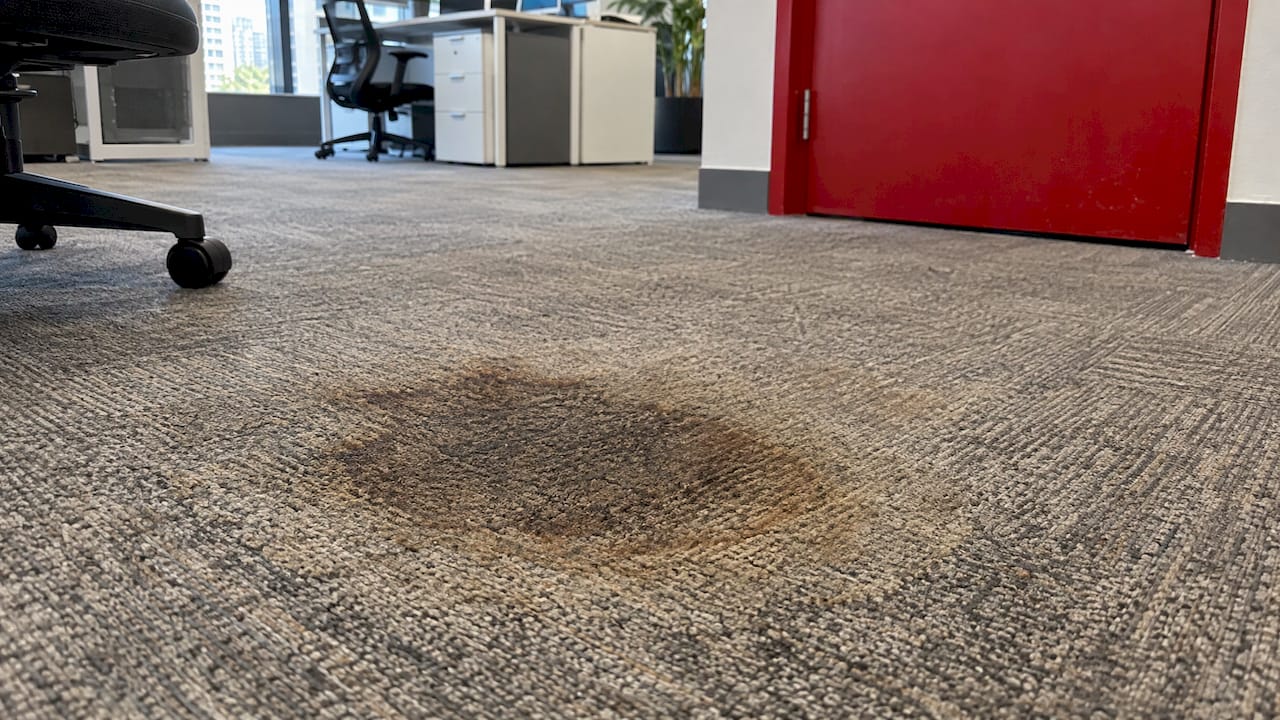
A stain that returns after shampooing is usually not a new stain. It is old soil rising from the carpet backing as the carpet dries (wicking), sticky detergent residue pulling in fresh dirt, or a brown discoloration caused by moisture and slow drying. Each cause has a different fix, and the wrong fix, usually more shampoo, often makes the spot worse. This guide shows how to tell the causes apart, what to do about each one, and how Dubai offices can stop the cycle.
Specializedcleaning
Stop Carpet Stains From Returning
Specializedcleaning provides professional cleaning for commercial spaces, using specialized equipment to address complex cleaning challenges.
Before you treat anything, look at when the stain came back and what it looks like. The timing tells you most of what you need to know.
What you see
When it appears
Most likely cause
The same spot reappears, often with the same outline as the original stain
Hours to a few days, while or after the carpet dries
Wicking
General dullness, gray traffic lanes, spots that darken again
One to three weeks
Detergent residue and rapid resoiling
Yellow or brown patches or halos
As the carpet dries
Browning or yellowing (cellulosic or alkaline)
Pale, cloudy or stiff patches
Right after cleaning
Residue left from spotting or shampoo
In a busy office, one more factor matters: the carpet is walked on again almost immediately. Damp fibers pick up shoe soil quickly, so a carpet that is reopened before it is fully dry can look dirty again within days even when the cleaning itself was sound.
Wicking: the stain that rises from below
The IICRC, the professional standards body for the cleaning industry, defines wicking as the upward or outward movement of water-soluble materials on carpet fiber surfaces during drying. It also highlights that, regardless of the cleaning method, it is not always possible to remove 100% of soil deeply embedded in the carpet fibers. Residual soil at the base of the yarns and on the backing can migrate to the yarn tips, reappearing as stains once the carpet dries, a common issue in Dubai office environments.
That explains the classic pattern in offices:
A coffee spill reaches the backing or pad before anyone notices it.
Surface shampooing lifts the visible part.
As moisture evaporates, the remaining coffee is drawn up the fibers and a ring or patch returns.
Wicking is common under desks, near pantries and by water coolers, where spills are frequent and often soak in before they are cleaned. It is a drying behavior, not proof that the cleaning was careless, and it can usually be corrected.
How to treat wicking
The IICRC’s consumer guidance gives a clear sequence for wicking. Here it is in plain steps:
Let the carpet dry completely. The IICRC advises at least 48 hours before you treat it.
Vacuum slowly with an upright vacuum that has a brush roll, working over the area from three or more directions.
Mist the spot lightly with distilled water and blot gently with a microfiber or white cotton towel. Repeat misting and blotting until the area looks normal again.
Cover the spot with 6 to 10 layers of white paper towel, or a folded white terry cloth towel, and weigh it down with books.
Remove the pad after 6 to 8 hours. The towels draw the remaining soil out of the fibers.
Call a certified technician if the carpet still does not look normal.
The same guidance mentions 3% hydrogen peroxide as an alternative to distilled water, but it is not recommended on wool or natural fibers without testing first. In an office, where carpet types are often unknown or mixed, we would leave that step to a technician.
Detergent residue and rapid resoiling
The second big cause is residue. IICRC lists several reasons carpet can become visibly dirty faster than it should: detergent or soap not rinsed out properly, contaminants tracked in from outside, excess soap left by untrained cleaners or DIY attempts, body oils and lotions, and a carpet that is not thoroughly dry when the space reopens.
Residue works like a thin tacky film. Every footstep deposits fine sand and dust, and the film holds on to it. The typical result is a spot that looks clean for a day, then slowly darkens over a week or two, usually in the same place where you scrubbed hardest or sprayed most product.
In Dubai, the outside environment makes this worse. Fine dust and sand are carried indoors on shoes and through lobbies, and an office carpet carrying even a faint residue picks it up fast. A good entrance mat system and regular vacuuming reduce the load, as we explain in our guide to daily vacuuming versus deep cleaning.
What to do about residue
The fix is the opposite of what most people try. Do not add more spotting product. Instead:
Rinse the area with clean warm water and extract it until the water coming out runs clear.
Dry it quickly with airflow.
Vacuum thoroughly once dry.
If the carpet still resoils fast, ask a professional to do a rinse-focused extraction pass rather than another shampoo.
Keep an eye on spot removers in the office cupboard too. The IICRC guidance warns that non-professional spot remover residue can stay in the carpet, so a bottle of general-purpose cleaner used on every spill can slowly build the very film you are trying to avoid.
Brown spots and yellowing as the carpet dries
The People Also Ask question “Why are brown spots appearing on my carpet?” points to a different issue. Two things are commonly mixed up:
Cellulosic browning. Natural cellulose materials, such as jute backing or natural fibers, carry soluble browning compounds. When a carpet stays wet for a long time, moisture carries those compounds up into the pile. As the water evaporates at the tips, a brown stain is left behind. Slow drying and a high-pH residue make it more likely.
Alkaline yellowing. This as related to natural fibers left in an alkaline state, and separates it from wicking, where hidden spots and soils rise to the surface during drying.
A browning problem is not always permanent. A professional can often correct it with a controlled acidic rinse and thorough extraction, followed by fast drying. Treat it as a job for a technician, particularly on wool or natural-fiber carpets. Home vinegar solutions are a popular suggestion, but they are a risk on natural fibers if you guess the mix or the fiber type, and your office carpet is the wrong place to experiment.
Why the cleaning method matters in a commercial office
Not all cleaning methods effectively address these issues. According to IICRC S100 standard, encapsulation and bonnet cleaning are considered interim methods, suitable for maintaining the appearance of carpets between deep cleans. In contrast, hot water extraction is the restorative standard for commercial carpets, effectively removing embedded soil and residues. For offices in Dubai, where maintaining high hygiene standards is essential, hot water extraction with proper rinsing and drying is recommended to ensure long-lasting cleanliness and prevent recurring stains.
In practice, a sensible office programme uses both:
Method
Best use
Drying time
Watch out for
Vacuuming (daily or several times a week)
Removing dry soil before it embeds
None
Needs a quality vacuum and regular emptying
Encapsulation
Routine maintenance in occupied offices, quick return to use
Short
Not a substitute for periodic deep cleaning
Hot water extraction
Periodic restorative clean, heavy soil and residue
Longer, needs airflow
Over-wetting and under-rinsing cause wicking and residue
Spot treatment
Fresh spills
Short
Overuse of product leaves residue
If your team wants a low-moisture option between deeper cleans, read about our encapsulation carpet cleaning, designed for offices that cannot afford long drying times. For the full picture of options, our carpet cleaning guide for Dubai covers methods and schedules.
Why the first stain matters: stopping spills before they soak in
Wicking starts with a spill that sinks beyond the surface. Quick, correct first response limits how much soil ends up in the backing:
Blot, do not rub. Rubbing pushes liquid down and spreads the stain.
Work from the outside in so the spot does not grow.
Use plain water first and blot with white cloth.
Report big spills to facilities rather than letting staff try three different products.
Protect high-spill zones. Under desks and around the pantry, hard, water-resistant surfaces help. For a sense of how a desk-level surface copes with liquid, see how cork desk mats handle spills.
A short spill protocol on the pantry wall, with the facilities contact number, costs nothing and saves a lot of recurring stains.
A repeat-stain checklist for office managers
Use this list when a stain returns and you need to decide what happens next.
Record it. Photograph the spot, note the date, the original cause and what was used on it.
Wait for full drying. Allow at least 48 hours before judging the result or treating wicking.
Stop adding product. No extra shampoo, spot remover or home mix.
Ask what was used last time. The technician needs to know the spotting chemicals involved. IICRC advises telling your technician which products were applied.
Check the environment. Is there a leaking pipe, an AC drip or condensation near the area? A recurring spot in the same place can have a moisture source.
Book a targeted return visit with a rinse-and-extract pass for that area, not a full redo of the floor.
Review the schedule. If many spots return, the interval between deep cleans may simply be too long for your traffic.
One point deserves emphasis: a leaking AC unit or condensation line is a classic hidden cause of repeat marks on ceiling-adjacent floors and carpeted corners. If the stain keeps returning in the same corner despite correct cleaning, look up as well as down.
How to prevent repeat stains at the source
Choose a process, not just a product
A reliable carpet clean includes pre-vacuuming, pre-treatment suited to the soil, controlled moisture, a proper rinse and extraction, and fast drying with airflow. Ask any provider to explain this sequence for your carpet type. The questions to raise are practical: how much moisture is used, how is residue removed, and how long until the floor can take foot traffic?
Schedule around your traffic
A reception area, corridor or open-plan zone near the entrance needs more frequent attention than a meeting room. Schedule by zone, not one-size-fits-all. Dubai offices with after-hours access can book cleaning at night so carpets dry before the team arrives in the morning.
Keep soil out
Entrance matting, regular vacuuming and prompt spill response keep dry soil from becoming embedded. Fewer deep-soil events means less to wick later.
Support the carpet with airflow
Slow drying is behind both browning and rapid resoiling. Keep air conditioning running, open vents toward the damp area where appropriate, and use air movers after extraction. If you manage a building where HVAC performance is a concern, our HVAC duct cleaning service looks at the air side of the same environment.
A note from our team
Most repeat-stain calls we hear start the same way: the carpet was shampooed, it looked good for a day, then the spot came back, and someone sprayed it again. That second spray is where a fixable wicking problem turns into a residue problem.
We approach office carpet as a system. Our technicians are licensed and insured, and we pair experienced staff with specialized equipment, so the focus stays on rinsing, extraction and drying, not on adding more chemistry. We offer free consultations and same-day scheduling, which matters when a stained reception carpet is the first thing a client sees.
Our advice to facility managers is simple. Photograph the recurring spot, leave it alone, and let us assess it. A short, targeted visit usually does more than another full-floor shampoo, and we can set a maintenance rhythm, with encapsulation between deep cleans, that suits your traffic.
Qadir
Need the spots gone for good? Talk to us
If the same marks keep returning on your office carpet, we can inspect the area, identify whether you are dealing with wicking, residue or browning, and recommend the right corrective clean. We work across Dubai with free consultations and same-day scheduling, and we cover carpet shampooing for offices as well as one-off and contract cleaning.
For ongoing coverage, our office janitorial cleaning services combine daily upkeep with scheduled deep carpet care, so soil does not get a chance to build up between visits.
When to call a professional
Bring in a certified technician when:
The spot is still visible 48 hours after the carpet has dried and you have followed a wicking treatment.
Brown or yellow patches appear, especially on wool or natural-fiber carpet.
The carpet resoils quickly across large areas, which suggests residue.
You are unsure what was applied to the area before.
The stain follows a spill of something that could damage fibers or dye.
The IICRC itself recommends consulting a certified technician for a return visit if wicking treatment does not restore the carpet. Tell them everything that was used on the spot, since the technician needs it to choose a compatible solution.
Why does my office carpet look dirty again after shampooing?
The three usual causes are wicking (soil from the backing rising as the carpet dries), residue left from shampoo or spot removers that attracts fresh dirt, and reopening the space before the carpet is fully dry. The timing helps identify which: returns within days suggest wicking, and slow darkening over one to three weeks suggests residue.
Should I shampoo the spot again?
Usually not. More product can add residue and worsen the problem. Let the carpet dry fully, then use the wicking steps above or arrange a rinse-and-extract pass with a professional. If the spot persists, a return visit from a certified technician is the safer route.
How long should a commercial carpet take to dry?
It depends on the method, the amount of water used, airflow and humidity. Hot water extraction takes longer than encapsulation, which is designed for a short drying window. Good airflow shortens drying and reduces the chance of wicking and browning, so ask your provider for the expected drying time before the job.
Can brown spots on carpet be removed?
Often, yes. Browning is not always permanent, and a professional can usually treat it with a controlled rinse and extraction. Natural fibers such as wool need extra care, so avoid home experiments and ask a technician to assess the carpet first.
How often should an office carpet be deep cleaned?
It depends on foot traffic and entrances. Many Dubai offices combine daily vacuuming with a deep clean every 6 to 12 months, and busier zones may need more frequent attention. We can set a zone-by-zone schedule after a free consultation.