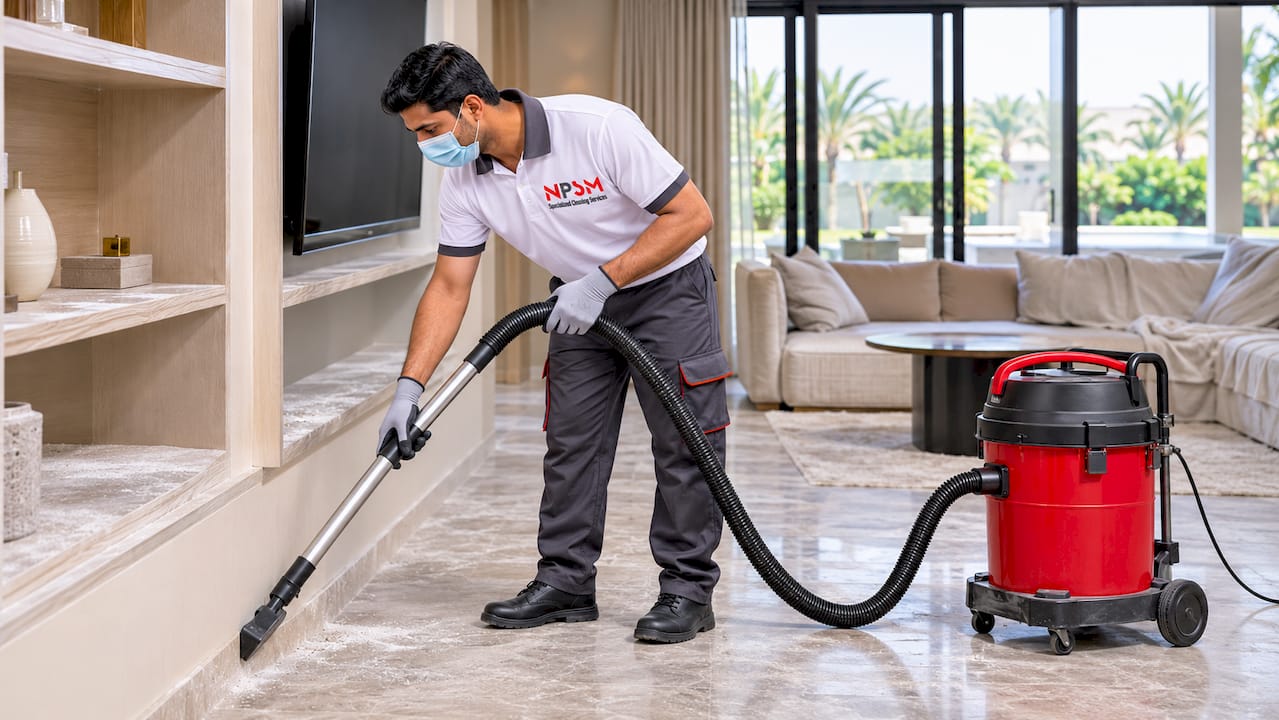
The most reliable way to remove renovation dust is a repeated cycle: HEPA vacuum, damp wipe, then HEPA vacuum again, working from the top of the room to the floor and finishing with the air conditioning system. Sweeping and dry dusting only lift fine particles back into the air. In a Dubai villa, apartment or office, where AC runs most of the year, the ducts and vents matter as much as the floors.
This guide explains the order of work, the tools that keep dust from spreading, the health precautions, and the point at which a specialist team saves you weeks of dust returning.
Specializedcleaning
Get renovation dust under control
Specializedcleaning provides professional post-construction cleaning in Dubai, with specialized equipment for complex cleaning challenges.
Why renovation dust is different from household dust
Renovation dust is made of crushed plaster, cement, sanding residue, tile cutting slurry, wood particles and paint fragments. It is much finer than everyday dust. It floats for hours, settles on every flat surface, then rises again when you walk or open a door.
One US home-care guide warns that construction dust is fine enough to wreck a home vacuum. Standard bags and filters clog or pass the finest particles straight back into the room. That is why a normal weekly clean never seems to finish the job after building work.
Is renovation dust harmful?
It can be harmful. According to health and safety guidelines applicable in Dubai and the UAE, renovation dust may irritate the eyes, nose, and throat, and very fine particles can penetrate deep into the lungs, causing respiratory issues for sensitive individuals. Certain dusts become hazardous if they contain materials such as asbestos, respirable crystalline silica, or lead. To ensure safety, it is essential to adhere to UAE regulations and use professional cleaning services specializing in post renovation dust removal within Dubai, without referencing external country regulations.
If you have children, elderly relatives, or anyone with asthma or other breathing conditions in the home, keep them out of the area until the cleanup is finished. Ask your doctor about specific symptoms.
Before you start: safety and preparation
Get these basics in place before you touch a surface.
Protect yourself. Wear a properly fitted respirator or face mask (not a loose cloth mask), goggles and gloves. In Dubai, these precautions should be followed along with proper ventilation and vacuum extraction.
Ventilate, but control the airflow. Open windows to let airborne dust leave. Do not let the dust drift into rooms you have already cleaned. Close doors to finished rooms.
Cover what is clean. Keep plastic sheeting over cleaned furniture, electronics and fitted wardrobes until the final pass.
Know your materials. Hazardous dust is a matter of what was removed or cut. If you suspect asbestos, lead paint or silica-heavy material in Dubai, stop and ask your contractor or a qualified specialist before cleaning.
Remove bulk debris first. Offcuts, packaging, tile boxes, paint cans and protective film should leave the property before fine cleaning starts.
The cleanup in the right order
Order prevents rework. Dust falls downward, so clean downward.
Step 1: Rough cleaning and bulk removal
Pick up large debris by hand, then remove loose material from floors with a vacuum. Avoid dry sweeping. Guidance for building work in health facilities issued by Dubai Health Authority recommends HEPA vacuuming rather than sweeping to avoid dispersing dust. The same logic applies at home: sweeping throws fine particles into the air.
Step 2: HEPA vacuum everything, top to bottom
Start at the ceiling, light fittings, fan blades, AC grilles and curtain rails. Then move to shelves, window frames and tracks, door frames, skirting boards, cabinet tops and inside drawers. Vacuum upholstery and curtains last. A HEPA-filtered vacuum traps particles that standard machines exhaust.
The House Work guide advises repeating the vacuum pass several times, then wiping top to bottom and mopping floors last. One pass is never enough on a fresh renovation.
Step 3: Wet cleaning
Damp wiping captures what vacuuming leaves. The US Department of Housing and Urban Development’s cleaning chapter says wet cleaning is probably the most effective method of picking up small particles. It also notes that the effort put into cleaning may matter more than the choice of cleaning agent, so you do not need harsh chemicals.
Use clean microfiber cloths, folded and turned often, and change the water as soon as it turns grey.
Wipe walls, doors, switches, windowsills and horizontal surfaces from top to bottom.
Use non-scratch pads and plastic scrapers for paint splatter, silicone and adhesive residue. Metal blades scratch glass, stone and sanitary ware.
Clean glass last on the inside, after the dust is gone, to avoid streaks.
Step 4: The vacuum, wet clean, vacuum cycle on floors
For high-dust jobs on rough or porous surfaces such as unsealed concrete, grouted tile or textured paint, HUD describes a three-phase cycle of vacuum, wet clean and vacuum again. The guidance explains that for rough surfaces a second vacuum pass after wet cleaning increases the chance of reaching a clean result.
On smooth surfaces such as polished porcelain, vinyl or sealed stone, a vacuum followed by a damp mop is usually enough. Do not drag grit across finished floors. Fine cement and tile dust acts like sandpaper on marble, wood and vinyl.
Step 5: Bathrooms, kitchens and fittings
Grout haze, cement film on tiles and silicone smears need the right product for the surface. Test any descaler on a hidden spot first, since acids can etch natural stone. Clean inside kitchen cabinets and drawers, appliance vents and extractor hoods, where dust settles unseen.
Step 6: Final pass
After the surfaces dry, HEPA vacuum the floors again, then damp mop. Let the space ventilate, then run your hand along a high shelf and a skirting board. If a visible film comes off, repeat the wet and vacuum cycle in that room.
Do not forget the AC system
This is the step most people skip, and the reason dust seems to return days after a thorough clean. During renovation, the air conditioning system is often running or exposed. Fine dust enters return grilles, coats filters and settles inside ducts. When you switch the AC on again, it blows that dust back into clean rooms.
The NADCA standard, the reference many duct cleaning contractors follow, says HVAC components contaminated with construction particulate or debris should be cleaned. The same page also lists a newly installed component or duct contaminated with construction dust, components discharging visible dirt into the space, and performance compromised by build-up as reasons to clean.
Practical checks after a renovation:
Look at supply diffusers and return grilles for a grey film or dark streaking.
Check filters in fan coil units, which clog quickly after dusty work.
Notice whether dust reappears on shelves within a day or two of cleaning.
If you see any of these, schedule duct and coil cleaning before you move in or reopen the office. Our guide on duct cleaning after construction explains how it protects the system, and our HVAC duct cleaning service page covers what the work involves.
Tools that keep dust under control
Tool
What it does
Where to use it
HEPA vacuum
Captures fine particles instead of exhausting them
Every surface, floors, upholstery, vents
Microfiber cloths
Hold dust when damp, instead of pushing it around
Walls, sills, cabinets, fixtures
Extension duster or pole
Reaches ceilings, fans, high shelves
Use with a vacuum, not as a dry duster on its own
Detail brushes
Loosen dust from vents, tracks and grilles
Window tracks, AC grilles, door frames
Plastic scrapers and non-scratch pads
Lift paint, adhesive and silicone without scratching
Glass, sanitary ware, tiles
Plastic sheeting and tape
Isolates clean rooms
Doors, vents, furniture
A standard home vacuum is the wrong tool for plaster and cement dust. Sheetrock dust in particular clogs filters quickly.
How long does it take, and why dust keeps returning
A single afternoon of cleaning rarely finishes a renovation. Dust that has settled in ceiling voids, behind cabinets and in ducts releases slowly over days. That is why a second round of cleaning a day or two later is common. We cover the pattern in our guide to why construction dust keeps coming back after cleaning, including a 48 to 72 hour plan for homeowners.
The usual causes:
Dust inside AC ducts and fan coil units.
Dust on high or hidden surfaces, such as the tops of wardrobes, light fittings, and inside false ceilings.
Cleaning done in the wrong order, so dust from upper areas lands on cleaned floors.
Open doors and windows moving dust between rooms.
Carpets, curtains and upholstery that hold fine particles.
Offices need to reopen on schedule, often with carpet tiles, raised floors, workstations and server or comms rooms to protect. Dust in ceiling plenums, AC returns and under carpet edges is the usual culprit. For sensitive environments, our data center cleaning service addresses dust where equipment integrity is at stake. Property teams can also review the common areas missed during post-construction cleaning.
Choose the right level of cleaning
Choose a routine clean if the work was minor, such as repainting one room with sheets down and no sanding.
Choose a deep clean if the job involved sanding, new flooring, joinery or tiling across several rooms. Our guide to post construction cleaning vs deep cleaning explains the difference.
Choose post-construction cleaning with duct cleaning if walls were demolished, plastered or cut, the AC ran during the work, or you are moving in or reopening to staff and customers soon.
Bring in a specialist first if you suspect asbestos, lead paint or heavy silica dust. Do not start cleaning those materials yourself.
What a professional post-renovation clean includes
A proper scope goes beyond wiping surfaces. When you hire a team, confirm it covers:
HEPA vacuuming of ceilings, fittings, walls, joinery and floors in the right order
Damp wiping of all hard surfaces, including window tracks and frames
Removal of paint, adhesive, cement and silicone residue without damaging finishes
Grout and tile cleaning, and floor protection or polishing where needed
Interior and exterior glass
AC grilles, filters and, where needed, duct cleaning
A walk-through at the end to confirm that nothing has been missed
Most renovation dust complaints we hear are not about a lack of effort. They are about order and tools. People clean the floors first, skip the AC, and then wonder why dust is back on the shelves two days later.
Our approach starts from the premise that dust has to be captured, not moved. That means the right vacuums, damp methods, working from the top down, and treating the air conditioning system as part of the cleanup rather than an afterthought. Our teams are licensed and insured, and we offer free consultations and same-day scheduling so a handover or reopening date does not slip.
If you want the job done once and signed off properly, a specialist team combining the right equipment with a clear checklist is the shortest route to a space you can actually use.
Qadir
Book a post-renovation clean in Dubai
NPSM Specialized Cleaning Services LLC has more than 15 years of experience with residential and commercial cleaning in Dubai, from villas and apartments to offices, warehouses and data centers. Our post construction deep cleaning service covers the full order of work described above, and we can pair it with HVAC duct cleaning, floor polishing and carpet shampooing.
Free consultations and same-day scheduling are available. Tell us the property type, the size and the handover or reopening date, and we will recommend the scope. You can start on the Specializedcleaning homepage or review our floor restoration and polishing options for floors that need more than cleaning.
FAQ
What is the best way to clean up dust after building work?
Use a HEPA vacuum and damp microfiber cloths, working from ceilings down to floors. Repeat the vacuum and wipe cycle, and finish with a final floor vacuum and mop. Do not sweep or dry dust, because that puts fine particles back into the air.
Is renovation dust harmful?
It can irritate the eyes, nose and throat, and very fine dust can reach deep into the lungs, according to Dubai Health Authority facility guidelines. Wear a proper respirator and goggles, and keep children and people with breathing conditions away from the area. Dust from materials that may contain asbestos, silica or lead needs specialist assessment.
Do I need duct cleaning after renovation?
Often, yes. The NADCA standard lists contamination with construction dust as a reason to clean HVAC components. If grilles show a dust film, filters clog quickly or dust returns soon after cleaning, have the ducts and fan coil units inspected before you move in.
How long does it take for renovation dust to settle?
It varies with the scale of the work, but dust keeps releasing from hidden spots for days. Plan a second cleaning round after the first, and clean again after the AC has run for a short time.
When should I hire a professional team?
Hire one when the work involved demolition, plastering, sanding or tiling in several rooms, when you have a handover or reopening date, or when the AC system was exposed to dust. A team with HEPA equipment and a checklist finishes faster and avoids damage to floors and fittings.