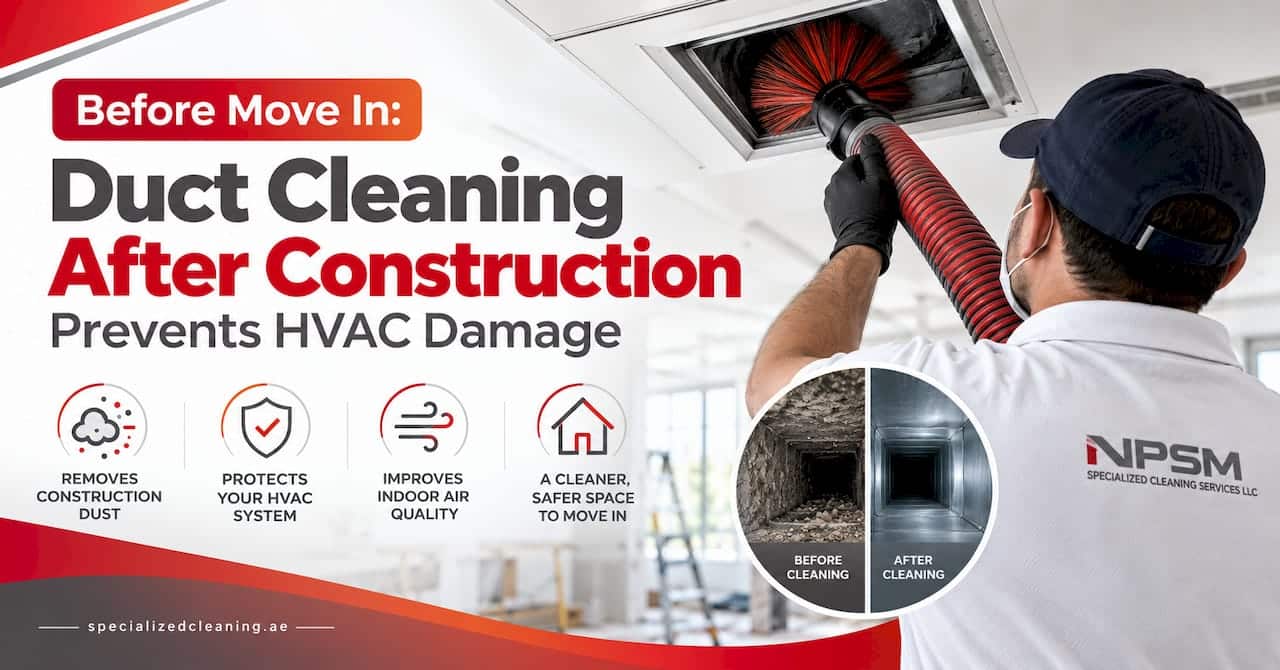
Yes, in most cases. If drywall work, sanding, demolition, or HVAC modifications happened anywhere near your ductwork, or the system ran during the job, schedule a professional source-removal duct cleaning before anyone moves in. If a pro can’t get there right away, seal the registers and swap the filter before you run the HVAC system at all.
TL;DR:
Duct cleaning becomes necessary after drywall-heavy renovations, new builds, or duct modifications that leave debris or fine particulates in the system.
Construction debris like drywall dust, fiberglass fragments, and metal shavings tend to settle heavily in trunk lines and near coils, impairing HVAC efficiency.
Professional source-removal cleaning involves inspection, sealing, agitation, high-volume vacuum extraction, and coil cleaning, with a focus on equipment with HEPA filtration.
DIY cleaning is insufficient if the system ran during construction or if residents have allergies, and proper job verification includes video proof and airflow checks.
Scheduling the cleaning after all dusty trades finish, with prior site preparation, maximizes efficiency and reduces the risk of re-contamination.
Specializedcleaning
Improve Indoor Air Before Move In
Specializedcleaning provides professional HVAC duct cleaning in Dubai for homes and businesses after construction work.
When Duct Cleaning After Construction Is Necessary
Not every home improvement warrants a duct cleaning crew. But certain project types almost always do, because they generate fine particulates that HVAC systems are not built to filter out completely.
You should plan on cleaning after:
New home builds, where framing dust and drywall compound residue settle into every duct run before the system is even commissioned
HVAC cut-ins or duct modifications, which leave metal shavings and sealant debris behind
Attic insulation work, especially blown-in fiberglass or cellulose
Kitchen or bathroom guttings involving tile demo, sanding, or plaster
The real damage happens when the HVAC system runs during construction. Airflow pulls fine dust through the return, across the blower wheel, and onto the evaporator coil, where it can bake into a crust. The Indoor airPLUS technical bulletin from the EPA specifically warns against operating HVAC systems during dusty work and against relying on filters alone to stop that migration. Left unaddressed, you get reduced coil efficiency, musty odors, allergen buildup for occupants, and HVAC maintenance bills that show up months earlier than they should.
What Construction Debris Actually Ends Up in Your Ducts
Construction sites generate a predictable mix of contaminants, and each one behaves differently once it’s airborne inside a duct system.
The usual suspects include:
Drywall dust, the finest and most pervasive contaminant, capable of traveling deep into trunk lines
Sawdust and wood particles from framing or trim work
Fiberglass fragments from insulation cutting or handling
Spray foam overspray, which can harden onto duct interior surfaces
Paint and adhesive residues, often sticky enough to trap other debris
Metal shavings from ductwork fabrication or HVAC line modifications
These particles don’t distribute evenly. They collect heavily in trunk lines, elbows, and the interior of lined ductwork, where airflow slows and turbulence drops debris out of suspension. Evaporator coils and blower housings take the worst of it. Drywall dust in particular can mix with condensation on a coil and form a paste that reduces heat transfer. The practical result: filters that clog in weeks instead of months, and airflow that drops noticeably before anyone realizes why.
How Professionals Remove Construction Debris (and What to Avoid)
Source removal is the industry standard, and it’s a physical process, not a chemical one. The Building America Solution Center is explicit that ducts should be cleaned with vacuum and pneumatic brushing systems, not wet solutions or ultraviolet treatments used as a substitute for actual particle removal.
A proper post-construction cleaning follows this sequence:
Access and inspection — technicians open service ports and often run a video camera through the trunk lines to document baseline contamination.
Containment — registers get sealed and the work area isolated so debris doesn’t spread to finished rooms.
Agitation — pneumatic or rotary brushes and air whips knock embedded dust loose from duct walls, sized to the duct type so lined or flexible sections aren’t damaged.
High-volume vacuum extraction — a truck-mounted or portable collector creates negative pressure inside the whole duct run, pulling loosened debris out through a single collection point rather than pushing it further into the system.
Air handler and coil cleaning — because drywall dust and moisture can cement onto coil fins, this step gets its own attention rather than getting skipped.
Look for equipment with genuine high-volume particulate collection and HEPA-level filtration on the vacuum exhaust, since a shop vacuum recirculating fine dust back into the room defeats the purpose. Avoid any contractor proposing wet pressure washing inside ducts, solvent-only “sanitizing” sprays, or UV lights marketed as a stand-alone fix. None of those remove physical debris, and moisture inside sheet metal ductwork invites corrosion.
Pro Tip:Ask every bidder for before-and-after video of the duct interior, not just a verbal confirmation the job is done. It’s the cheapest way to verify the work actually happened.
DIY vs. Hiring a Pro: What You Can (and Can’t) Handle Yourself
Cleaning your own register covers and vacuuming visible dust near vent openings is fine as basic upkeep. It is not a substitute for real duct cleaning after a renovation.
DIY tools can’t reach trunk lines, can’t access coils inside the air handler, and can’t remove dust embedded in duct liner material. If the HVAC system ran at any point during construction, or if anyone in the building has asthma or allergies, call a professional. The same applies if you want documented proof the job was done correctly.
A typical residential duct cleaning after construction runs a few hours for a standard home. Commercial spaces or larger properties with complex duct layouts, multiple air handlers, or difficult access points take longer. Cost depends on square footage, the number of supply and return runs, whether the air handler and coils need cleaning, and how contaminated the system actually is.
Before signing anything, ask bidders:
What specific equipment and brush types will they use?
Do they perform a video inspection before and after?
Is air handler and coil cleaning included, or billed separately?
Do they follow ACCA standards or equivalent industry qualifications?
What warranty or verification do they offer once the job wraps?
Preparing for Service and What Happens on Cleaning Day
Getting the site ready before the crew arrives keeps the job efficient and prevents re-contamination immediately after cleaning.
Before technicians show up:
Confirm every trade has finished dust-generating work. Cleaning too early just means cleaning twice.
Vacuum finished surfaces, especially near registers and returns.
Secure valuables and clear access to the mechanical room or air handler closet.
Label any vents you already know are problem areas, like rooms with visible dust buildup or weak airflow.
On service day, expect the HVAC system to be shut down first. Technicians set up containment and negative pressure, run a video inspection, connect to the main trunk, then work through brushing and vacuum extraction section by section before finishing at the air handler and coils. A fresh filter goes in at the end. Coordinate timing with your general contractor or facilities manager so the cleaning happens after drywall and paint are done but before final walkthroughs or move-in.
Verifying the Job and Keeping Ducts Clean Afterward
A finished cleaning should come with proof, not just an invoice.
Ask for:
Before-and-after video of the duct interior
Confirmation that airflow feels stronger at registers than before
No lingering dust or construction odor when the system runs
The filter type installed and a note on when to replace it next
Run the system briefly after service with the new filter in place, then swap it again before full occupancy if the technician recommends it, since a fresh filter often loads up fast right after a cleaning. Post-construction cleaning effectively resets the maintenance clock on your HVAC system. Watch for a return of dust on supply vents or a musty smell within the first few weeks. According to the OSHA silica health effects overview, fine construction particulates like silica dust pose measurable respiratory risk, which is part of why getting this step right the first time matters more than treating it as optional cleanup.
How NPSM Specialized Cleaning Services Approaches This Work
This company has extensive experience handling HVAC duct cleaning and post-construction jobs, working closely with contractors and property managers on handover timelines. They use source-removal methods and offer consultations and scheduling options to provide clients with a clear scope before service.
Prevention Beats Cleanup Every Time
Every contractor I’ve seen do this well treats duct protection as part of quality control, not an afterthought. Sealing registers and keeping the HVAC system off during dusty phases costs almost nothing compared to a full post-construction cleaning bill. When you’re unsure whether contamination is bad enough to warrant a full service, a quick video inspection is far cheaper than either an unnecessary cleaning or, worse, skipping one that was actually needed. Prevention integrated early, guided by SMACNA’s duct cleanliness standards, saves owners more money than any cleaning invoice ever will.
— Qadir
Get Your Ducts Cleaned Before Move-In
This service provides property owners a direct path to source-removal duct cleaning without the guesswork of comparing contractors after a renovation. The team handles the full sequence: containment, pneumatic brushing, high-volume vacuum extraction, air handler and coil cleaning, video verification, and filter replacement, timed to fit your contractor’s handover schedule rather than working around it.
Scheduling and consultations are arranged promptly to help get technicians on site in a timely manner. If your renovation is wrapping up, request a site visit through the HVAC duct cleaning services page and get a firm quote based on your actual duct layout and contamination level, not a generic estimate. For projects bundling duct work with broader handover cleaning, the post-construction deep cleaning services cover both in one coordinated visit.
Sources
This guide draws on established construction and indoor air quality standards rather than opinion. Each source below shaped a specific recommendation above:
When should duct cleaning be done after construction?
Schedule it after all dust-generating trades finish but before final occupancy, ideally right after painting and flooring wrap up. Cleaning too early means redoing the work once remaining trades track more dust through the space.
How long does construction dust take to settle?
Fine construction dust can remain airborne or re-suspend from surfaces for weeks after visible work ends, especially once HVAC airflow starts stirring it. That’s why post-construction duct cleaning matters even after the site looks clean.
How long does a duct cleaning usually take?
A standard residential duct cleaning after construction typically takes a few hours, while larger commercial properties with multiple air handlers take longer. A scope and time estimate can be provided during a consultation based on the actual duct layout.
What are the signs my ducts need cleaning after renovation?
Watch for visible dust blowing from registers, a musty or dusty odor when the system runs, weaker airflow than before construction, or filters that clog within days instead of weeks. Any one of these signals warrants a professional inspection rather than waiting it out.