Janitorial services are scheduled, recurring interior cleaning that keeps offices, retail spaces, and shared facilities sanitary and presentable day to day. A standard contract covers trash and recycling removal, restroom sanitation, floor care, dusting, and disinfection of high-touch surfaces, plus basic restocking of supplies. Heavier work like carpet extraction, exterior windows, or HVAC ductwork is usually billed separately.
TL;DR:
Routine janitorial services in Dubai typically include trash removal, restroom sanitation, floor cleaning, dusting, and disinfecting high-touch surfaces, with heavier tasks billed separately.
Cleaning frequency and pricing depend on space size, foot traffic, and specific needs, with providers offering hourly, per-square-meter, or flat-rate contracts accordingly.
Most providers separate routine maintenance from specialty work such as carpet extraction, duct cleaning, or post-construction cleanup, requiring additional quotes and certifications.
Verify licensed, insured providers with clear scope of work, defined service levels, and references, and consider requesting a trial period before committing long-term.
Having all services handled by a single licensed provider reduces coordination issues, as many companies in Dubai now offer both janitorial and specialized cleaning under one contract.
Specializedcleaning
Simplify Your Dubai Cleaning Needs
Specializedcleaning serves residential and commercial spaces with professional cleaning solutions, including janitorial and specialized services.
Who Needs Janitorial Services and How Do They Differ From Deep Cleaning?
Offices, retail stores, medical clinics, and property managers make up the bulk of janitorial clients, along with a smaller number of homeowners who set up recurring residential plans instead of one-off cleanings. The terminology trips people up more than the actual work does. “Janitorial” refers specifically to recurring maintenance routines that keep a space usable day to day, while “commercial cleaning” is a broader umbrella that can include one-time projects, and “deep cleaning” refers to intensive, restorative work done periodically rather than daily. Wikipedia’s overview of the sector places janitorial work under contract cleaning for building interiors, typically serving offices, schools, hospitals, retail sites, and transport facilities.
You want recurring janitorial if your space sees daily foot traffic and needs upkeep between visits. You want a one-off deep cleaning if you’re resetting a space after a renovation, a move, or months of neglect. Many businesses use both: janitorial for maintenance, deep cleaning on a quarterly or semiannual cycle.
What Tasks Are Included in a Standard Janitorial Contract?
A typical janitorial service is built around a recurring, scheduled routine that keeps interiors sanitary without requiring a full-scale intervention every visit. According to Arelli Cleaning’s breakdown of what a janitorial service actually covers, the core recurring tasks include trash removal, restroom sanitation, vacuuming and mopping, dusting, touchpoint disinfection, and basic restocking. Here’s what that typically looks like on the ground in a Dubai office or retail unit:
Trash and recycling removal from all bins, liner replacement, and disposal to the designated collection point, usually done daily or per visit.
Restroom cleaning, including toilets, sinks, mirrors, floors, and restocking of soap, paper towels, and toilet tissue.
Vacuuming, sweeping, and damp mopping of hard floors and carpeted areas, with extra attention to entrance mats where sand and grit collect fastest.
Dusting and surface wiping across reception desks, meeting room tables, window sills, and shared equipment.
Break Room and kitchenette upkeep, including counter wiping, sink cleaning, and removal of food waste before it attracts pests.
High-touch disinfection of door handles, light switches, elevator buttons, and shared keyboards, which matters more in a climate where indoor air is recirculated for most of the year.
Floor condition checks that flag when scuffing, dullness, or grout discoloration has crossed the line from routine mopping into a job for machine buffing or restoration.
That last point trips up a lot of facility managers. Janitorial staff maintain floors, but they don’t restore them. Once a floor needs stripping, resealing, or polishing, that’s a separate line item.
What Cleaning Services in Dubai Get Billed as Add-Ons?
Providers almost always separate routine janitorial upkeep from specialty or restorative work, and knowing the difference before you sign a contract prevents billing surprises later. Distinguishing what’s “included by default” from what gets quoted separately is one of the clearest ways to avoid procurement disputes down the line. The following are typically quoted apart from a standard janitorial plan:
Deep carpet extraction and floor stripping or resealing, which requires equipment and downtime a daily routine doesn’t cover.
Post-construction cleanup, including dust and debris removal after renovation or fit-out work.
Interior glass beyond spot-cleaning, plus all exterior window work, which usually needs specialized access equipment.
HVAC duct cleaning, water tank cleaning and disinfection, and data center cleaning, which demand trained technicians and specific certifications.
Event support and day-porter services for one-off functions or extended-hours coverage.
Intensive disinfection protocols beyond routine touchpoint wiping, often requested after illness outbreaks or for healthcare-adjacent spaces.
Kitchen exhaust systems fall into this same category. Routine janitorial scope rarely touches grease buildup inside hoods or ductwork. That work typically requires certified exhaust cleaning specialists rather than a standard janitorial crew.
How Are Janitorial Contracts Scheduled and Priced?
Frequency and pricing depend heavily on foot traffic, space size, and how many restrooms and floor types you’re managing. Local Dubai providers frequently note that pricing shifts based on area, time required, and the number of cleaners assigned to a job, so a quote for a 500-square-meter office looks nothing like one for a 5,000-square-meter warehouse. Here’s how to think through the structure:
Match frequency to traffic. A busy retail floor or clinic often needs daily service; a lower-traffic office might get by on three visits a week; smaller spaces sometimes work fine on weekly service.
Understand the pricing model. Providers typically quote hourly rates for small or irregular jobs, per-square-meter rates for larger spaces, or flat monthly contracts for recurring commercial accounts.
Identify your real cost drivers. Number of restrooms, floor type (hard floor versus carpet), after-hours access requirements, and overall traffic volume all move the price up or down. Dubai-based providers confirm that advertised entry-level hourly rates for simple home cleaning vary widely and shouldn’t be treated as a fixed benchmark for commercial contracts.
Ask about the fine print before signing. Minimum billable hours, overtime rates, who supplies consumables, and how invoicing is structured all affect the real monthly cost more than the headline rate does.
How Do You Choose a Janitorial Provider in Dubai?
Picking a provider comes down to verifying a handful of things most people skip past in the rush to get a quote. Start with licensing and insurance. Any company sending staff into your office or clinic should carry liability coverage and be able to show it without hesitation. Employee vetting matters just as much, particularly for after-hours access to your space.
Beyond that, look for:
A written scope of work that spells out exactly what’s included, what frequency each task runs on, and what’s explicitly excluded.
Staffing details, including shift coverage and what happens if your regular cleaner calls in sick.
Defined service level agreements, quality checks, and a reporting cadence so you’re not guessing whether the contract is being fulfilled.
References from current clients with a similar space type or size to yours.
Whether eco-friendly products are available, since many providers in the Dubai commercial cleaning market now offer green product lines as a standard option rather than a premium add-on.
Pro Tip:Ask any shortlisted provider for a one-week trial run before signing a full annual contract. It’s the fastest way to catch gaps between what’s promised on paper and what actually shows up at your door.
Why NPSM Specialized Cleaning 15’s Years in Dubai Cleaning Shape This Checklist
A contract is only as good as the scope behind it. Vague language like “general cleaning as needed” leads to disputes every time. The businesses that get consistent results are the ones who insist on a task-level scope before they sign anything.
This checklist draws on Qadir’s 15-plus years working in professional cleaning across Dubai’s commercial and residential sectors. That experience sits behind NPSM Specialized Cleaning Services LLC, a provider built around licensed staff, same-day scheduling, and free consultations for new clients. The specialized end of the business, including HVAC duct cleaning and data center cleaning, informs how the recommendations above are framed: those jobs demand a different skill set than daily janitorial upkeep, and knowing where that line sits is exactly what protects you from paying for the wrong service or missing the right one.
What Procurement Mistakes Should You Watch For?
The biggest mistakes I see are vague scopes, assuming consumables are included when they’re not, skipping reference checks, and overlooking high-touch surfaces in the routine. Fix it by writing task-based scopes, confirming who supplies paper and soap, and Go for a contract basis .
— Qadir
Get a Same-Day Janitorial Quote for Your Dubai Space
A quality cleaning service can be an alternative to piecing together separate vendors for routine upkeep and specialty jobs. Where most providers hand off HVAC ducts, water tanks, or data center floors to a third party, NPSM Specialized Cleaning Services LLC keeps office janitorial contracts, deep cleaning, and specialized work like duct cleaning under one licensed team.
That matters if you’ve ever had to coordinate two separate vendors for one building. Free consultations and same-day scheduling mean you can get a scoped quote without waiting a week for a site visit, and the same crew that handles your daily trash and restroom routine can also be booked for a quarterly deep clean or a duct inspection without starting the vetting process over. If your Dubai office needs a recurring cleaning plan built around a clear, task-based scope, request a quote through the Office Janitorial Cleaning Services page and get a written proposal before your current contract renews.
Janitorial services typically include trash and recycling removal, restroom cleaning and restocking, vacuuming and mopping, dusting, and disinfection of high-touch surfaces like door handles and switches. Heavier work such as carpet extraction, exterior windows, or duct cleaning is usually quoted as a separate service.
What Cleaning Services Are Available in Dubai?
Dubai providers commonly offer office and commercial cleaning, residential and move-in/move-out cleaning, deep cleaning, carpet shampooing, and specialty services like HVAC duct cleaning and water tank disinfection. Many local companies also list eco-friendly product options as part of their standard commercial packages.
How Much Does a One-Hour Clean Cost?
Pricing for cleaning services in Dubai varies depending on area, provider, and scope of work, so rates differ widely across the city. Specializedcleaning’s current pricing for office janitorial contracts and specialty services is available directly on its service pages after a free consultation.
What Is Meant by Janitorial Services?
Janitorial services mean recurring, scheduled interior cleaning that maintains a space’s sanitation and usability between deeper cleanings, rather than a one-time restorative job. The term specifically covers routine maintenance tasks like trash removal and restroom upkeep, distinct from broader commercial cleaning or deep cleaning projects.
Hire a specialist crew for post-construction window cleaning whenever a property has bonded construction residue, extensive glazing, or a handover date that leaves no room for a redo. This service goes far beyond a standard window wash: it strips silica dust, drywall mud, paint specks, and adhesive from glass, frames, tracks, and seals so the property is genuinely ready for occupancy. Skip it, or hand it to a general cleaning crew, and you risk scratched glass or a failed final walkthrough.
TL;DR:
Residue bonding like silica dust and cured adhesives significantly increase cleaning time and costs compared to standard window washing.
The cleaning process involves multiple steps, including dry debris removal, targeted residue stripping, and streak-free finishing with deionized water.
Scheduling should occur shortly before the final walkthrough, ideally one to three days prior, to prevent recontamination from ongoing trade activities.
Proper provider selection requires verifying insurance, documented scope, equipment, safety plans, and experience with builder handovers.
Preparation includes clearing debris, securing fragile fixtures, and coordinating access to ensure a smooth, dispute-free handover cleaning.
Specializedcleaning
Prepare Your Property for Handover
Specializedcleaning provides professional post-construction cleaning in Dubai for residential and commercial spaces, supported by experienced staff and specialized equipment.
What Does Post-Construction Window Cleaning Cover?
Post-construction window cleaning treats the entire window assembly as one job, not just the glass. A standard clean wipes panes and calls it done. This service works through frames, tracks, sills, seals, hardware, and screens, then finishes with sticker and label removal on every pane that still carries manufacturer markings.
The residues involved are also different in kind, not just amount. Crews are removing bonded materials: silica dust from grinding and sanding, drywall mud splatter, paint overspray specks, cured silicone, and construction adhesive. None of that lifts with a spray bottle and a paper towel. That is part of why post-construction cleanup typically runs at roughly twice the labor of a routine window wash.
A thorough scope of work usually includes:
Interior and exterior glass, edge to edge, including corners standard washing skips
Frame and track detailing to clear grit that causes sliding windows to bind
Sill and hardware cleaning, including handles, locks, and hinges
Screen removal, cleaning, and reinstallation
Sticker, label, and tape residue removal from glass and frames
What it usually excludes matters just as much. Structural repairs, caulking replacement, and a full final clean of floors, walls, and fixtures are typically separate line items. If you need the whole property handover-ready, not just the glass, pair this service with a broader post-construction cleaning scope rather than assuming one crew covers everything.
How Do Professionals Clean Windows After Construction?
The sequence matters more than the products used. Skip a step, and you either damage glass or leave residue that shows up under afternoon light.
Inspect and document. Crews walk the property first, photographing existing scratches, chips, or manufacturing defects before any tool touches the glass. This pre-clean documentation protects both the owner and the cleaner from disputes over who caused what.
Remove dry debris first. HEPA vacuums and soft-bristled brushes clear loose grit from tracks and sills before any wet work begins. Skipping this step is the single most common cause of scratched glass.
Target bonded residue. Plastic razor blades lift paint specks and adhesive, paired with solvents matched to the contaminant. Latex overspray and cured polyurethane need different chemistry, and using the wrong one can haze the glass.
Wash and finish. A squeegee pass or a deionized, pure-water system delivers the streak-free finish exterior glass needs, since pure water leaves no mineral spotting behind.
Detail and verify. Hardware gets a final wipe, after-photos get taken, and the crew walks the scope against the checklist before handover.
Pro Tip:Ask any vendor whether dry debris removal happens before wet cleaning. If they jump straight to wiping wet glass, grit trapped in the residue will scratch the surface as it drags across.
When Should You Schedule Cleaning After Construction?
Timing this wrong costs money twice. Book too early, while trades are still active, and dust from drywall sanding or final paint touch-ups recontaminates glass you already paid to clean. Book too late, and you risk delaying the handover itself.
The window that works best sits after final trades finish their punch-list items but close enough to the walkthrough that nothing new gets tracked in. Many specialist crews schedule the final window clean one to three days before the final walkthrough, a tight enough gap to avoid new dust settling in but with a buffer for touch-ups if the walkthrough flags anything.
Coordinate access with the builder directly rather than assuming the site is open. Confirm whether HVAC systems will be running (airborne dust circulates faster with fans on), whether flooring protection is still down, and whether any trade still needs ladder or scaffold access that would conflict with the window crew’s equipment.
What Determines the Cost of Post-Construction Window Cleaning?
Price swings more on residue severity than on window count alone. A property with light construction dust costs far less to clean than one with cured overspray bonded to every pane.
The main cost drivers are:
Window count and size. More glass, more labor hours, regardless of condition.
Height and access. Second-story and above often require ladders, lifts, or in rare cases rope access, which adds equipment cost.
Residue severity. Light dust wipes off quickly; cured paint overspray or heavy adhesive requires scraping and solvent work that takes far longer per pane.
Coatings and tints. Low-E coatings and window film limit which solvents and tools are safe, sometimes requiring gentler, slower methods.
Add-ons. Scaffolding, rope access, or specialized solvent work for stubborn residue usually get quoted separately from the base rate.
Quoting models vary by provider. Some price per window, some by the hour, and larger jobs often go project-based. Representative pricing for residential new-builds commonly falls in the $400 to $1,200-plus range, with mid-size projects often landing between $700 and $950. Ask for an itemized quote so you can see exactly what pushes a price toward the higher end before work starts.
Is Post-Construction Window Cleaning Safe for Glass?
Scratches are the biggest risk, and they almost always trace back to grit dragged across glass during wet cleaning. That is why dry removal comes first: any sand-like particle left on the surface acts like sandpaper the moment a squeegee or cloth passes over it.
Height work carries its own risk profile. Reputable crews use harnesses, stabilized ladders, or lift equipment, along with basic PPE like gloves and eye protection when scraping cured materials or handling solvents.
Two contractual protections are worth confirming before work starts. A scratch waiver covers scraping on tempered or coated glass, acknowledging that pre-existing defects or unavoidable micro-scratches from bonded residue removal aren’t the crew’s fault. A documented pre-clean condition report, backed by photos before work begins, gives you a record to compare against if anything looks off at handover. Ask about insurance coverage too. Licensed, insured crews should carry liability coverage that protects you if something does go wrong.
How Do You Choose a Post-Construction Window Cleaning Provider?
Comparing quotes gets easier once you know what to check line by line rather than just the bottom-line number.
Verify these before signing anything:
Licensed and insured crew members, not subcontracted labor without coverage
A pre-site inspection with a written, documented scope and clear exclusions
Equipment on hand: HEPA vacuums, deionized or pure-water systems, and plastic (not metal) scrapers
A written safety plan for any height work involved
A warranty, rework policy, or scratch waiver spelled out in the agreement
When you get a quote, ask directly: What exactly is included, down to tracks, sills, and screens? When relative to handover will the work happen? What triggers an add-on charge? What’s the policy if something gets damaged? Will you document before-and-after with photos?
Match each vendor’s scope against the others item by item rather than comparing final prices alone. A lower quote that skips tracks and hardware detailing isn’t actually cheaper once you factor in what you’d have to redo. For jobs coordinated with a builder or renovation team, providers with experience in post-construction cleaning for renovation companies tend to understand handoff timing better than generalists.
How Long Does the Whole Process Take From Booking to Final Approval?
The full arc from first call to final sign-off usually runs longer than the cleaning itself, and most of that time is scheduling, not scrubbing.
Expect this rough sequence: an initial inquiry and site visit happen first, often within a day or two of first contact for responsive providers. The crew inspects the property, documents existing conditions, and issues a written quote, which can take another day or two depending on how quickly access gets confirmed with the builder. Once booked, the actual cleaning for a typical residential new-build takes anywhere from a few hours to a full day, scaling with window count and residue severity. Larger commercial properties or heavily glazed buildings can stretch to multiple days.
After the crew finishes, most reputable providers walk the space with the owner or property manager, comparing the work against the documented scope and the before-photos taken during inspection. This is the point where any missed spot or overlooked track gets flagged and corrected before final sign-off. Only after that walkthrough does the job get marked complete.
For a straightforward residential handover, the realistic window from first contact to final approval is often five to ten days, factoring in quote turnaround, scheduling around other trades, and the walkthrough itself. Commercial projects with multiple stakeholders, or any job caught behind delayed punch-list items from other trades, can run longer. Building a buffer into your handover timeline saves you from a last-minute scramble if the first cleaning pass reveals residue heavier than expected.
What Contract Terms Should You Expect to See?
Most post-construction cleaning agreements are structured around a defined scope of work rather than an open-ended hourly arrangement, which protects both sides from scope creep.
A typical contract spells out the exact areas covered (glass, frames, tracks, sills, hardware, screens), the residue types included in the base price, and what counts as an add-on requiring separate approval before the crew proceeds. Payment terms vary by provider. Some request a deposit to hold the schedule slot, with the balance due on completion and sign-off; others invoice the full amount after the final walkthrough confirms the scope was met.
Cancellation policies deserve a close read, especially on construction sites where trade delays are common. Because post-construction cleaning depends on other work finishing first, most providers build in flexible rescheduling rather than strict cancellation fees, recognizing that a plumber running two days behind isn’t the property owner’s fault. That said, short-notice cancellations, inside 24 to 48 hours of a scheduled appointment, sometimes carry a partial fee since the crew has already blocked that time and can’t easily fill it.
Ask specifically about rework policy. If the final walkthrough turns up a missed area or a spot the solvent didn’t fully clear, a solid contract states in writing that the crew returns to correct it at no extra charge, provided the issue falls within the original scope. Get this in writing before the crew starts, not as a verbal assurance during the site visit.
How Should You Prepare the Site Before the Crew Arrives?
A little preparation on your end speeds up the job and reduces the chance of disputes later.
Clear loose construction materials, offcuts, packaging, and debris from window sills and the immediate work area so the crew isn’t clearing your mess before they can start theirs. Secure or remove any delicate fixtures near windows, light hardware, curtain rods not yet fully mounted, or decorative elements that could get bumped during ladder work.
Confirm interior access to every room with windows, including any locked areas, and flag windows with existing damage yourself before the crew’s own inspection. This gives you a second layer of documentation on top of their photos. If floors are still protected with builder’s paper or plastic sheeting, decide whether that stays down during the window work or gets removed first, since wet cleaning near unprotected flooring can create its own mess.
Finally, confirm whether other trades will still be on-site the same day. A painter touching up trim while a crew cleans glass two feet away defeats the purpose of the job. If your project also needs a full-site final clean beyond windows, coordinate that scope now rather than discovering a gap after the window crew has already left. A combined deep-cleaning approach covering floors, fixtures, and surfaces alongside the glass avoids a second mobilization and a second bill.
What Problems Come Up Most Often on These Jobs?
Cured overspray is the most common surprise. Paint that looked like light dust during a walk-through can turn out to be bonded to the glass, requiring scraping and solvent work the original quote didn’t account for. This is why an in-person inspection before quoting, rather than a phone estimate, matters so much.
Low-E coatings and window film create a second recurring issue. Aggressive scraping or the wrong solvent can permanently haze a coated pane, so crews need to identify coated glass before touching it with anything sharper than a soft cloth. Not all residues respond to the same chemistry, and a crew carrying only one solvent will either fail to remove the residue or damage the surface trying.
Access problems show up on commercial and multi-story residential jobs specifically. Windows that seemed reachable on paper sometimes need scaffold or lift equipment once the crew is on-site, turning a same-day job into a multi-day one. Recontamination is the fourth common headache: if the window crew finishes too early and other trades are still generating dust, the job effectively has to happen twice. That’s the core reason experienced crews push scheduling as close to the final walkthrough as the project timeline allows.
How Do You Pick a Provider for a Newly Built or Renovated Property?
New builds and recent renovations have different failure points than an occupied home needing routine window care, so the selection criteria shift accordingly.
Prioritize a provider that treats the pre-clean inspection as mandatory, not optional, since bonded residue severity varies enormously between properties that look similar from the street. Ask whether the crew has handled builder handovers before. A provider used to occupied homes may not carry the plastic scrapers, pure-water systems, or solvent range that cured construction residue demands.
Confirm the provider works on the timeline construction projects actually need. Builders slip schedules constantly, and a cleaning company that can only book three weeks out isn’t a fit for a handover date that might move by a few days in either direction. Ask directly how they handle a reschedule request with short notice.
Finally, weigh licensing, insurance, and documentation practices as heavily as price. A provider that photographs pre-existing conditions, issues a written scope, and stands behind a scratch waiver is protecting you from disputes that are far more common on construction sites than in routine residential cleaning.
Why Handover Cleaning Deserves a Specialist, Not a Generalist
Most owners underestimate how different bonded construction residue is from ordinary grime until a generalist crew leaves streaks, missed sills, or worse, a scratched pane. The instinct to save money by booking whoever’s available is understandable on a project where every other line item has already run over budget. It’s also the single most common way handovers get delayed.
What gets overlooked most often isn’t the glass itself, it’s the frames, tracks, and hardware around it. A window that looks spotless from six feet away can still have grit-packed tracks that bind the mechanism within weeks, or sticker residue clouding the corner of a pane that only shows up once furniture and lighting change the angle of view. The parts of the job that don’t photograph well are exactly the parts that separate a rushed clean from one that actually holds up at final inspection.
The other underrated factor is timing discipline. Owners fixate on finding the right crew and then let scheduling slip, booking the clean too early because a slot opened up rather than because the site was actually ready. That single decision causes more redo work than any technique choice the crew makes. Get the sequence right, inspect before you scrape, remove dry debris before wet work, document before and after, and the rest of the process tends to take care of itself.
— Qadir
Ready to Book Post-Construction Window Cleaning?
Cleaning companies often bring the same crew and equipment to window handover as they use for full post-construction jobs, avoiding the need to coordinate separate vendors for glass and surrounding areas. Experienced cleaning teams often pair professional staff with equipment built for the job: HEPA vacuums for dry debris, deionized pure-water systems for streak-free finishing, and solvent kits matched to the project’s residue.
Some providers handle builder handovers, commercial fit-outs, and residential new-builds with heavy glazing, and offer quotes that start with a free, in-person site visit rather than a phone estimate. That visit covers inspection, documented scope, and a realistic timeline before you commit to anything. If your project needs the glass and the rest of the site handled together, our deep cleaning and post-construction services cover both under one scope.
To get started, request a free site visit and have your punch-list status, access details, and any known problem areas ready to walk through with our team. Same-day scheduling is available when your timeline is tight.
FAQ
What Is Post-Construction Cleaning?
Post-construction cleaning is a deep, multi-stage cleaning process that removes bonded residues, dust, paint, and adhesive left behind after a building project. It covers glass, frames, tracks, and surfaces throughout a property, not just a surface wipe-down, and typically requires more labor and specialized tools than routine cleaning.
How Much Does Window Cleaning Cost in Dubai?
Pricing depends heavily on window count, access, and how severe the construction residue is, since cured overspray takes far longer to remove than light dust. Some companies provide pricing after a free, in-person site visit rather than offering a flat rate, recognizing that accurate quotes require assessing the actual condition of the glass.
What Services Are Available for Post-Construction Cleaning?
A full post-construction service typically covers window and glass cleaning alongside floors, fixtures, and surfaces throughout the property, preparing it for occupancy or handover. Specialized cleaning offers this as part of its broader deep cleaning and post-construction services, covering both residential and commercial properties.
Why Does Post-Construction Window Cleaning Cost More Than a Standard Clean?
Bonded residues like silica dust, drywall mud, and cured adhesive require scraping and solvent work that a standard window wash doesn’t need. That extra labor is why post-construction cleaning typically runs at roughly twice the labor of routine window cleaning.
When Should I Book Window Cleaning After Construction Finishes?
The ideal window is after final trades complete their punch-list items but close enough to the handover walkthrough that no new dust gets tracked in. Many providers schedule this final clean one to three days before the walkthrough to balance both risks.
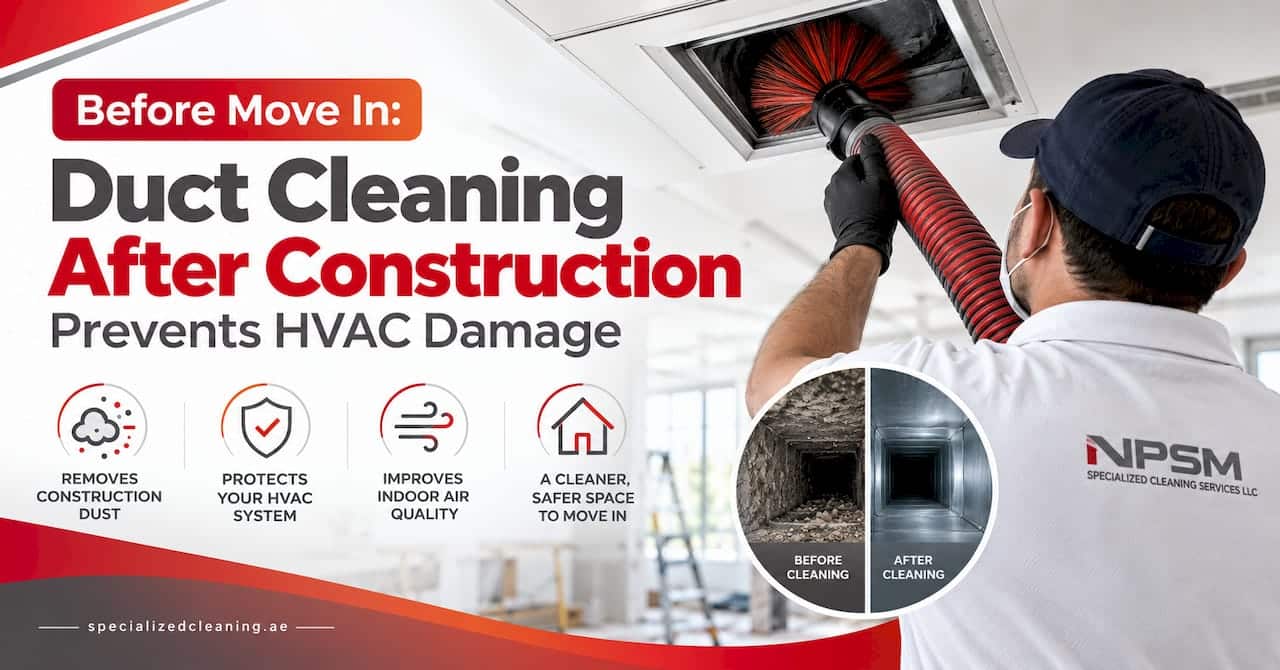
Yes, in most cases. If drywall work, sanding, demolition, or HVAC modifications happened anywhere near your ductwork, or the system ran during the job, schedule a professional source-removal duct cleaning before anyone moves in. If a pro can’t get there right away, seal the registers and swap the filter before you run the HVAC system at all.
TL;DR:
Duct cleaning becomes necessary after drywall-heavy renovations, new builds, or duct modifications that leave debris or fine particulates in the system.
Construction debris like drywall dust, fiberglass fragments, and metal shavings tend to settle heavily in trunk lines and near coils, impairing HVAC efficiency.
Professional source-removal cleaning involves inspection, sealing, agitation, high-volume vacuum extraction, and coil cleaning, with a focus on equipment with HEPA filtration.
DIY cleaning is insufficient if the system ran during construction or if residents have allergies, and proper job verification includes video proof and airflow checks.
Scheduling the cleaning after all dusty trades finish, with prior site preparation, maximizes efficiency and reduces the risk of re-contamination.
Specializedcleaning
Improve Indoor Air Before Move In
Specializedcleaning provides professional HVAC duct cleaning in Dubai for homes and businesses after construction work.
When Duct Cleaning After Construction Is Necessary
Not every home improvement warrants a duct cleaning crew. But certain project types almost always do, because they generate fine particulates that HVAC systems are not built to filter out completely.
You should plan on cleaning after:
New home builds, where framing dust and drywall compound residue settle into every duct run before the system is even commissioned
HVAC cut-ins or duct modifications, which leave metal shavings and sealant debris behind
Attic insulation work, especially blown-in fiberglass or cellulose
Kitchen or bathroom guttings involving tile demo, sanding, or plaster
The real damage happens when the HVAC system runs during construction. Airflow pulls fine dust through the return, across the blower wheel, and onto the evaporator coil, where it can bake into a crust. The Indoor airPLUS technical bulletin from the EPA specifically warns against operating HVAC systems during dusty work and against relying on filters alone to stop that migration. Left unaddressed, you get reduced coil efficiency, musty odors, allergen buildup for occupants, and HVAC maintenance bills that show up months earlier than they should.
What Construction Debris Actually Ends Up in Your Ducts
Construction sites generate a predictable mix of contaminants, and each one behaves differently once it’s airborne inside a duct system.
The usual suspects include:
Drywall dust, the finest and most pervasive contaminant, capable of traveling deep into trunk lines
Sawdust and wood particles from framing or trim work
Fiberglass fragments from insulation cutting or handling
Spray foam overspray, which can harden onto duct interior surfaces
Paint and adhesive residues, often sticky enough to trap other debris
Metal shavings from ductwork fabrication or HVAC line modifications
These particles don’t distribute evenly. They collect heavily in trunk lines, elbows, and the interior of lined ductwork, where airflow slows and turbulence drops debris out of suspension. Evaporator coils and blower housings take the worst of it. Drywall dust in particular can mix with condensation on a coil and form a paste that reduces heat transfer. The practical result: filters that clog in weeks instead of months, and airflow that drops noticeably before anyone realizes why.
How Professionals Remove Construction Debris (and What to Avoid)
Source removal is the industry standard, and it’s a physical process, not a chemical one. The Building America Solution Center is explicit that ducts should be cleaned with vacuum and pneumatic brushing systems, not wet solutions or ultraviolet treatments used as a substitute for actual particle removal.
A proper post-construction cleaning follows this sequence:
Access and inspection — technicians open service ports and often run a video camera through the trunk lines to document baseline contamination.
Containment — registers get sealed and the work area isolated so debris doesn’t spread to finished rooms.
Agitation — pneumatic or rotary brushes and air whips knock embedded dust loose from duct walls, sized to the duct type so lined or flexible sections aren’t damaged.
High-volume vacuum extraction — a truck-mounted or portable collector creates negative pressure inside the whole duct run, pulling loosened debris out through a single collection point rather than pushing it further into the system.
Air handler and coil cleaning — because drywall dust and moisture can cement onto coil fins, this step gets its own attention rather than getting skipped.
Look for equipment with genuine high-volume particulate collection and HEPA-level filtration on the vacuum exhaust, since a shop vacuum recirculating fine dust back into the room defeats the purpose. Avoid any contractor proposing wet pressure washing inside ducts, solvent-only “sanitizing” sprays, or UV lights marketed as a stand-alone fix. None of those remove physical debris, and moisture inside sheet metal ductwork invites corrosion.
Pro Tip:Ask every bidder for before-and-after video of the duct interior, not just a verbal confirmation the job is done. It’s the cheapest way to verify the work actually happened.
DIY vs. Hiring a Pro: What You Can (and Can’t) Handle Yourself
Cleaning your own register covers and vacuuming visible dust near vent openings is fine as basic upkeep. It is not a substitute for real duct cleaning after a renovation.
DIY tools can’t reach trunk lines, can’t access coils inside the air handler, and can’t remove dust embedded in duct liner material. If the HVAC system ran at any point during construction, or if anyone in the building has asthma or allergies, call a professional. The same applies if you want documented proof the job was done correctly.
A typical residential duct cleaning after construction runs a few hours for a standard home. Commercial spaces or larger properties with complex duct layouts, multiple air handlers, or difficult access points take longer. Cost depends on square footage, the number of supply and return runs, whether the air handler and coils need cleaning, and how contaminated the system actually is.
Before signing anything, ask bidders:
What specific equipment and brush types will they use?
Do they perform a video inspection before and after?
Is air handler and coil cleaning included, or billed separately?
Do they follow ACCA standards or equivalent industry qualifications?
What warranty or verification do they offer once the job wraps?
Preparing for Service and What Happens on Cleaning Day
Getting the site ready before the crew arrives keeps the job efficient and prevents re-contamination immediately after cleaning.
Before technicians show up:
Confirm every trade has finished dust-generating work. Cleaning too early just means cleaning twice.
Vacuum finished surfaces, especially near registers and returns.
Secure valuables and clear access to the mechanical room or air handler closet.
Label any vents you already know are problem areas, like rooms with visible dust buildup or weak airflow.
On service day, expect the HVAC system to be shut down first. Technicians set up containment and negative pressure, run a video inspection, connect to the main trunk, then work through brushing and vacuum extraction section by section before finishing at the air handler and coils. A fresh filter goes in at the end. Coordinate timing with your general contractor or facilities manager so the cleaning happens after drywall and paint are done but before final walkthroughs or move-in.
Verifying the Job and Keeping Ducts Clean Afterward
A finished cleaning should come with proof, not just an invoice.
Ask for:
Before-and-after video of the duct interior
Confirmation that airflow feels stronger at registers than before
No lingering dust or construction odor when the system runs
The filter type installed and a note on when to replace it next
Run the system briefly after service with the new filter in place, then swap it again before full occupancy if the technician recommends it, since a fresh filter often loads up fast right after a cleaning. Post-construction cleaning effectively resets the maintenance clock on your HVAC system. Watch for a return of dust on supply vents or a musty smell within the first few weeks. According to the OSHA silica health effects overview, fine construction particulates like silica dust pose measurable respiratory risk, which is part of why getting this step right the first time matters more than treating it as optional cleanup.
How NPSM Specialized Cleaning Services Approaches This Work
This company has extensive experience handling HVAC duct cleaning and post-construction jobs, working closely with contractors and property managers on handover timelines. They use source-removal methods and offer consultations and scheduling options to provide clients with a clear scope before service.
Prevention Beats Cleanup Every Time
Every contractor I’ve seen do this well treats duct protection as part of quality control, not an afterthought. Sealing registers and keeping the HVAC system off during dusty phases costs almost nothing compared to a full post-construction cleaning bill. When you’re unsure whether contamination is bad enough to warrant a full service, a quick video inspection is far cheaper than either an unnecessary cleaning or, worse, skipping one that was actually needed. Prevention integrated early, guided by SMACNA’s duct cleanliness standards, saves owners more money than any cleaning invoice ever will.
— Qadir
Get Your Ducts Cleaned Before Move-In
This service provides property owners a direct path to source-removal duct cleaning without the guesswork of comparing contractors after a renovation. The team handles the full sequence: containment, pneumatic brushing, high-volume vacuum extraction, air handler and coil cleaning, video verification, and filter replacement, timed to fit your contractor’s handover schedule rather than working around it.
Scheduling and consultations are arranged promptly to help get technicians on site in a timely manner. If your renovation is wrapping up, request a site visit through the HVAC duct cleaning services page and get a firm quote based on your actual duct layout and contamination level, not a generic estimate. For projects bundling duct work with broader handover cleaning, the post-construction deep cleaning services cover both in one coordinated visit.
Sources
This guide draws on established construction and indoor air quality standards rather than opinion. Each source below shaped a specific recommendation above:
When should duct cleaning be done after construction?
Schedule it after all dust-generating trades finish but before final occupancy, ideally right after painting and flooring wrap up. Cleaning too early means redoing the work once remaining trades track more dust through the space.
How long does construction dust take to settle?
Fine construction dust can remain airborne or re-suspend from surfaces for weeks after visible work ends, especially once HVAC airflow starts stirring it. That’s why post-construction duct cleaning matters even after the site looks clean.
How long does a duct cleaning usually take?
A standard residential duct cleaning after construction typically takes a few hours, while larger commercial properties with multiple air handlers take longer. A scope and time estimate can be provided during a consultation based on the actual duct layout.
What are the signs my ducts need cleaning after renovation?
Watch for visible dust blowing from registers, a musty or dusty odor when the system runs, weaker airflow than before construction, or filters that clog within days instead of weeks. Any one of these signals warrants a professional inspection rather than waiting it out.
Many homeowners, tenants, contractors and business owners assume that post construction cleaning and deep cleaning are the same service. While both involve detailed cleaning, they are designed for different situations and address different types of dirt, dust and contamination.
If you’ve recently completed a renovation, moved into a newly built property or are preparing a property for occupancy, understanding the difference will help you choose the right cleaning service.
This guide explains what each service includes, when it should be used and which option is best for your property.
Post construction cleaning is performed after construction, renovation or fit-out work and focuses on removing construction dust, paint splashes, cement residue, adhesive marks and building debris.
Deep cleaning is designed for occupied homes, offices and commercial spaces. It removes accumulated dirt, grease, bacteria and hidden grime from areas that are not usually cleaned during routine maintenance.
In simple terms:
Post Construction Cleaning = Construction Residue Removal
Deep Cleaning = Intensive Hygiene Cleaning
What Is Post Construction Cleaning?
Post construction cleaning is a specialized cleaning service carried out after construction, renovation or refurbishment projects have been completed.
The objective is to prepare the property for handover, occupancy or final inspection by removing construction-related residue.
Typical tasks include:
Removing construction dust from all surfaces
Cleaning paint splashes
Removing cement residue
Cleaning grout haze
Removing silicone residue
Cleaning adhesive and sticker marks
Cleaning windows and glass partitions
Vacuuming and mopping floors
Cleaning cabinets, wardrobes and shelves
Preparing kitchens and bathrooms for use
This service is commonly required for:
Newly built villas
Renovated apartments
Office fit-outs
Retail shops
Commercial buildings
Restaurants
Warehouses
Property handovers
What Is Deep Cleaning?
Deep cleaning is a detailed cleaning service for properties that are already occupied or in regular use.
Unlike routine cleaning, deep cleaning targets hidden dirt, grease, bacteria and dust in areas that are often overlooked.
Typical deep cleaning tasks include:
Kitchen degreasing
Bathroom sanitization
Tile and grout cleaning
Dust removal behind furniture
Air vent cleaning
Interior cabinet cleaning
High-touch surface disinfection
Appliance exterior cleaning
Detailed floor cleaning
Removal of accumulated dirt and stains
Deep cleaning is recommended for:
Homes
Apartments
Villas
Offices
Restaurants
Clinics
Retail shops
Hotels
Schools
Post Construction Cleaning vs Deep Cleaning Comparison
Feature
Post Construction Cleaning
Deep Cleaning
Purpose
Remove construction residue
Remove accumulated dirt and bacteria
Performed After
Construction or renovation
Regular property use
Dust Removal
Heavy construction dust
Household or office dust
Paint & Cement Removal
Yes
Usually not required
Grease Removal
Limited
Extensive
Bathroom Sanitization
Yes
Yes
Kitchen Cleaning
Yes
Yes
Glass Cleaning
Yes
Yes
Suitable for Occupied Property
Usually before occupancy
Yes
Main Goal
Property handover
Hygiene and maintenance
Which Service Do You Need?
Choose Post Construction Cleaning If:
Your property has just been built.
Renovation work has been completed.
Contractors have finished a fit-out.
There is construction dust throughout the property.
Paint marks or cement residue are present.
The property is being prepared for handover.
Choose Deep Cleaning If:
Your property is occupied.
Dirt has accumulated over time.
Kitchens or bathrooms require intensive cleaning.
You want seasonal cleaning.
You are moving into or out of an existing property.
Hygiene improvement is your main objective.
Can a Property Need Both Services?
Yes.
Many newly renovated properties benefit from both services.
For example:
A post construction cleaning removes construction dust, paint residue and debris.
A deep cleaning focuses on sanitizing kitchens, bathrooms and frequently touched surfaces before the property is occupied.
For high-end villas, commercial offices and luxury apartments, combining both services often delivers the best results.
What Does Post Construction Cleaning Remove?
Professional post construction cleaning can help remove:
Construction dust
Paint splashes
Cement residue
Grout haze
Adhesive residue
Silicone marks
Packaging materials
Protective film residue
Stickers
Sawdust
Fine drywall dust
How Long Does Each Service Take?
The duration depends on the size and condition of the property.
Generally:
A post construction cleaning project may take longer because construction residue often requires additional attention.
Deep cleaning duration varies depending on the level of dirt and the number of rooms.
A site inspection allows the cleaning team to estimate the required time more accurately.
Which Service Costs More?
Pricing depends on factors such as:
Property size
Cleaning scope
Dust levels
Construction residue
Number of bathrooms
Glass cleaning requirements
Floor type
Accessibility
Post construction cleaning may require additional labour due to paint, cement and adhesive removal, while deep cleaning focuses more on hygiene and detailed cleaning of occupied spaces.
For detailed pricing, visit our Post Construction Cleaning Price Dubai guide.
Why Professional Cleaning Matters
Both services require appropriate equipment, experienced technicians and cleaning methods suited to different surfaces.
Professional cleaning helps:
Improve indoor air quality
Remove fine dust
Prepare properties for occupancy
Maintain a professional appearance
Reduce cleaning time for property owners
Support smooth property handovers
Frequently Asked Questions
Is post construction cleaning the same as deep cleaning?
No. Post construction cleaning focuses on removing construction residue, while deep cleaning focuses on removing accumulated dirt and improving hygiene.
Do I need post construction cleaning after a renovation?
Yes. Renovation work typically leaves dust, paint marks and construction residue that should be removed before using the property.
Can I book deep cleaning after post construction cleaning?
Yes. Some properties benefit from a deep cleaning after construction residue has been removed.
Does post construction cleaning include window cleaning?
Yes. Interior windows and glass surfaces are commonly cleaned as part of the service, depending on the project scope.
Which service is better before moving into a new home?
If the property has just been renovated or built, post construction cleaning is usually recommended first. If the property has been occupied, deep cleaning may be more appropriate.
Dubai’s climate is characterized by its scorching summers and high humidity, making HVAC systems a vital part of daily life. Whether it’s in homes, offices, malls, or industrial units, the HVAC (heating, ventilation, and air conditioning) system works continuously to maintain indoor comfort. However, one critical part of this system is often overlooked—HVAC duct cleaning.
In this blog post, we’ll explore why HVAC duct cleaning is essential in Dubai, the signs you need it, the benefits for health and energy efficiency, the cleaning process, and how to choose the right HVAC duct cleaning company in Dubai. This guide is perfect for both residential homeowners and facility managers of commercial properties.
What is HVAC duct cleaning?
HVAC duct cleaning refers to the process of cleaning the air ducts and components of your heating and cooling system, including supply and return ducts, registers, grilles, diffusers, heat exchangers, cooling coils, drip pans, fan motors, fan housings, and the air handling unit. Over time, dust, debris, mold, allergens, and even pests can accumulate inside these ducts, affecting the quality of air and efficiency of your system.
Why HVAC Duct Cleaning is Essential in Dubai
Dubai’s harsh environmental conditions make HVAC duct cleaning more than a luxury—it’s a necessity. Here’s why:
1. Dust and Sand Infiltration
Dubai experiences frequent sandstorms and dusty weather. Even with sealed windows, fine particles can enter buildings and settle inside ducts. Over time, this dust clogs the system and reduces its efficiency.
2. Humidity and Mold Growth
The high humidity levels in Dubai make HVAC systems a breeding ground for mold and mildew, especially in ducts that retain moisture. Breathing in mold spores can cause respiratory issues and allergies.
3. Year-Round Air Conditioning
Unlike cooler climates, air conditioning in Dubai is used nearly all year. This non-stop usage causes ducts to accumulate debris faster, requiring more frequent maintenance.
Signs You Need HVAC Duct Cleaning in Dubai
Many residents and business owners wait until a major issue arises before calling for service. However, early signs can help prevent costly repairs. Here’s what to look out for:
Clean ducts mean fewer airborne contaminants like dust, pet dander, mold spores, and pollen. This is especially beneficial for individuals with asthma, allergies, or respiratory issues.
2. Energy Efficiency and Cost Savings
Clogged ducts restrict airflow, forcing the HVAC system to work harder. This leads to increased energy consumption and higher electricity bills. Clean ducts allow the system to run efficiently, saving money in the long run.
3. Extended HVAC System Life
Dirt and debris buildup can cause premature wear and tear. Routine duct cleaning helps maintain the system and prevents costly repairs or replacements.
4. Eliminates Bad Odors
Mold, mildew, and pest droppings in the ducts can cause foul smells. Professional cleaning removes these odor sources, leaving your indoor environment fresh.
5. Prevents Mold Growth
Mold thrives in dark, damp areas like AC ducts. By cleaning and disinfecting ducts, you minimize the risk of mold formation.
The HVAC Duct Cleaning Process: Step-by-Step
Professional HVAC duct cleaning is not just about vacuuming the vents. It’s a thorough, step-by-step process performed using specialized tools and equipment. Here’s how a reputable HVAC duct cleaning company in Dubai does it:
Step 1: Inspection
A certified technician inspects your HVAC system using cameras and diagnostic tools to check for dust levels, mold, pests, and structural issues.
Step 2: System shutdown
Before cleaning begins, the system is turned off and isolated to avoid contamination of clean areas.
Step 3: Protection of Interior Space
Furniture and flooring are covered with protective sheets. Technicians wear shoe covers and masks to maintain cleanliness.
Step 4: High-powered Vacuuming
Industrial-grade vacuums create negative air pressure in the duct system. This sucks out dust, dirt, and debris without releasing particles into the indoor air.
Step 5: Agitation and Brushing
Mechanical brushes and air whips loosen any stubborn buildup stuck on the duct walls. This is followed by vacuuming again.
Step 6: Mold and Bacteria Disinfection
If mold or bacteria are present, technicians apply EPA-approved sanitizers to disinfect the ducts safely.
Step 7: Cleaning Other Components
Coils, fans, grills, diffusers, and drip pans are cleaned to ensure the entire system is free from contaminants.
Step 8: Final Inspection and Report
A post-cleaning inspection is carried out to ensure all contaminants are removed. Clients are given a detailed report with before-and-after photos.
How Often Should You Get Your HVAC Ducts Cleaned in Dubai?
According to the National Air Duct Cleaners Association (NADCA) and considering Dubai’s climate, here’s a good schedule to follow:
Residential Properties: Every 1 to 2 years
Commercial Buildings: Every 6 to 12 months
Restaurants and Kitchens: Every 6 months
Clinics, Hospitals, and Labs: Every 3 to 6 months
After Renovation or Construction: Immediately
Choosing the Right HVAC Duct Cleaning Company in Dubai
Not all duct cleaning services are created equal. Here’s how to choose a reliable and professional provider:
✅ Certified Technicians
Ensure the company employs trained technicians with experience in handling both residential and commercial systems.
✅ Advanced Equipment
Look for companies that use negative air machines, HEPA filters, and high-powered vacuums designed specifically for HVAC systems.
✅ Transparent Pricing
A good company will offer free site inspections and transparent pricing without hidden fees.
✅ Disinfection Services
Given the health risks of mold and bacteria, choose a company that offers sanitization using non-toxic, certified disinfectants.
HVAC Duct Cleaning for Commercial Properties in Dubai
In commercial settings such as offices, malls, schools, and hotels, the HVAC load is significantly higher, and so is the risk of air contamination. Clean air is not only about comfort — it’s about productivity, legal compliance, and customer satisfaction.
Key Benefits for Businesses:
Healthier work environment
Reduced sick leaves and absenteeism
Better impression on clients and visitors
Compliance with Dubai Municipality regulations
Lower maintenance costs
HVAC Duct Cleaning for Residential Properties in Dubai
Whether you live in a villa, apartment, or townhouse, air ducts in your home play a vital role in your indoor environment. Pet hair, kitchen grease, perfume particles, and even cigarette smoke can get trapped in the ducts and recirculate in the air.
Regular duct cleaning is highly recommended for homes with:
Children or elderly individuals
Pets
Smokers
Individuals with asthma or allergies
Recent renovations or construction
HVAC Duct Cleaning Regulations in Dubai
The Dubai Municipality and Dubai Health Authority (DHA) emphasize the importance of indoor air quality. Commercial buildings, especially hospitals, schools, and offices, are expected to maintain clean air systems.
Non-compliance can lead to:
Fines
Health violations
Tenant complaints
Increased insurance premiums
By hiring a professional HVAC duct cleaning company in Dubai, you ensure compliance and peace of mind.
Eco-Friendly and Safe Duct Cleaning Practices
In line with Dubai’s sustainability vision, leading cleaning companies now use eco-friendly practices, including
Biodegradable disinfectants
Water-efficient methods
HEPA filters that reduce particle emissions
Proper disposal of contaminated waste
When hiring a service provider, always ask about their green cleaning protocols.
Common Myths About HVAC Duct Cleaning
❌ “It’s Not Necessary Unless There’s a Problem.”
Fact: Regular cleaning prevents problems before they start.
❌ “It’s Too Expensive”
Fact: It saves money in the long run through reduced energy bills and fewer repairs.
❌ “DIY Cleaning is Good Enough”
Fact: Home tools can’t reach deep inside ducts or remove mold and bacteria effectively.
Marble countertops are synonymous with elegance and luxury. Whether in upscale homes, modern offices, or boutique hotels, marble surfaces offer unmatched beauty. However, over time, daily wear, scratches, and dullness can take away their shine. That’s where professional marble polishing comes in. But how much does it cost to polish marble countertops in Dubai—and why should you trust NPSM for this service?
Why Marble Countertop Polishing Is Essential
Marble is a naturally porous and delicate stone, especially in Dubai’s climate, where dust, humidity, and heat can accelerate its wear. Regular marble restoration and polishing not only restore its gloss but also extend the surface’s life. At NPSM Specialized Cleaning Services, we specialize in complete marble care, ensuring your countertops stay pristine and protected.
Understanding the Cost of Marble Polishing in Dubai
The price of marble polishing services in Dubai typically ranges between AED 25 to AED 75 per square Meter, depending on several factors:
Size and surface area of the countertop
Condition of the marble (scratches, stains, dullness)
Choice of finish: high-gloss, semi-gloss, or matte
At NPSM, our transparent pricing and personalized approach ensure you get the best value for money, without compromising quality.
What’s Included in Our Marble Countertop Polishing Services?
When you choose NPSM, you get a comprehensive, step-by-step marble polishing process that ensures long-lasting results:
1. Deep Cleaning
We begin by removing surface dust, grime, and stains to prep the countertop for restoration. This ensures a clean base for all further steps.
2. Grinding and Leveling
If your marble has deep scratches or uneven areas, we perform diamond grinding to level the surface and eliminate imperfections.
3. Professional Polishing
Using high-end polishing machines and compounds, we bring back the original luster of your marble—tailored to your preferred finish.
4. Sealing
Once polished, a sealant is applied to protect the marble from moisture, oil, and chemical stains. This step is vital for durability.
5. Crystallization
For added shine and surface strength, we offer marble crystallization—a chemical reaction that enhances the marble’s hardness and finish.
Why Choose NPSM for Marble Countertop Polishing in Dubai?
At NPSM Specialized Cleaning Services, we are proud to be one of the top-rated marble polishing companies in Dubai. Here’s why clients trust us:
Experienced Marble Specialists: Our skilled technicians have years of experience with residential and commercial marble restoration.
End-to-End Services: From kitchen countertop polishing to large-scale marble flooring, we handle projects of all sizes across Dubai and the UAE.
Affordable Pricing: Get premium-quality service starting from just AED 25 per sq. ft., including cleaning, polishing, sealing, and more.
Customized Approach: We tailor each project based on the type of marble, the condition of the surface, and your specific preferences.
How Much Does It Cost to Polish Marble Countertops?
At NPSM, our marble countertop polishing costs are competitive and transparent, starting from AED 25/sqm. This includes all essential steps—deep cleaning, grinding, polishing, sealing, and optional crystallization. We offer free consultations and on-site assessments to provide you with an accurate quote based on your countertop’s needs.
Why Invest in Marble Polishing?
Polishing is more than just aesthetics—it’s about protecting your investment. Well-maintained marble countertops:
Resist stains and scratches better
Are easier to clean and maintain
Look newer and more luxurious
Add value to your property
Whether you’re renovating your kitchen, preparing your property for sale, or just maintaining your space, polishing your marble countertops is a smart, long-term decision.
How to Book with NPSM?
Getting started is simple. Reach out to NPSM Specialized Cleaning Services for a free consultation or quote. We’ll assess your countertops, explain the process, and offer a tailored plan that fits your budget and needs.
Trust NPSM Specialized Cleaning Services LLC to deliver exceptional marble restoration and polishing services for both commercial and residential properties in Dubai. With our expertise and dedication to quality, your marble surfaces will look immaculate and elegant, enhancing the overall appeal of your space.
Dubai’s dynamic growth, with its ever-evolving skyline and luxury living, means construction and relocation are everyday realities. Whether you’re finishing a new build, moving into a dream villa, or preparing to exit a rental property, professional cleaning services are essential to restore hygiene, appearance, and comfort.
In this comprehensive guide, we’ll explore the vital role of Post Construction Cleaning in Dubai, Move In Move Out Cleaning Services, and Villa Deep Cleaning, why they matter, and how to choose the right service for your needs.
What is post-construction cleaning?
Post-construction cleaning is a specialized service provided after the completion of a construction or renovation project. Construction leaves behind dust, debris, paint splatters, grout haze, and leftover building materials. This mess can pose health risks, reduce the aesthetic value of your property, and delay your move-in timeline.
Why is post-construction cleaning in Dubai important?
Dubai’s environment brings a unique combination of desert dust, humidity, and high-end construction materials. Without proper cleaning:
Dust and debris can accumulate in vents and air ducts, affecting indoor air quality.
Leftover cement, silicone, or adhesive can harden on surfaces and become tough to remove.
Paint splashes and window stickers diminish the luxurious look of the interiors.
Hiring a post-construction cleaning company in Dubai ensures all areas are scrubbed, sanitized, and presented to perfection. The service is not just aesthetic—it’s essential for safety and comfort.
What’s Included in Post-Construction Cleaning Services?
Removal of construction dust from walls, ceilings, windows, and floors
Polishing of all surfaces, especially glass and tiles
Vacuuming and mopping floors, including vinyl, marble, PVC, and ceramic tiles
Cleaning and sanitizing bathrooms and kitchens
Spot removal from walls and baseboards
Waste disposal, including packaging and leftover materials
HVAC duct cleaning, if needed
Whether a commercial tower or a residential villa, post-construction cleaning in Dubai is tailored to the property type and client needs.
Move-In/Move-Out Cleaning Services in Dubai
Moving into a new property or preparing to hand over your current one can be stressful. Cleaning shouldn’t be another task on your plate.
Move-in and move-out cleaning in Dubai is designed to deliver a spotless, sanitized home before or after occupancy. Whether you’re a tenant, landlord, or real estate agent, this service ensures the property is fresh, disinfected, and ready.
Why Choose Move-In/Move-Out Cleaning in Dubai?
Tenants: Ensure you get your security deposit back by handing over a perfectly cleaned property.
Landlords: Make your property more appealing for future tenants.
Homeowners: Begin your new chapter in a sanitized, welcoming space.
What’s Included in the Service?
Deep cleaning of all rooms
Sanitization of bathrooms and kitchens
Interior cabinet cleaning
Window washing (interior side)
Appliance cleaning (inside & out)
Tile and grout cleaning
Stain removal from walls and doors
Dubai’s rental market is competitive, and cleanliness plays a big role in tenant satisfaction and property value. That’s why hiring professional move-out cleaning services in Dubai is a smart investment.
Villa Deep Cleaning Services in Dubai
Living in a villa in Dubai is all about comfort, luxury, and space. But more space also means more surfaces to accumulate dust, sand, and grime. Regular cleaning isn’t enough, especially after renovations, long stays, or before hosting events.
Villa Deep Cleaning in Dubai offers a comprehensive, top-to-bottom sanitization process for your property.
Benefits of Professional Villa Deep Cleaning in Dubai
Eliminates hidden dirt and allergens
Prepares your home for guests or resale
Extends the life of flooring, carpets, and furniture
Disinfects high-touch areas to maintain family health
Ideal after renovations, festive seasons, or long absences
What Does a Villa Deep Cleaning Service Include?
Dusting and wiping all surfaces, including ceilings and walls
Marble polishing, vinyl, and PVC floor cleaning (if required)
Steam cleaning of bathrooms and kitchens
Upholstery vacuuming
Disinfection of high-touch areas
Balcony and outdoor cleaning
Garage sweeping and jetting
Villas often feature multiple floors, outdoor areas, and luxury finishes that require expert care. That’s why homeowners rely on villa deep cleaning companies in Dubai to maintain their property’s appeal and cleanliness.
Why Hire a Professional Cleaning Company in Dubai?
Dubai has a wide range of cleaning providers, but not all offer the same expertise, equipment, or attention to detail. Here’s what you should look for:
1. Experience with Dubai Properties
Look for cleaners familiar with local property types—villas, townhouses, apartments, and commercial spaces. They should understand the materials used in Dubai’s buildings and how to treat them safely.
2. Eco-Friendly and Safe Products
The best post-construction and deep cleaning services in Dubai use non-toxic, safe, and eco-friendly products that leave no residue and are safe for children and pets.
3. Trained and Background-Checked Staff
Trustworthy companies ensure their cleaning staff are trained, uniformed, and verified for safety and quality.
4. Custom Packages
Whether you need post-renovation cleaning, villa deep cleaning, or move-in or move-out cleaning in Dubai, you should be able to customize your service based on your requirements.
When Should You Book These Services?
After completing a construction or renovation project
Before moving into a new home
After moving out, to ensure the property is ready for the next tenant
Before or after hosting a major event
Seasonally, especially before Ramadan or holidays
Professional cleaning transforms not just how your space looks but how it feels.
NPSM Specialized Cleaning Services: Your Trusted Partner in Dubai
At NPSM Specialized Cleaning Services, we bring 15+ years of expertise and over 4000 completed projects to the table. Whether you need post-construction cleaning, move-in or move-out services, or a professional villa deep cleaning in Dubai, we offer:
Advanced equipment and techniques
Certified and experienced cleaners
Eco-friendly cleaning products
Flexible scheduling and quick turnarounds
Affordable pricing with transparent quotes
We serve both residential and commercial clients across Dubai, ensuring that every job is done to perfection.
Final Thoughts
In a city like Dubai, where luxury meets lifestyle, cleanliness is not just a choice; it’s a necessity. Whether you’re finishing construction, relocating, or simply refreshing your space, post-construction cleaning, move-in and move-out cleaning, and villa deep cleaning services in Dubai are the key to ensuring a healthy and inviting environment.
Don’t let dirt, dust, or stains ruin your space. Book your professional cleaning with NPSM today and experience the difference a deep clean makes.
Marble is beautiful—but it’s not indestructible. Whether it’s on your floor, wall, or countertop, over time, cracks can appear in marble due to wear, heavy foot traffic, or the natural settling of buildings. These cracks don’t just take away from the beauty of the stone—they can also trap dirt, moisture, and bacteria, making them worse over time.
The good news? You don’t need to replace your marble. At NPSM Specialized Cleaning Services, we offer a complete marble restoration service that includes crack repair using mastic filler, full grinding, polishing, and sealing—bringing your marble back to life.
Let’s walk you through how we professionally repair cracks in marble and why mastic filler and our step-by-step restoration process are the best solutions.
Why Do Cracks Form in Marble?
Before jumping into the repair process, let’s understand why cracks appear:
Impact from heavy objects
Natural shifting or settling of structures
Moisture infiltration
Improper installation or uneven subfloor
Lack of maintenance or sealing
While some cracks are surface-level, others may go deeper. That’s why our marble restoration service isn’t just about patching cracks—it’s about bringing the whole surface back to a uniform, polished, and sealed condition.
Our Marble Restoration Process (Including Crack Repair)
We don’t just fix the crack—we restore the entire surface so the repair blends in seamlessly and your marble shines like new again.
We start by grinding the marble surface using diamond abrasive pads. This step helps to:
Level uneven tiles (lippage)
Remove minor scratches and dull spots
Open up hairline cracks for proper filling
Expose the raw surface for better adhesion
This grinding process gives us a clean, smooth base to work on.
2. Grouting & Crack Filling with Mastic Filler
Once the surface is prepared, we begin grouting and filling the cracks and any visible holes using mastic glue—a professional-grade filler specifically designed for natural stone like marble.
Why mastic?
It bonds well with marble
Can be color-matched for a seamless look
Long-lasting and non-yellowing
Flexible enough to move with minor shifts in the surface
We use high-quality mastic that’s either pre-mixed or tinted to match the exact shade of your marble, ensuring the repair blends in naturally.
3. Second Phase of Grinding
After filling and curing, we perform a second round of grinding. This step ensures:
The mastic filler is flush with the marble surface
Any remaining scratches or filler residue is removed
The surface is prepped for a high-gloss finish
This double-grinding technique is key to making sure your marble surface looks uniform and perfectly level.
4. Powder Polishing with Surfactant
Next, we apply a special marble polishing powder combined with a surfactant. This polishing compound reacts with the marble surface to:
Restore natural shine
Enhance color depth
Smooth out minor imperfections
Leave a glossy, elegant finish
We use polishing machines equipped with soft pads that glide over the surface, slowly revealing the natural sheen of the marble.
5. Rinsing with Neutral Stone Soap
After polishing, we carefully rinse the surface using a pH-neutral stone soap. This removes:
Residual polishing powder
Surface dust and mastic particles
Any oil or debris left from the polishing stage
Neutral cleaners are important because harsh chemicals can damage marble and strip away its natural finish.
6. Buffing with White Pad
Once cleaned, we buff the surface using a soft white pad. This step:
Emphasizes the natural veins and color
Enhances the final shine
Smooths out any remaining unevenness
Gives the surface a fresh, finished look
Buffing is what gives marble that luxurious “hotel lobby” shine that everyone loves.
7. Applying Marble Sealer
Finally, we apply a high-quality stone sealer to protect the surface. This seals the grout, the repaired cracks, and the entire marble surface, preventing:
Stains from liquids
Moisture intrusion
Dust and dirt build
Discoloration over time
Sealing is one of the most important steps and is often skipped in DIY repairs. But with Dubai’s climate and foot traffic, sealing helps your repair last longer.
Many people ask, “Should I use epoxy?” But for marble crack repair, we specifically use mastic glue because:
It’s designed for natural stone
It’s easier to sand and polish
It blends better with the marble’s texture
It stays flexible, reducing the risk of future cracks
Unlike epoxy, mastic is forgiving, especially during polishing. It becomes part of the surface rather than sitting on top of it.
Common Questions About Marble Crack Repair
Q1: Will the crack still be visible after repair? If color-matched and polished correctly, cracks are nearly invisible after restoration.
Q2: Can I fix marble cracks on my own? Small hairline cracks might be DIY-able, but full repairs require grinding, filling, polishing, and sealing—best done by professionals.
Q3: How long does the full restoration take? A standard villa or commercial floor takes about 1 to 2 days, depending on area and crack severity.
Q4: How long does the repair last? With proper sealing and maintenance, our crack repairs last for years—even under heavy foot traffic.
Don’t Just Patch It—Restore It Properly
Fixing a marble crack isn’t just about filling the line. It’s about restoring the entire surface so it shines, protects, and lasts.
At NPSM Specialized Cleaning Services, we don’t believe in shortcuts. Our full marble restoration process ensures that once we’ve repaired your marble, it looks and feels brand new—no mismatched patches, no dull spots.
If you’ve got cracked marble floors, damaged vanity tops, or aging staircases, let us restore their beauty and strength with our tried-and-tested process.
In a city like Dubai, where the desert environment contributes to dust, sand, and allergens infiltrating indoor spaces, maintaining clean air inside your home or office is more important than ever. One often overlooked aspect of indoor air hygiene is the cleanliness of your HVAC duct system.
HVAC (heating, ventilation, and air conditioning) ducts are responsible for circulating air throughout your property. Over time, these ducts accumulate dust, pet dander, mold, bacteria, and other airborne contaminants. If left uncleaned, these pollutants can affect not just your indoor air quality but also the health of the people living or working inside the premises.
In this blog, we’ll cover the 7 key benefits of regular HVAC duct cleaning in Dubai and why it’s essential for both residential and commercial properties.
Improved Indoor Air Quality
The most immediate and noticeable benefit of regular duct cleaning is the significant improvement in indoor air quality (IAQ). As your HVAC system circulates air, it also distributes any contaminants trapped within its ductwork. This includes:
Dust and debris can restrict airflow inside the ducts, forcing your HVAC system to work harder to maintain the desired temperature. When airflow is compromised, it can lead to uneven heating or cooling and unnecessary strain on the system.
Clean ducts improve air circulation, allowing your HVAC system to run efficiently and maintain indoor comfort with less effort. This means quicker cooling during Dubai’s scorching summer months and better heating during cooler months.
3. Reduction in Energy Bills
An efficient HVAC system translates directly to lower energy consumption. When airflow is unrestricted, your system requires less power to circulate air throughout the building. On the contrary, dirty ducts can lead to a 20-30% increase in energy usage.
By investing in regular duct cleaning, especially in Dubai’s dusty environment, you’ll experience a noticeable reduction in your electricity bills.
4. Eliminates Allergens and Respiratory Irritants
Allergens such as pollen, mold, and dust mites often accumulate in HVAC ducts, especially in homes with pets or in areas prone to high humidity. Every time the system runs, these allergens are circulated throughout the property, which can trigger asthma, sinus infections, and other respiratory problems.
For those with allergies, elderly residents, or children, duct cleaning is not just maintenance — it’s a health necessity.
5. Removes Unpleasant Odors
Stale smells, moldy odors, and even pet smells can linger inside HVAC ducts. If you’ve ever noticed a musty scent when your AC turns on, your ducts may be the culprit. This is often caused by
Mold growth inside damp ducts
Bacteria from accumulated debris
Cigarette smoke
Pet fur and urine particles
Professional HVAC duct cleaners in Dubai use industrial-grade vacuums and sanitizing agents to thoroughly clean and deodorize the ductwork.
6. Less Dust Accumulation on Surfaces
If your furniture seems to get dusty soon after cleaning, your dirty air ducts might be to blame. Contaminants sitting inside the ducts are blown into the air and settle on your floors, tables, and other surfaces.
Clean ducts reduce airborne dust levels, meaning your interiors stay cleaner for longer. This is particularly beneficial in offices or showrooms, where cleanliness and presentation are key.
7. Extends the Lifespan of Your HVAC System
HVAC systems are a major investment — and like all machines, they work best when they’re well-maintained. Dirty ducts contribute to mechanical wear and tear by increasing strain on fans, coils, and filters. Over time, this can lead to breakdowns, expensive repairs, or even premature system failure.
Routine duct maintenance helps protect your HVAC unit and extend its useful life, ensuring better performance and fewer service calls.
Why HVAC Duct Cleaning Is Crucial in Dubai
Dubai’s environmental conditions make regular duct cleaning more important than in other regions:
High dust levels: Frequent sandstorms and construction dust infiltrate indoor spaces
High humidity: Promotes mold and mildew growth in ducts
Long AC usage: Systems run year-round, accelerating buildup inside ducts
That’s why NPSM Specialized Cleaning Services LLC offers certified HVAC duct cleaning in Dubai, designed for both residential villas and commercial properties.
When Should You Clean Your HVAC Ducts?
While there’s no one-size-fits-all answer, experts recommend duct cleaning every 12 to 18 months, or immediately if you notice:
Musty or foul odors
Increased allergy symptoms
Visible mold growth in vents
Excessive dust buildup around air outlets
Poor HVAC airflow or rising energy bills
Need an inspection? Schedule a free site visit with our team today.
Final Thoughts
Regular HVAC duct cleaning is one of the simplest ways to:
✅ Enhance your indoor air quality ✅ Lower energy bills ✅ Improve system performance ✅ Reduce allergens ✅ Keep your home or office clean and healthy
Marble is a stunning natural stone that adds elegance to homes and commercial spaces. However, due to its porous nature, marble can easily absorb spills, leading to stubborn stains. Whether it’s a marble countertop, flooring, or a bathroom vanity, knowing how to effectively remove stains while maintaining its shine is essential. In this guide, we’ll share expert-approved methods to remove stains from marble, as well as tips for maintaining its polished finish.
If you’re looking for professional marble polishing in Dubai, marble restoration in Dubai, marble floor repair in Dubai, or countertop polishing services, these tips will also help you understand the best care practices for your marble surfaces.
Lorem ipsum dolor sit amet, consectetur adipiscing elit. Ut elit tellus, luctus nec ullamcorper mattis, pulvinar dapibus leo.
Understanding Marble Stains and Their Causes
Before jumping into the cleaning process, it’s essential to identify the type of stain on your marble. The most common types of stains include:
Organic Stains – Caused by coffee, tea, wine, fruit juices, and other food items.
Oil-Based Stains – Cooking oil, grease, and cosmetic products like lotions or creams.
Rust Stains – From metal objects left on marble surfaces for extended periods.
Water Spots and Hard Water Stains – Result from mineral deposits in tap water.
Ink and Paint Stains – Commonly from markers, ink pens, or paint spills.
Etch Marks – Caused by acidic substances like lemon juice, vinegar, or harsh cleaners.
Each type of stain requires a different approach to remove it effectively without damaging the marble surface.
How to Remove Stains from Marble Surfaces
1. Organic Stains (Coffee, Tea, Wine, Fruit Juices, etc.)
Organic stains tend to leave brownish or pinkish marks on marble. The best way to remove them is
Solution:
Mix hydrogen peroxide (12%) with a few drops of ammonia.
Apply the solution using a soft cloth and gently rub the stained area.
Let it sit for a few minutes, then wipe it clean with a damp cloth.
For stubborn stains, use a poultice (a paste made of baking soda and water) and let it sit for 24 hours before rinsing.
Oil stains darken marble and can be tricky to remove.
Solution:
Apply a mixture of baking soda and water over the stain to absorb the oil.
Cover the paste with plastic wrap and leave it overnight.
Rinse with warm water and dry with a clean cloth.
If the stain persists, use a few drops of acetone (nail polish remover) on a cotton pad and rub gently.
3. Rust Stains (From Metal Objects)
Rust stains are usually orange or brown and can be challenging to remove.
Solution:
Use a commercial rust remover specifically designed for marble.
Avoid acidic cleaners as they can damage the marble surface.
Gently scrub the stain with a soft cloth or sponge.
Rinse thoroughly and dry the area.
4. Water Spots and Hard Water Stains
Water stains appear as dull spots on marble surfaces, caused by mineral buildup.
Solution:
Wipe the area with a mixture of water and mild dish soap.
Use a soft microfiber cloth to buff the area dry.
For stubborn water stains, apply a marble polishing powder and gently rub it in circular motions.
5. Ink and Paint Stains
Ink and paint stains can be tricky, especially on light-colored marble.
Solution:
Use rubbing alcohol for light-colored marble.
For dark-colored marble, use acetone.
Apply with a cotton pad and blot the stain until it lifts.
Rinse with a damp cloth and dry immediately.
6. Etch Marks (From Acidic Substances)
The etching looks like dull spots or discoloration on marble caused by acidic spills.
Solution:
Use a marble polishing powder to restore the surface.
For severe etching, professional marble restoration services in Dubai may be required.
Always use a pH-neutral cleaner to prevent future etching.
Preventive Measures to Keep Your Marble Stain-Free
Preventing stains is the best way to maintain the beauty of marble surfaces. Here are expert tips to protect your marble:
Seal Your Marble Regularly – Applying a high-quality marble sealer helps prevent the absorption of spills.
Clean Spills Immediately – Wipe up spills as soon as they occur to avoid deep stains.
Use Coasters and Mats – Protect countertops from beverage rings and oil stains.
Avoid Harsh Cleaners – Do not use vinegar, lemon, or ammonia-based cleaners as they cause etching.
Use Soft Cloths and Mops – Prevent scratches by using microfiber cloths and soft mops for cleaning.
When to Call Professionals for Marble Cleaning
While DIY stain removal methods work in many cases, some stains and damage require expert intervention. If you notice deep stains, dull patches, or scratches that won’t go away, it’s best to call professionals for marble floor repair in Dubai or countertop polishing services.
Benefits of Professional Marble Cleaning Services:
Advanced Stain Removal Techniques – Experts use specialized treatments to restore marble surfaces.
Marble Polishing for Shine – Professional marble polishing in Dubai services restore the glossy finish.
Restoration of Damaged Surfaces – If your marble has deep scratches or etching, professional marble restoration in Dubai can bring it back to life.
Long-Term Protection – Professionals apply high-quality sealers to protect against future stains.
Marble surfaces require proper care to maintain their natural beauty. Whether dealing with stains on your marble floors, countertops, or vanities, using the right cleaning techniques ensures longevity and shine. Regular sealing, gentle cleaning, and immediate spill removal will prevent stains and damage. For deep stains or extensive damage, hiring professionals for marble floor repair in Dubai, countertop polishing, or marble restoration in Dubai is the best solution.
If you’re looking for expert marble polishing in Dubai, contact a professional service provider to keep your marble looking flawless and elegant for years to come
FAQ's
Can I use vinegar to clean marble stains? No, vinegar is acidic and can cause etching on marble surfaces. Use a pH-neutral cleaner instead.
How often should I seal my marble surfaces? Sealing is recommended once or twice a year, depending on usage and exposure to stains.
What is the best cleaner for marble? A mild dish soap with warm water or a marble-specific cleaner is best.
Can professional marble polishing remove all stains? Most stains can be removed with professional polishing, but deep-set stains may require marble restoration.
What should I do if my marble countertop gets stained? Try a baking soda poultice for oil-based stains or hydrogen peroxide for organic stains. If stains persist, seek professional help.
By following these expert tips, you can keep your marble surfaces spotless and gleaming. For professional marble restoration in Dubai, marble polishing in Dubai, or marble floor repair in Dubai, contact a trusted cleaning service today!