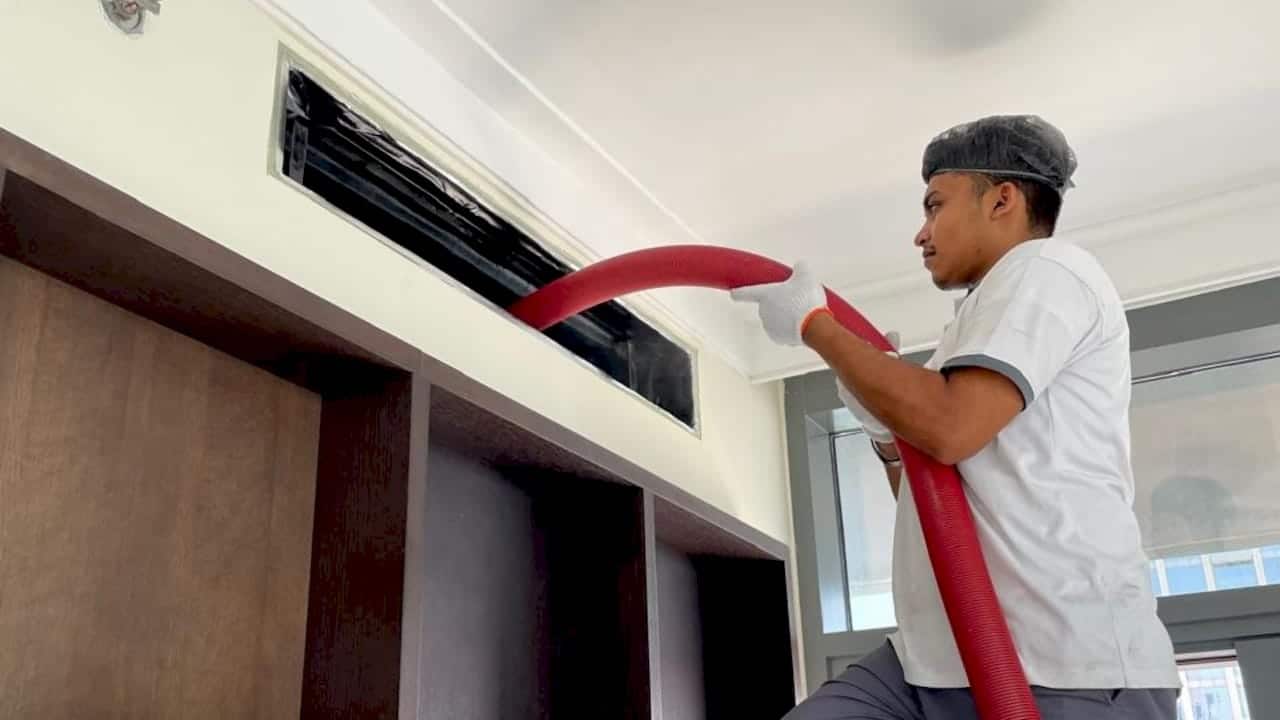
A professional air duct cleaning job in Dubai follows a fixed sequence: inspect the system, protect the property, seal and depressurize the ductwork, loosen the deposits mechanically, extract them with HEPA-filtered vacuum equipment, clean the other components, restore every access point and verify the result. The goal is to physically remove contamination from the system, not to mask it with a spray or fragrance. This guide walks through each stage, the equipment involved, how to prepare your villa, apartment or office, and what you should see when the crew leaves.
Specializedcleaning
Cleaner Ducts, Better Indoor Air
Specializedcleaning provides HVAC duct cleaning in Dubai, using specialized equipment to address complex cleaning challenges in homes and businesses.
Real duct cleaning is source removal: technicians dislodge dust and debris with brushes, air whips or compressed air, then capture it with vacuum equipment.
The sequence is inspection, protection of the space, containment under negative pressure, agitation and extraction, component cleaning, restoration and a final check.
Dubai Municipality expects HVAC systems to be cleaned to approved specifications by approved specialist companies or by qualified building-operator staff.
Preparation is simple: clear access to vents and the air handler, protect delicate items and arrange building access.
Ask for a written report and before-and-after photos so your service history is documented.
The National Air Duct Cleaners Association (NADCA) describes HVAC cleaning as a source-removal process. That phrase matters. Contamination is physically taken out of the system. Deodorizers, fogging on its own or a quick wipe of the visible grille do not meet that definition.
In Dubai, ducts work harder than in most cities. Air conditioning runs for much of the year, fine desert dust finds its way into return air, and construction is constant. Dust settles inside ductwork, on coils and in drain pans. Over time that load affects airflow and what comes out of your vents. If you want the local background on why this matters, see our guide on why HVAC duct cleaning matters in Dubai.
Duct cleaning here is not only a comfort decision. Dubai Municipality’s Green Building Regulations (2020, clause 401.08) state that HVAC equipment and systems must be inspected and cleaned according to approved standard specifications. The work is to be carried out by specialized maintenance companies approved by the municipality, or by the building operator using qualified personnel and equipment.
The same document ties into the Al Sa’fat system and the Dubai Building Code (clause 502.14): mechanical, electrical and plumbing systems should be maintained regularly, with documented service logs kept onsite for inspection. For a property manager, that is a practical reason to keep every duct cleaning report on file.
Dubai Municipality also publishes a technical guideline on indoor air quality. Its existence points to an approach where indoor air quality is treated as a building-health and maintenance issue, not as cosmetic vent cleaning.
Crews differ in detail, but a properly run job covers the same stages. Here is what happens, in order.
Step 1: Inspection and scoping
The job starts with a look at the system before anything is opened. A technician checks the type of system (split units with ductwork, ducted units, central chilled-water air handlers or fan coil units), the ductwork material, the number and location of supply and return grilles, and the condition of filters, coils and drain pans.
Inspection tells you three things: how much contamination there is, whether anything needs special handling (moisture, mold-like growth, damaged insulation), and how much access the crew has. Dubai Municipality’s regulations emphasize that systems must be installed with adequate access for inspection, maintenance and cleaning, so that cleaning does not require dismantling building structures. Where access is poor, the crew may need to add access openings, and that should be agreed before work begins.
This is also the point where scope and quotation are set. We offer free consultations, so you can have the system looked at and the work scoped before you commit.
Step 2: Protecting the property
Before cleaning, the crew protects the space. In practice that means:
Covering floors and furniture near grilles and the air handler.
Switching off the system so that nothing circulates while ducts are open.
Marking the positions of dampers so they can be returned exactly where they were.
Agreeing where equipment will be placed and where the vacuum exhaust will run.
This stage is why a careful crew leaves a home or office looking the way it did when they arrived.
Step 3: Containment under negative pressure
This is the stage that separates a clean job from a dusty one. Technicians connect a powerful HEPA-filtered vacuum to the ductwork so that air is drawn into the system rather than pushed out of it. NADCA’s commercial checklist treats maintaining negative pressure as a central control while the system is being cleaned.
Why it matters: when dislodged dust has nowhere to go but into the collector, it does not drift into your living room or open-plan office. Sealed, well-maintained filtration on the vacuum’s exhaust keeps captured particles from being released back into the space.
Step 4: Agitation, the loosening of deposits
Dust that has settled and compacted on duct walls will not simply blow away. Technicians use brushes, air whips, compressed-air nozzles or skipper balls to loosen contaminants from the surfaces, working section by section from the point of vacuum connection outward.
A rough guide to the tools:
Tool
What it does
Typical use
Rotary or hand brushes
Scrubs duct walls mechanically
Rigid metal ducts, plenums, return boxes
Air whips
Flexible whips driven by compressed air that flail the surface
Longer runs and tight bends
Compressed-air nozzles
Directs air to lift deposits from hard-to-reach spots
Branch ducts, corners, behind grilles
Skipper balls
Propelled through the duct to knock debris loose
Long straight runs
The tool has to suit the material. NADCA’s checklist notes that cleaning must not damage HVAC components, and that wet processes such as power washing should not be applied to electrical parts or porous fibrous glass materials. Choosing the right method for the duct type is a skill, and it is the reason scoping comes first.
Step 5: Extraction with HEPA vacuum equipment
Agitation and extraction happen together. As the brush or whip releases debris, the vacuum pulls it out of the duct and into the collector. Agitation without simultaneous collection only relocates dust, and extraction without agitation leaves the stuck-on layer behind. The combination is what makes it source removal.
Step 6: Cleaning the other components
Ducts are only part of the airflow path. After the main runs are done, the crew moves to the parts you can often see or reach:
Supply and return grilles and registers, which are removed, cleaned and refitted.
The air handling unit’s blower assembly and plenum.
Coils and drain pans where they are accessible.
Filters, which are cleaned or replaced according to type.
Step 7: Treating biological growth, only where needed
If the inspection finds moisture-related growth, the system may need an antimicrobial treatment. Treatment is not a routine add-on for every job. Where it is needed, it should be a registered product used according to its label, with the product, dilution and contact time recorded in the job report. Ask the crew which product was used and keep that record with the rest of the paperwork.
Step 8: Restoring access points and settings
Any access panel opened during cleaning has to be resealed. Dampers, including fire dampers, must be returned to their marked positions. Grilles go back on, and the system is switched on and checked for normal operation, airflow at the registers and unusual noise. A job is not finished until the system is as sealed and functional as it was before, only cleaner.
Step 9: Final check and reporting
The last stage is verification. A technician should show you what was done: photos before and after, a list of areas cleaned, any issues found (damaged insulation, leaking joints, a blocked drain) and recommendations. In a building where service logs are kept for inspection, as the Dubai Building Code expects, this report is part of your record.
Preparing your home or office
Preparation is light, and a little planning makes the job faster.
Clear access. Move furniture away from grilles and from the air handler cupboard or ceiling hatch.
Protect valuables. Cover or relocate electronics, artwork and delicate items near vents.
Arrange building access. In towers and managed communities you may need a permit or a time slot for equipment and technicians. Ask your building management early.
Plan for the day. The AC will be off for part of the job, so choose a time that suits the household or the business. In an office, an evening or weekend slot avoids disruption.
Tell the crew what you have noticed. Strange smells, water stains around the unit or a vent that blows noticeably less air all help the inspection.
We offer same-day scheduling where possible, which helps when a handover or an event is close.
Will it be dusty afterwards?
It should not be. If containment works, the dust is drawn into the vacuum, not into your rooms. Some fine dust on a grille’s surface in the first days is normal because grilles and ceilings catch what was already floating around. If you see dust blowing from vents when the AC restarts, tell the crew the same day so they can recheck. Our article on common causes of dust coming from AC vents in Dubai explains other sources of dust, such as leaking return paths or unsealed ceiling voids.
Signs that your ducts need inspection
You cannot see most of your ductwork, so look for indirect signs:
Visible dust or dark residue around supply grilles.
A persistent musty smell when the AC starts.
Dust settling quickly on surfaces even after cleaning the room.
Weak or uneven airflow between rooms.
Water staining or condensation near the indoor unit.
Work nearby, such as renovation or fit-out, that has released dust into the building.
None of these proves ducts are dirty on their own. They are reasons to book an inspection. How often to repeat the work depends on the building, the usage and the condition found, and we cover that in our article on duct cleaning frequency. If you are unsure how cleaning differs from servicing, read about annual AC maintenance versus duct cleaning.
What to expect when the crew leaves
A good result is easy to recognize:
Grilles are clean and fitted straight, with no loose screws or gaps at the ceiling.
Access panels are sealed and labeled where needed.
The system starts, cools and runs at its normal noise level.
Your floors and furniture are as you left them, with no dust trail.
You have a written report with photos, the areas cleaned and any recommendations.
File the report. For landlords, tenants and facility managers, a record of cleaning dates is useful when the building is inspected or when you hand a unit back at the end of a lease.
Villas, apartments and commercial buildings: how the process changes
The principles stay the same, but scale and logistics change.
Apartments and villas. Systems are smaller, and the job is often finished in a single visit. Access to ceiling hatches and the air handler is the main variable.
Offices. Work is usually scheduled outside business hours, floor by floor, with the crew coordinating with the building’s facility team.
Restaurants and commercial kitchens. Kitchen exhaust is a separate system with different hazards, so it is treated on its own. See our page on kitchen exhaust cleaning in Dubai.
Data centers. Airflow and cleanliness are critical to equipment, so the work follows a stricter protocol. We cover that under data center cleaning.
How to choose a duct cleaning provider in Dubai
Because Dubai Municipality’s rules point to approved specialist companies or qualified operator staff, start by asking about approval and qualifications. Then check the following:
Do they inspect before quoting, and put the scope in writing?
Do they use HEPA-filtered vacuum extraction with negative pressure?
Do they use mechanical agitation suited to your duct material?
Will they reseal panels, restore dampers and test the system?
Will you receive a report with photos?
Are staff licensed and insured?
We answer yes to each of these in how we work: our staff are licensed and insured, and our consultations are free.
Our perspective
After more than 15 years of cleaning in Dubai, we see the same pattern: a duct job is judged by what the owner never notices afterwards. No dust on the sofa, no smell when the AC starts, no loose panel in the ceiling.
That outcome comes from process, not from products. We combine trained technicians with specialized equipment so that agitation, containment and extraction happen together, and so that every access point is restored before we leave. For a villa owner it means a calmer, cleaner home. For a facility manager it means a documented job that fits into the building’s maintenance log.
Our advice is to treat duct cleaning as part of planned building care, not as an emergency. Inspect first, scope the work in writing, keep the report and let the system’s condition decide the next date. That is how clean air becomes routine instead of a surprise.
The time depends on the number of vents, the size of the system and the condition found at inspection. A small apartment is usually a shorter visit than a villa or a multi-floor office. Your inspection quote should state the expected duration so that you can plan around the AC being off.
Do I need to leave the property during duct cleaning?
Not necessarily. The crew works in the ductwork and at the air handler, and the AC is off for part of the job. Many residents stay home, while others choose to be out for the day because of noise from the vacuum equipment. In offices, an out-of-hours slot keeps staff undisturbed.
Is air duct cleaning the same as AC servicing?
No. Servicing focuses on the unit: filters, coils, drain, gas and electrical checks. Duct cleaning removes contamination from the ductwork and the connected components. They complement each other, and our guide to AC maintenance versus duct cleaning explains how to plan both.
How can I tell the job was done properly?
Look for sealed access panels, clean grilles, a normal start-up and a written report with before-and-after photos. Dust trails on floors or loose ceiling hatches suggest the containment or restoration was incomplete. Keep the report for your maintenance log.
Does duct cleaning use chemicals?
The core of the job is mechanical: agitation and vacuum extraction. Antimicrobial treatment is applied only where inspection finds biological growth, using a registered product, and its details should be recorded in your report.