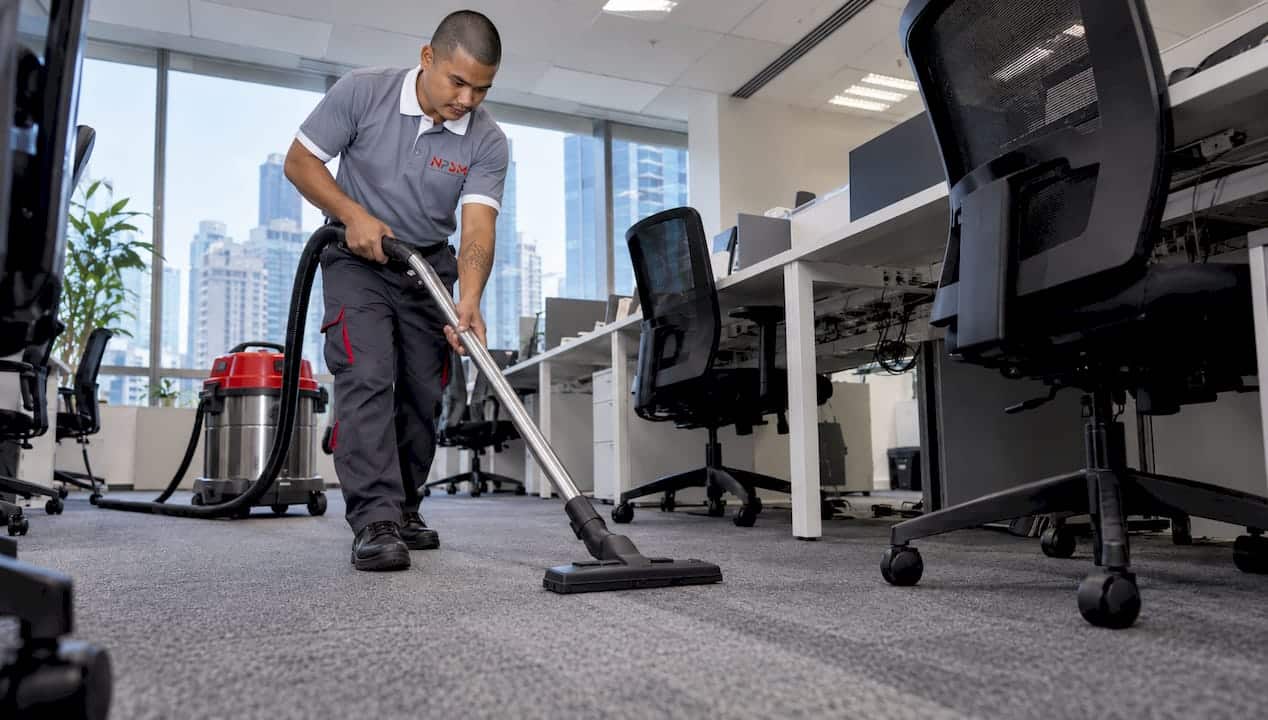
Small offices usually do best with daily outsourced cleaning, because the cost stays predictable and nobody has to manage a cleaner. Mid-size sites can go either way, depending on how much supervision you can spare. Large, complex facilities often need on-site staff, ideally supplied and verified by a managed provider. Below we compare operations, costs, procurement criteria and the switch itself.
TL;DR:
In house staffing becomes easier to justify as headcount and floor space grow, especially when facilities need daytime coverage and managers can supervise staff.
Small sites may face outsourced minimum fees; a Dubai mainland cleaning license alone typically costs AED 12,000 to AED 18,000, excluding rent and visas.
Complex sites with marble floors, server rooms, or HVAC systems often need specialist cleaning capability, so verify a provider’s experience before assigning the work.
Require a written service agreement with measurable KPIs, reporting schedules, penalties, attendance checks, escalation steps, and a clear plan for covering staff absences.
Before switching, audit access and high risk areas, run a pilot, activate attendance checks on day one, and briefly overlap with current cleaners.
Specializedcleaning
Keep Your Dubai Office Clean
Specializedcleaning provides professional cleaning for commercial spaces, with experienced staff and specialized equipment for complex cleaning needs.
How do daily outsourced cleaning and in-house janitors differ day to day?
The core difference is who carries the responsibility for consistency. With outsourcing, a provider schedules the crew, supplies the equipment and answers for the result. With an in-house janitor, your own team does all of that.
Daily outsourced cleaning typically covers:
Scheduled daily visits, usually before or after office hours
Surface cleaning, floors, restrooms and pantry areas
Waste removal and high-touch disinfecting of door handles, switches and shared devices
Periodic add-ons such as carpet shampooing or deep cleans, booked as needed
Dedicated janitorial staff typically provide:
A constant on-site presence during working hours
Immediate response to spills, restroom issues and visitor-facing mess
Flexible, multi-task duties, from restocking supplies to moving furniture
A direct liaison with your facilities or admin team
Reliability is enforced differently. A strong outsourced contract rests on a clear service level agreement (SLA). Procurement experts note that consistency is the primary KPI and that providers using workforce management tools, such as GPS clock-ins and digital cleaning checklists, are more likely to win and keep B2B contracts. With in-house staff, reliability comes from your own supervision, attendance records and HR controls.
For background on how the two terms are used in practice, this explainer on janitorial versus cleaning services is a useful read. Which model wins depends on your priorities: outsourcing favors flexibility and continuity when someone is sick or on leave, while in-house staff favor security control and instant, informal responsiveness.
What does each model really cost you?
Budget the full set of line items, not just the salary or the monthly fee.
In-house cost items:
Salaries and statutory benefits
Visas and work permits
Recruitment and HR overhead
Uniforms, training and PPE
Insurance
Cleaning equipment and consumables, unless your contract bundles them
Outsourced cost items:
A monthly or per-visit contract fee
Minimum service fees for small sites
Add-ons such as deep cleaning, carpet shampooing or floor polishing
If you were to set up your own commercial cleaning operation instead of hiring either option, the licensing alone is a real number. The Department of Economy and Tourism says:
A mainland commercial cleaning license underactivity code 8121typically costs AED 12,000–18,000 to set up, before any office lease or visa costs.
That figure matters mainly as a reminder of what a provider carries on its books, and why a reputable one must be properly licensed before you sign.
Scale changes the math. One cleaner in a small office is a full salary, visa and supervision burden for a job that may only need a few hours of actual work. A provider spreads those same overheads across many sites and many staff. As your headcount and floor space grow, in-house costs become easier to justify, particularly when you need staff on-site all day. For most small and mid-size offices, outsourcing gives better unit economics and a number you can forecast.
We publish no fixed prices for our office janitorial contracts, because the right quote depends on floor area, visit frequency and scope. Ask us for a site-specific figure.
How do you choose between them?
Match the model to your business size, facility complexity, security needs and the budget certainty you require. Marble floors, server rooms and HVAC-heavy buildings push you toward specialist capability, which is easier to buy than to hire.
When you assess an outsourcing provider, ask:
Which SLA metrics will you commit to, and how are they measured?
How often will you report, and in what format?
How do you verify that staff were on site (GPS clock-ins, digital checklists)?
What escalation path and penalty clauses apply to missed standards?
Who covers absences, and how fast?
Well-structured contracts, according to industry guidance, define specific KPIs, penalty structures for missed standards and clear reporting procedures.
If you lean toward in-house hiring, check your supervision plan, payroll and compliance setup, recruitment timeline, and the full cost of benefits and visas.
Pro Tip:Compare each provider or option on SLA clarity, verification tools, reporting, escalation and cover for absences. Require the SLA, reporting cadence and penalty clauses in writing before you sign.
A handover goes best when you audit first, pilot second and commit last.
Audit the current setup. List the scope, inventory, access and security rules, and high-risk areas such as server rooms and HVAC zones.
Survey the site. For outsourcing, the provider walks the premises and drafts the SLA with you.
Run a pilot window. A trial period is sensible for a standard office. Complex sites may need longer.
Switch on verification. Turn on GPS clock-ins, digital checklists and your reporting cadence from day one.
Finalize the paperwork. Sign the contract only after the pilot meets the agreed standards.
Overlap, then hand over. Keep your current cleaners or janitor in place for a short overlap so nothing is missed.
Going the other way, hiring in-house takes longer. Allow time for recruitment, induction, training, PPE, payroll setup and visa processing before your first cleaner starts. Our daily janitorial checklist for commercial offices is a handy baseline for what the daily routine should cover during the pilot.
Where we land on the decision
In our view, the tipping point is rarely the monthly price. It is whether you want to manage people or manage outcomes. Once a site needs cover for absences, specialist work such as HVAC duct or data center cleaning, or consistency across more than one location, outsourcing to a managed provider is the pragmatic route. Buying a verified result beats supervising a headcount. Our staff and specialist teams are built for exactly that situation.
— Qadir
Ready to compare a managed daily service with your current setup?
We provide office janitorial cleaning services alongside office boy and girl supply, deep cleaning, floor restoration, HVAC duct cleaning and data center cleaning. Contact us to discuss our staff credentials and scheduling options. Book a free consultation and site survey, and we will map your daily scope, SLA and verification method so you can compare it line by line with an in-house hire.
FAQ
Is janitorial the same as commercial cleaning?
Not exactly. Janitorial usually means ongoing upkeep of a building, often with staff on site, while commercial cleaning is a broader term that also covers one-off and specialized jobs. In practice, providers often combine both under one contract.
Is daily office cleaning effective for hygiene?
Yes, when the scope includes restrooms, shared surfaces and high-touch points, and when the provider verifies attendance and reports on standards. Consistency matters more than the number of hours, so a clear checklist and regular reporting are the real safeguards.
When does hiring dedicated janitorial staff make more sense?
It makes sense when you need a constant on-site presence, immediate response to issues and tight security control, and you have the supervision capacity to manage the person. Large facilities with all-day foot traffic are the usual fit.
What should an office cleaning SLA include?
At minimum, it should define specific KPIs, reporting procedures and penalties for missed standards, as industry guidance describes. Add verification methods such as GPS clock-ins or digital checklists, and a clear escalation path.