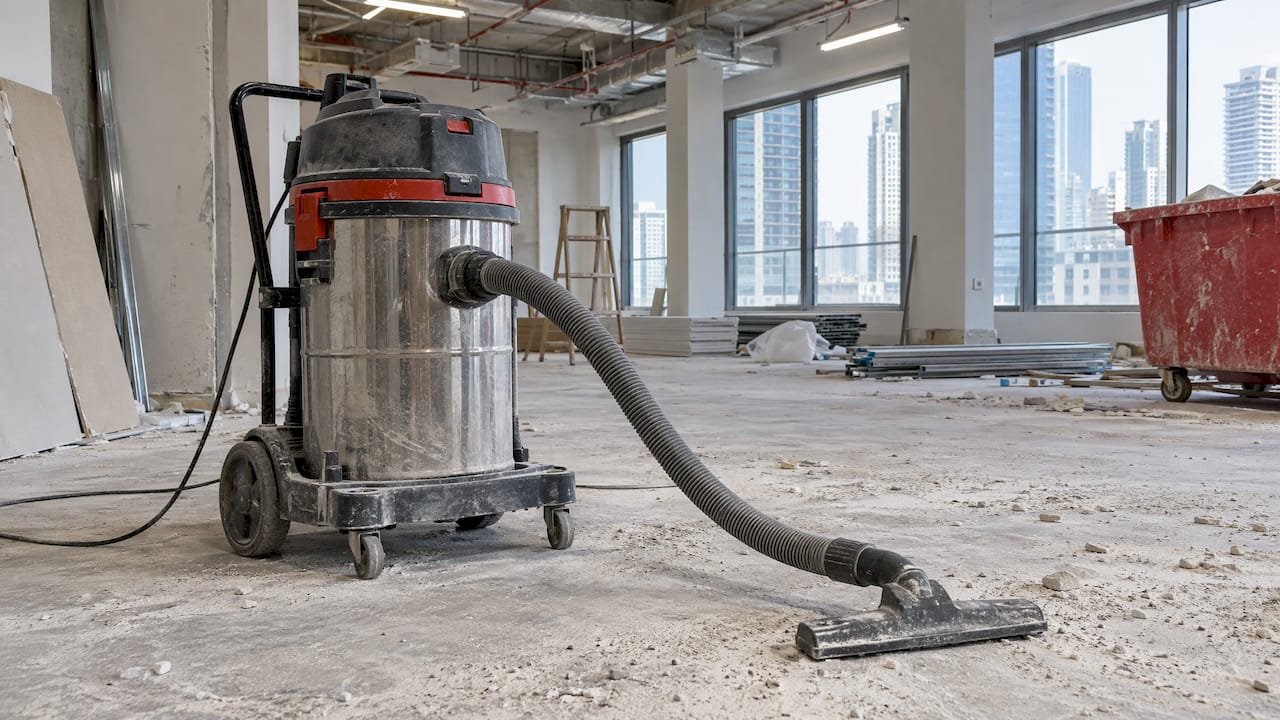
A proper post construction clean needs more than a mop and a bucket. The core kit is an M or H class industrial vacuum for fine dust, a floor scrubber and buffer, a wet-dry vacuum, a carpet extractor, a steam cleaner, soft non-scratch tools for finished surfaces, heavy-duty debris containers and respiratory protection. Each item has a job in a set order, and using the wrong one is how new marble gets scratched and fine dust ends up back in the air conditioning.
This guide covers what each piece of equipment does, which phase it belongs to, what to use on delicate finishes, and what Dubai sites add to the picture. It is written for homeowners finishing a villa fit-out, contractors handing over a unit, and property managers preparing apartments for tenants.
Specializedcleaning
Prepare Your Dubai Property for Handover
Specializedcleaning provides professional cleaning for residential and commercial spaces, including post-construction cleaning in Dubai.
Post construction cleaning runs in three phases (rough, light, final). Each phase needs different machines, so one vacuum or one mop is never enough.
Fine construction dust needs an M or H class extraction vacuum. Ordinary household vacuums blow it back into the room.
Finished surfaces (glass, stone, wood, vinyl, stainless steel) need soft, non-scratch tools, plastic scrapers and the correct pad for each one.
Respiratory protection, gloves and eye protection are part of the equipment list, not an extra.
In Dubai, debris must go to approved disposal sites, and handover deadlines make a trained crew with its own equipment the practical choice for most projects.
A professional crew typically arrives with machines in four groups. The list below follows the equipment named by NCCER, a construction education body, which includes a floor scrubber, buffer and sweeper, a professional vacuum cleaner and carpet extractor, a steam cleaner, a high-pressure washer, heavy-duty trash bags and containers, microfiber cloths and PPE, plus a large dumpster for leftover debris.
Remove paint, silicone and plaster from finished surfaces
Deep clean
Microfiber cloths and lint-free rags
Final wipe-down of glass, joinery and fixtures
All phases
Ladders and step stools
Reach ceilings, vents, light fittings
Deep clean
PPE
Protect the crew
All phases
Debris removal tools: the rough clean
The first pass has one aim: get bulk material off the site before anyone touches fine dust. Wood offcuts, bricks, plasterboard, cable ends, cardboard and packaging go into heavy-duty bags and containers, and larger volumes into a skip or dumpster. Brooms, shovels, rakes and wheelbarrows do this job. Sweeping dry dust with a broom alone is a mistake, because it throws the finest particles into the air.
The Dubai Municipality and local health authorities recommend controlling construction dust by damping down with water spray and using tools like rakes, shovels, and buckets or wheelbarrows to remove larger debris, followed by an M or H class extraction vacuum for finer dust. This approach aligns with best practices to minimize airborne dust and protect indoor air quality: wet or extract, do not dry sweep.
In Dubai, where the debris goes matters as much as how it is lifted. Local Order No. 11 of 2003 on public health requires construction and demolition debris to be disposed of only at approved sites. A crew with its own transport and disposal arrangement saves you from dumping questions at handover.
Dust extraction: the most important machine on the job
Construction dust from cutting, sanding, grinding and plastering is very fine. It settles on every horizontal surface and drifts into ducts. The machine that handles it is an industrial vacuum with a certified filter class, not a household unit.
M class and H class: which one
Kärcher explains that M and H class vacuums are used for moderately or highly hazardous dust, such as concrete dust, and that these units monitor airflow. A UAE equipment supplier, notes that M class works well for many general tasks, but H class is the safer choice when concrete and masonry are routinely ground, chased or cut, because the silica fraction is ultra-fine. It adds that many UAE contractors keep M class units for general cleanup and use H class for high-dust trades.
A practical rule for your project:
Light fit-out or cosmetic renovation (paint, fixtures, tiling touch-ups): M class is generally suitable for cleanup.
Structural work, core drilling, grinding or demolition: H class extraction is the safer choice.
What to look for in an extractor
Specifications give a sense of what site-grade equipment looks like. Hilti UAE lists its VC 40L-X dust extractor with a 30 L tank, 74 l/s motor airflow and 24.5 kPa maximum vacuum, made for wet and dry jobsite cleanup. Safatco also recommends HEPA filters for the smallest particles, multi-stage filtration (pre-filter, main filter, HEPA) to extend service life, cyclonic separators for heavy grinding and sealed bagging to limit puff-back when disposing.
Kärcher adds that extraction units work best when placed as close as possible to the source of dust, for example on a power tool. For a cleaning crew arriving after the trades have left, the equivalent is to vacuum from the top down, ceilings and ledges first, floors last.
Floor scrubber: applies solution, brushes and recovers the dirty water in one pass. It suits large hard floors in offices, warehouses, retail units and lobbies, and clears the grout haze and cement film left on tile.
Floor sweeper: for big open areas such as warehouses and car parks, where it collects loose dust before scrubbing.
Buffer or burnisher: restores sheen after scrubbing, relevant for polished concrete, vinyl and resin finishes.
Carpet extractor: used on fitted carpets and rugs, where dust works deep into fibers. Our carpet cleaning guide for Dubai explains the process in more detail.
Marble, wood and heavily stained stone are a different job. They often need diamond pads, polishing compounds or restoration, not just scrubbing, which is why floor restoration and polishing is often booked after the main clean.
Tools for glass, fixtures, vents and finished surfaces
This is where the wrong tool causes permanent damage. Each surface has a safe tool and a risky one.
Glass and mirrors: a plastic or fresh-blade scraper held flat removes paint splatter and sticker residue, followed by a squeegee and microfiber cloth. Steel wool and abrasive pads leave scratches that are visible in sunlight.
Stainless steel and chrome fixtures: soft cloths and detail brushes for hinges, taps and handles. Avoid abrasive powders on brushed finishes.
Window frames and tracks: a vacuum with a brush or crevice attachment first, then damp cloths. Dubai dust and construction dust mix into a paste if you wet the track first.
Painted walls and joinery: extension dusters and dry microfiber for dust, then a barely damp cloth. Too much water swells wood and lifts fresh paint.
Kitchen cabinets and wardrobes: soft brush attachments for inside corners, then a damp wipe of each surface.
Tile and grout: soft-bristle brushes, a steam cleaner and a pH-appropriate cleaner, applied after dry dust removal.
Light fittings and ceiling fans: ladders or step stools, plus a vacuum with a soft brush, before wiping.
Vents and grilles: vacuum with a brush head and wipe covers. Ductwork itself needs specialist cleaning, covered under HVAC duct cleaning.
Cloths matter more than most people think. Lint-free cloths and industrial wiping rags get used in the rough, light and final phases alike, because a fresh cloth per surface type stops grit from one area scratching another. Change cloths often, and keep separate sets for glass, bathrooms and wood.
PPE: the equipment that protects the crew
Dust, solvents and sharp debris make protective gear part of the kit. Respiratory protection comes first. The HSE says that, for site cleaning of construction dust, RPE with an assigned protection factor of 20, such as an FFP3 disposable mask or a half mask with P3 filter, may be needed. A basic paper mask does not meet that level.
Beyond respirators, a standard kit includes:
Safety glasses or goggles
Chemical-resistant gloves for cleaning agents and disinfectants
Safety boots with protective toecaps
High-visibility vests on active sites
Hard hats where trades are still working overhead
If you are cleaning your own property with workers still on site, ask the contractor which areas are safe to enter. Anyone with asthma, a lung condition or allergies should stay out of the space until the rough clean and extraction are complete, and speak to their doctor about re-entry.
The order equipment is used in
Sequence protects your investment. Cleaning wet before dry work is finished means dust turns to mud, and polishing floors before ceilings are cleaned means doing them twice.
Rough clean. Bag and remove debris, damp down, then use the industrial vacuum on floors, ledges and surfaces. Work high to low.
Light clean. Use a wet-dry vacuum for slurry and residue, remove paint, plaster and silicone with scrapers, and wipe windows, frames and fixtures.
Settling time. NCCER says deep cleaning is best done at least a day after the rough clean, and that the final touch-up is best several days after the deep clean, because dust takes about a week to settle after construction ends.
Deep clean. Vacuum air vents, scrub and sanitize sinks, taps and toilets, scrub tile paying attention to grout lines, and wipe scuffs, paint and plaster from hinges, floors and walls.
Final clean. Floor scrubber or buffer, carpet extraction, glass polishing and a last dust of every surface before handover.
If a snag list means tradespeople will return, schedule the final clean after that work, or expect a second visit.
Dubai site conditions that change the equipment you need
Several local factors shape the kit.
Fine desert dust. Dubai air already carries dust, so a space that is cleaned and then left with open doors or running AC picks it up again. Seal the area and keep contractors out after the final pass.
Large glass and high ceilings. Villas, lobbies and towers often need ladders, scaffolding or access platforms for glazing and double-height spaces.
Marble, porcelain and imported stone. Common in Dubai homes and offices, and they are sensitive to acidic cleaners and abrasive pads.
Healthcare and sensitive sites. The Dubai Health Authority guidance on construction and renovation in health facilities recommends negative pressurization of the construction zone to stop dust entering clinical areas, and controlled access limited to people who have had site induction. Cleaning there needs sealed extraction equipment and trained staff.
Debris disposal. As noted above, construction and demolition debris must go to approved sites under Dubai’s public health order.
For offices and shared buildings, our page on building cleaning services explains how we handle common areas, lobbies and external glazing.
Our perspective
Most handover problems we see come from the wrong sequence, not a lack of effort. A crew that wipes before extracting fine dust leaves a film on every surface, and one that uses an aggressive pad on new stone leaves marks that need restoration.
At NPSM Specialized Cleaning Services we bring the equipment, the trained staff and the order of work together. Our teams are licensed and insured, we offer free consultations, and we can schedule same-day when a handover date is close. With more than 15 years in Dubai, we have cleaned villas, apartments, offices and warehouses after fit-outs, and the lesson is consistent: match the machine to the surface, and match the clean to the stage of the project.
If you are weighing buying or renting machines against hiring a crew, consider what you are really buying: not the vacuum, but the experience of knowing when to use it.
Qadir
How we can help with your handover
We provide post construction cleaning for villas, apartments, offices and warehouses across Dubai, with deep cleaning, move-in and move-out cleaning, floor polishing and HVAC duct cleaning available alongside it. Our teams arrive with their own equipment, and a free consultation lets us look at your space and plan the phases.
Choose a full professional crew if you have a handover date, a large or multi-floor property, delicate stone or wood floors, or dust from structural work.
Choose a targeted clean if the work was cosmetic, such as painting and fixture replacement, and you need only a deep clean and a final polish.
Add HVAC duct cleaning if the AC was running during construction or ducts were left uncovered, since dust can settle inside them.
Add floor restoration if floors show cement film, scratches or dull finish that scrubbing does not remove.
FAQ
What equipment is needed for post construction cleaning?
The core kit is an M or H class industrial vacuum, a wet-dry vacuum, a floor scrubber and buffer, a carpet extractor, a steam cleaner, scrapers and non-scratch pads, microfiber cloths, ladders, debris containers and PPE. Large sites may add a sweeper and a pressure washer for exterior areas.
Can I use a household vacuum after renovation?
It is not a good idea. Household vacuums are not built for fine construction dust, and many blow the smallest particles back into the room. Industrial vacuums with M or H class filtration are designed for this dust, and professionals use them for that reason.
How long after construction should the final clean happen?
NCCER says dust takes about a week to settle after construction ends, so the final touch-up works best several days after the deep clean. Your timing also depends on whether tradespeople are returning for snag items.
Do I need a pressure washer?
Only for exterior areas such as terraces, balconies, driveways and some façades. Interiors use scrubbers, steam cleaners and extraction vacuums, because high-pressure water can damage finished surfaces and joinery.
Is it better to buy equipment or hire a crew?
For a single project, hiring a crew generally means you avoid buying several machines, finding the right filter class, and handling debris disposal. A crew also knows the right tool for each surface, which protects new finishes.