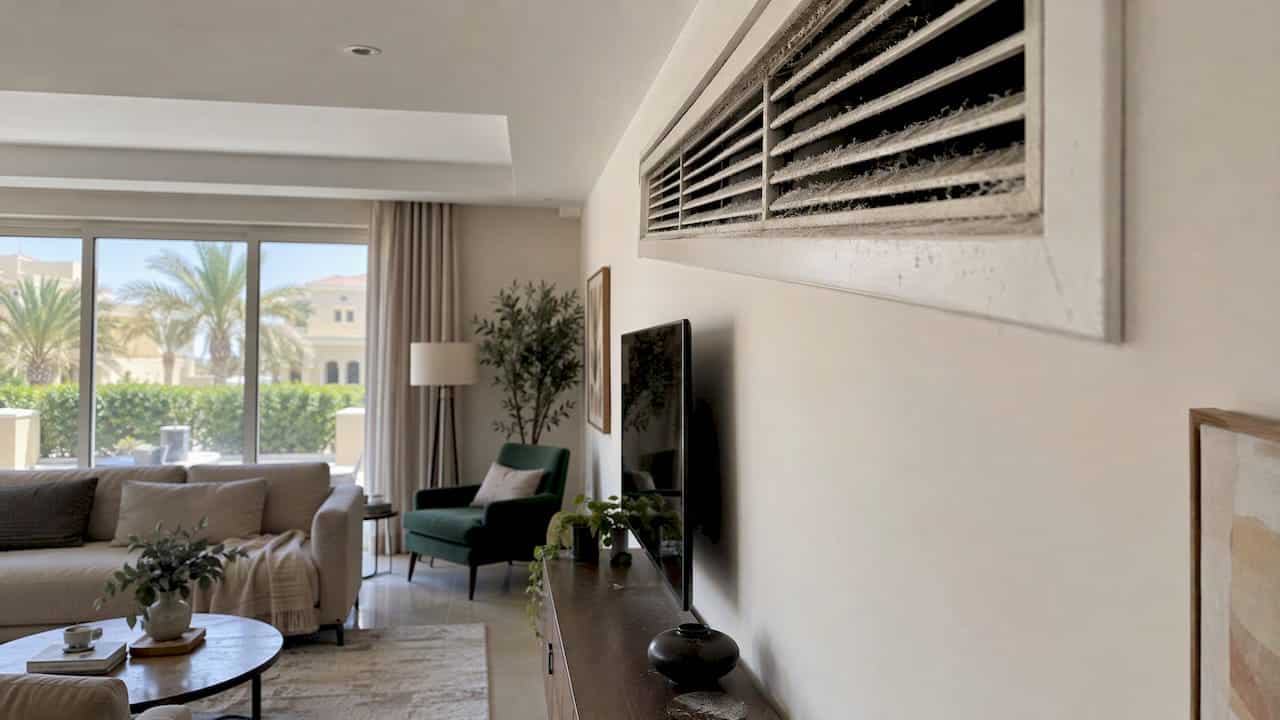
Dust blowing out of AC vents in Dubai usually comes from one of six places: a clogged filter, a dirty grille, a coated cooling coil, contaminated ductwork, leaks that pull in outside air, or renovation debris that never left the system. In a desert city with constant fine sand, heavy cooling use and a lot of building work, all six are common. The fix depends on which one you have, so the first job is to find the source.
This guide walks through each cause, shows how to tell them apart from what you see and when you see it, and explains when a vent problem is a cleaning job and when it needs a proper duct inspection.
Specializedcleaning
Clear Dust at Its Source
Specializedcleaning provides HVAC duct cleaning in Dubai, using specialized equipment to address dust and support indoor air quality.
Dust from vents comes from the filter, grille, coil, ducts, air leaks or renovation debris. Check the cheap, visible causes first.
Dubai Municipality’s indoor air quality guidance names weak filtration, poor filter upkeep and moisture in the system as the conditions that let dirt and biological growth build up.
Black marks around a vent do not prove mold. Location patterns, an inspection and lab testing tell you more than color.
Dust that appears right after fit-out or handover points to construction debris inside the ducts, not ordinary household dust.
If cleaning filters and grilles does not stop it, book a duct inspection before a full clean.
Dubai Municipality’s Indoor Air Quality Technical Guidelines, issued on 10 July 2024, list three possible sources of indoor dust: contaminated outdoor air, indoor sources and the HVAC system itself. In practice all three act at once here.
Outdoors, the load is high. Sand is always in the air, and construction adds cement dust and gypsum. Indoors, air conditioners run for most of the year, so a system moves a very large volume of air through the same filters and coils day after day. Anything that gets past a weak filter ends up on the coil and the duct walls, and then comes out of the vents.
The same guidelines note that dirt in ventilation systems, combined with poor water management, can cause biological growth and serious indoor air quality problems. The conditions they point to are inadequate particle filtration, poor filter maintenance and moisture from cooling-coil condensate. Dubai’s humidity and the cold surfaces inside an AC system make that last one a real local issue.
The six common causes, from easiest to hardest to fix
1. A clogged or worn-out filter
The filter is the first line of defense, and the most common culprit. A loaded filter restricts airflow. Dubai Health Authority engineering guidance for healthcare facilities warns that dirty intake filters clog the airstream, raise pressure drop and cut air volume. The same logic applies to a split unit in a flat or a ducted system in a villa.
What it looks like:
Dust shows up on furniture within a day or two of cleaning.
Airflow from the vent feels weaker than it used to.
The filter looks gray or furry when you pull it out.
A torn or badly fitted filter lets dust straight around the edges.
What to do: wash or replace the filter as the unit’s manual directs, and check it more often in summer and after sandstorms. We suggest looking at it monthly, because a quick glance costs nothing.
2. Dust on the grille itself
Sometimes the dust you see is not coming from the system at all. Supply grilles and diffusers collect a layer of dust over time, especially around the slats. When the AC starts, airflow lifts some of it into the room.
A simple test: wipe the grille with a damp cloth, switch the AC on and watch. If the dust returns within days, the source is further inside. If it stays clean, the grille was the whole story. This is why many contractors advise cleaning grilles and filters first, then deciding whether duct work is needed.
3. A dirty cooling coil
The evaporator coil is cold and wet in operation, which makes it a sticky surface for anything the filter misses. Dust holds to the damp fins and builds into a layer that restricts airflow and sheds particles. Coil buildup often comes with a musty smell, weaker cooling or water dripping where it should not.
The Dubai Health Authority guidance goes further for healthcare buildings: it encourages UV-C light to help avoid fungal growth on cooling-coil surfaces. That is a healthcare design requirement, not a rule for homes, but it shows how seriously coil moisture is treated. Coil cleaning belongs to routine AC servicing, not to duct cleaning, which is a point many tenants mix up. Our guide on annual AC maintenance versus duct cleaning explains where each job starts and stops.
4. Contaminated ductwork
If the filter, grille and coil are clean and dust still comes out, the ducts are the next suspect. Over years, fine dust settles on the inside walls, binds with humidity and sheds back into the airstream. Flexible ducts, long runs in villas and ducts above ceilings in offices all collect more.
Signs that point to the ducts:
Dust returns quickly after cleaning the room.
Several vents across the property show the same problem, not just one.
You see dust puffs when the AC first starts.
Rooms at the far end of a duct run get weak airflow.
Visible debris or dark streaking inside the vent opening.
Air follows the path of least resistance. The National Air Duct Cleaners Association notes that leaky filters or ducts can let contaminants into HVAC systems. In a ceiling void, a loose joint or an unsealed return pulls in whatever dust is up there: construction residue, insulation fibers, sand that came in through gaps.
This cause is easy to miss because the filter can be spotless and the vents still dusty. Return air paths that draw from dusty plenums or storerooms are a classic example, particularly in older offices and in villas where ceiling voids were never fully sealed.
Sand also enters the building itself. Worn window seals, door gaps and balcony frames let it in, and the AC pulls it into the return. Sealing these gaps cuts the load on every filter you own.
6. Renovation and construction debris
This is the cause that explains sudden, heavy dust. Building work fills the air with cement dust, gypsum and fine sand. If the AC runs while work is going on, or if the vents were not covered, the debris goes straight into the ducts and sits there.
Dubai’s Green Building Regulations (item 401.02) require HVAC openings to be protected during construction and renovation, with temporary filters if the system must operate. In reality, many fit-outs skip this, and the first people to find out are the new tenants. Dust then keeps appearing for weeks after a deep clean of the rooms.
Timing and appearance narrow the cause quickly. Use this table as a first diagnosis.
What you notice
Most likely cause
First action
Dust on the grille only, wipes off clean
Grille buildup
Wipe grilles, monitor for a week
Weak airflow, gray filter
Clogged filter
Clean or replace the filter
Musty smell, weak cooling, dust plus dampness
Dirty coil, moisture
Book AC servicing
Dust puffs at start-up, many vents affected
Duct contamination
Duct inspection
Filter clean but vents dusty
Duct leaks, return air issues
Inspect ducts and ceiling void
Heavy dust after fit-out or handover
Construction debris in ducts
Post-construction duct and room clean
Dust after a sandstorm
Sand through gaps and intakes
Seal gaps, change filter
Dark dust and black marks around vents
Black streaks or dark powder around diffusers worry people, and mold is the usual fear. The reality is more nuanced. UL Solutions explains that black particles near a diffuser do not prove the HVAC system is the source. They may come from occupants, or from mold, rust or insulation. Only laboratory analysis can confirm whether a material is mold.
The practical approach is to establish whether the HVAC system is actually the source before assuming anything. Look at where the marks appear (only on ceiling diffusers near a cold spot, or everywhere), inspect the components, check the maintenance history and, if the question matters, have a sample identified. Color alone is not reliable.
A few things justify a faster call to a professional: a musty smell, visible dampness inside a duct or at the unit, or anyone in the home or office with breathing problems that worsen indoors. In that case speak to a qualified HVAC contractor and, for health concerns, your doctor.
Homes and offices face different problems
Villas have long ducted runs, ceiling voids and often a lot of renovation history. Dust usually builds inside ducts and at return grilles. Many villas have never had their ducts opened since handover.
Apartments often run split units or fan coil units, where the filter and coil are the main suspects. Shared risers in chilled-water buildings can add odors and dust from elsewhere in the building.
Offices run longer hours, with more people, paper and carpet fibers in the air, and frequent fit-out changes. A tenant-led partition move can send debris into ceiling plenums. Offices also often have a landlord responsible for central plant and a tenant responsible for fan coil units, so it pays to know who owns which part before you call anyone. Facility managers should keep a written record of filter changes and cleaning dates.
What Dubai’s rules say about inspection and cleaning
Two requirements in Dubai’s Green Building Regulations matter to owners and managers:
Item 401.08 requires HVAC systems and equipment in new and existing buildings to be inspected and cleaned according to approved standards.
Item 503.02 requires buildings with a cooling load of 2 MW or more, excluding villas, to re-commission their ventilation and air conditioning systems at least once every five years.
The same document also sets a maximum for respirable dust (under 10 microns) of 150 micrograms per cubic meter in public, commercial and educational buildings. Dubai Municipality’s indoor air guidance covers indoor environments in buildings, including residential buildings and office premises, with some stated exceptions. So for an office, regular inspection is not just good practice: it is tied to the building’s compliance duties. All of these are found in the Green Building Regulations and Specifications.
A step-by-step way to find the source
The Dubai Municipality guidelines suggest an investigation approach: collect building and HVAC history, inspect the space and the system, then form and test hypotheses. At home you can follow the same logic.
Note the history. When was the last renovation, AC service and filter change? Has anything changed recently, such as new tenants, new furniture or building work next door?
Clean the visible parts. Wash the filter, wipe the grilles with a damp cloth and vacuum around the unit.
Watch for a week. If the dust returns on a clean grille, the source is inside.
Check the coil and drain. Ask your AC technician to inspect the coil, drain pan and blower during a service.
Inspect the ducts. A camera inspection shows duct condition without guessing.
Decide. Clean only what the inspection shows needs cleaning.
The options for dusty air vents and how to fix them are laid out clearly in this separate guide if you want a second walkthrough of the steps.
How to keep dust out of the vents
Prevention is cheaper than cleaning. These steps help in Dubai conditions:
Clean or replace filters regularly, and more often in summer and after dust storms.
Seal gaps around windows, doors and balcony frames.
Use entry mats inside and outside the main door to trap sand.
Vacuum with a HEPA-filter vacuum rather than sweeping, which puts fine dust back into the air.
Wipe surfaces with a damp cloth.
Cover supply and return openings during any building or renovation work, and ask contractors in writing to do it.
Arrange regular professional AC maintenance and inspect ducts when symptoms appear.
Avoid closing too many vents, which can disturb airflow and pressure.
How often should ducts themselves be cleaned? There is no single number that fits every property. Our article on duct cleaning frequency explains why inspection should come first, with one to two years as a baseline rather than a rule.
Our perspective: inspect first, then clean what needs cleaning
We have been cleaning homes, offices and technical spaces in Dubai for over 15 years, and the pattern is consistent. Most complaints about dusty vents start with something simple, a spent filter or a dirty grille, and a smaller share trace back to the ducts. The mistake we see most is jumping to a full duct clean without checking, or the opposite, replacing filters for years while the ducts carry builders’ dust from a handover nobody cleaned properly.
Our approach is to look first. We offer a free consultation, our staff are licensed and insured, and we can often schedule the same day. If the inspection shows the ducts are fine, we say so. If it shows heavy debris, we explain what we found and what the cleaning will involve. For offices and property managers, we also build duct and filter checks into regular janitorial and facility schedules, so dust never gets to the point where tenants complain.
One more point from experience: do not treat dust as a cosmetic matter. Equipment suffers too. Dust on coils and in blowers makes a system work harder, which is a cost problem as well as an air quality one.
— Qadir
When to call a professional
Book an inspection if any of these apply:
Dust keeps returning after you clean filters and grilles.
The property was recently built, renovated or handed over.
Airflow is weak in some rooms and normal in others.
You can see debris or dark growth inside vents.
There is a musty smell that does not go away.
You manage an office or building and need documented maintenance for compliance.
If the AC is still under a landlord’s or developer’s responsibility, check with the owner or property manager before starting work, since access and approvals can differ.
Get the vents checked by a Dubai specialist
NPSM Specialized Cleaning handles HVAC duct cleaning for homes and commercial spaces across Dubai, from villas to offices and data rooms. We start with a free consultation so you know what is in the system before you decide.
Why is so much dust coming out of my AC vents in Dubai?
The usual causes are a clogged filter, dusty grilles, a dirty coil, contaminated ducts, air leaks or leftover construction debris. Dubai’s constant fine sand and heavy AC use make all of them more likely. Start with the filter and grilles, then look at the ducts if the dust returns.
What are the signs that my air ducts are dirty?
Common signs are dust that returns quickly after cleaning, dust puffs when the AC starts, weak airflow, visible debris inside vents and a musty smell. Seeing the same problem at several vents points to the ducts rather than one grille. A camera inspection confirms it.
Is black dust around AC vents always mold?
No. Dark particles can come from occupants, rust, insulation or mold, and only laboratory analysis can confirm mold. Check where the marks appear, inspect the system and get a sample tested if there is a smell or dampness.
How can I stop dust coming through my AC vents?
Keep filters clean, seal gaps around windows and doors, use entry mats, vacuum with a HEPA filter and cover vent openings during renovation. If the dust persists, have the ducts and coil inspected, since cleaning the room alone will not remove dust that sits inside the system.
Do Dubai regulations require AC and duct cleaning?
Dubai’s Green Building Regulations require HVAC systems in new and existing buildings to be inspected and cleaned according to approved standards. Larger non-villa buildings with a cooling load of 2 MW or more must also re-commission their systems at least once every five years. Ask your property manager which duties apply to your building.