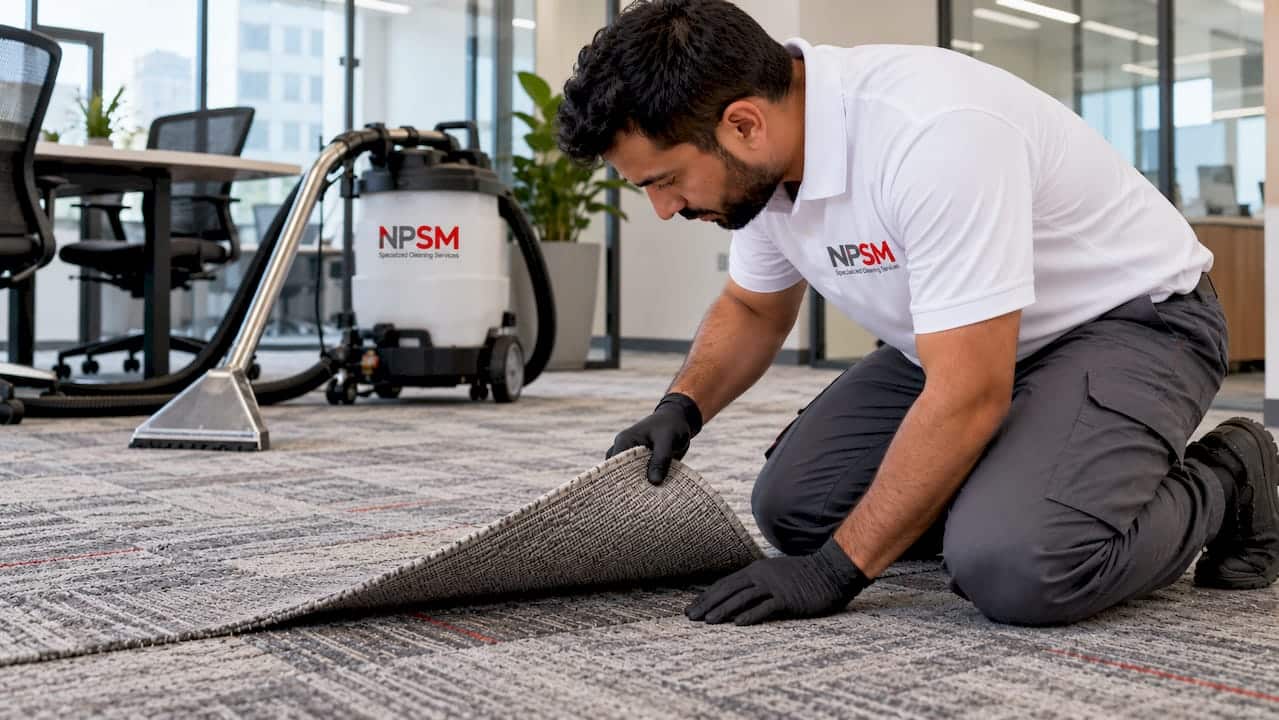
Most carpets in offices and commercial spaces dry in about 6 to 12 hours after professional shampooing under good indoor conditions, with the most effective step being immediate control of air movement and humidity. Thicker pile, wool fibers, or high indoor humidity can extend drying to 12 to 24 hours, while heavily saturated carpets from leaks or floods may require 24 to 72 hours or longer. Running your HVAC system or a dehumidifier and positioning fans for cross airflow right after cleaning is essential to speed up drying in commercial environments.
TL;DR:
Low moisture methods can leave carpet fully dry within 6 to 12 hours, while hot water extraction may take 6 to 24 hours.
The surface may be safe for walking before the backing and pad dry, but keep furniture off until every layer is fully dry.
Use two fans at opposite ends of the room, run air conditioning or a dehumidifier, and keep windows closed when outdoor air is humid.
Federal guidance recommends drying wet materials within 24 to 48 hours to reduce mold risk; persistent dampness or musty odors warrant professional assessment.
Ask cleaners how many dry passes they make and what residual moisture their equipment leaves, because the pile can feel dry while padding remains wet.
Specializedcleaning
Keep Carpet Care Thorough
Specializedcleaning provides professional cleaning for homes and businesses in Dubai, including solutions for complex cleaning challenges.
Typical Drying Times and What “Dry” Actually Means
Drying time depends heavily on the cleaning method and the carpet itself, so a single number rarely tells the whole story. Low-moisture methods leave carpet surface dry within 2 to 6 hours and fully dry within 6 to 12 hours, which is why encapsulation cleaning has become popular for offices and commercial spaces that need fast turnaround. Traditional hot-water extraction, still the most common professional method, typically dries in 6 to 12 hours under normal indoor conditions, though reports on the full range extend to 6 to 24 hours depending on humidity, airflow, and fiber type.
Wool, thick pile, and carpet in humid rooms often need 12 to 24 hours, and heavily wetted carpet from flooding can take 24 to 72 hours or more.
Surface dry means the fibers feel dry to the touch, but backing and padding can still hold moisture.
Fully dry means the pile, the backing, and the pad underneath have all released their moisture.
Carpet is generally safe to walk on once surface dry, but furniture should wait until it is fully dry to avoid trapping dampness or causing indentation marks.
Padding dries slower than the visible pile, so judging dryness by touch alone can be misleading.
What Determines How Fast Your Carpet Dries
Several variables interact to set your actual drying time, and understanding them helps you diagnose why one job dries in 6 hours while another takes a full day.
Cleaning method and extraction quality: hot-water extraction pulls out more moisture than shampooing but leaves more residual water than encapsulation or bonnet cleaning.
Fiber, pile height, and backing: dense wool carpet holds water longer than low-pile synthetic carpet, and thicker padding beneath it extends drying further.
Indoor humidity and temperature: a cooler, humid room slows evaporation, while warm, circulating air speeds it.
HVAC air changes and outdoor air quality: mechanical ventilation that exchanges indoor air faster helps, but pulling in humid outdoor air can work against you.
Technician technique: the number of dry passes made during extraction and the extractor’s suction settings directly affect how much water remains in the carpet.
A carpet cleaning standard from the Carpet and Rug Institute notes that most residential carpets dry within 6 to 12 hours after extraction when ventilation and HVAC circulation are used properly. That benchmark assumes the technician used an effective number of dry passes and the extractor removed most of the water during cleaning, not just on the surface.
Extraction performance is measurable. The industry’s residual moisture testing method documents how much water different extractors leave behind, which is why asking your cleaner about their equipment and dry-pass count matters more than trusting a surface touch test. Carpet can feel dry at the top while the pad underneath stays saturated for hours longer, especially with thicker underlayment.
How to Speed Up Carpet Drying: Step-by-Step
Cutting drying time comes down to moving air, pulling out humidity, and acting fast in the first few hours. Follow these steps in order:
Blot residual moisture immediately. Use clean white towels to press out surface water right after cleaning finishes, and ask your cleaner for one or two extra dry passes if the carpet feels heavily damp.
Set up fans for cross-flow airflow. Place two or more floor fans at opposite ends of the room, angled to push air across the carpet surface rather than straight down.
Run HVAC or a dehumidifier. Commercial cleaning guidance recommends air movers, HVAC systems, and dehumidifiers to meaningfully cut drying time, especially in humid climates where opening windows can backfire.
Keep windows closed if outside air is humid. Bringing in moist outdoor air slows evaporation more than it helps, so air conditioning or a standalone dehumidifier is usually the better call.
Rent equipment for larger jobs. A wet-vac, additional floor fans, or a dehumidifier rented for 24 hours can resolve a slow-drying room without waiting on indoor climate alone.
Protect furniture legs. Place plastic or foil tabs under furniture legs until the carpet is fully dry, which prevents color transfer and moisture trapping.
Monitor progress by touch, smell, and time. Check for a cool, damp feel or musty odor at the 12-hour and 24-hour marks, and verify the backing and pad feel dry before moving furniture back into place.
Pro Tip:Set your thermostat near 70°F and run two fans with your air conditioning rather than opening a window, since cooler, drier indoor air pulls moisture out of carpet fibers faster than humid outdoor air ever will.
Mold Risk: Why the First 24 to 48 Hours Matter
Standing moisture invites bacterial and mold growth fast, which is why timing matters beyond comfort. Federal guidance on water damage states that drying wet materials within 24 to 48 hours significantly reduces the risk of mold growth. That window applies to carpet just as it does to drywall or furniture.
Watch for these warning signs:
A musty odor that develops or lingers past 24 hours.
Visible mold spots on the carpet surface or along baseboards.
Carpet that still feels damp or cool to the touch after 24 hours.
Standing water or saturated padding from a leak or flood rather than routine cleaning.
When these signs appear, remediation typically involves re-extracting the moisture, pulling back the carpet and pad to dry them separately with air movers and dehumidifiers, and discarding padding that cannot dry fully within that window.
When to Call a Professional and What to Ask
A carpet that stays damp past 12 to 24 hours after routine cleaning, or one that has been soaked by a leak, flood, or burst pipe, is past the point where fans and patience alone will fix it. Soaked padding, a musty smell, or any sign of standing water calls for a professional assessment rather than more waiting.
When you call, ask these questions:
What extraction method will you use, and how many dry passes does the job include?
What residual moisture level should I expect right after the job, based on your equipment?
Will you bring air movers or a dehumidifier, or should I arrange those separately?
What is your plan if the padding or backing stays wet after extraction?
Do you provide a written dry-time estimate, and is a follow-up visit included if the carpet lags behind?
A cleaner who references hot-water extraction procedure and gives a specific dry-time estimate, rather than a vague “it’ll dry overnight,” is giving you something to hold them to.
A Local Perspective on Faster, Safer Drying
Experience shows that jobs that pair thorough extraction with immediate HVAC and air mover coordination dry faster and more evenly than jobs left to air dry alone. Licensed technicians and timely scheduling are important because drying starts the moment cleaning ends, not hours later. Ask about dry-pass details when you book, every time.
Our Take: Stop Trusting the Surface Touch Test
The most common mistake we see is treating a dry-feeling carpet surface as proof the job is done. It isn’t. Padding and backing routinely stay damp for hours after the pile feels fine, and that gap is exactly where musty odors and mold risk start to build. Conventional advice leans too heavily on “just wait it out” or “open a window,” and in a climate where outdoor humidity often works against you, that guidance can actively slow drying rather than speed it.
What actually moves the needle is airflow and humidity control applied immediately, not eventually, paired with a cleaner who tells you upfront how many dry passes they performed and what residual moisture to expect. Readers who prioritize one thing from this article should prioritize that conversation before the job even starts, not troubleshooting after the carpet still feels damp the next day.
— Qadir
How We Handle Cleaning and Managed Drying Together
Drying is treated as part of the cleaning job, not an afterthought left to HVAC systems alone. Carpet shampooing services pair thorough extraction with coordinated air movers and dehumidifiers, and timely scheduling helps us respond quickly when a spill or leak turns into a time-sensitive drying problem rather than routine maintenance.
When you book, ask us directly about our extraction method, expected dry-pass count, and a realistic dry-time estimate for your specific carpet and room conditions. You can review our carpet shampooing services and request a free consultation to get a drying plan built around your space before we ever start.
FAQ
How long does it take for carpet to dry?
Most carpets dry within 6 to 12 hours after professional cleaning under normal indoor conditions. Thicker pile, wool fibers, or high humidity can extend that to 12 to 24 hours, and heavily saturated carpet from flooding may take 24 to 72 hours or longer.
How can I speed up carpet drying?
Run your HVAC system or a dehumidifier and position fans for cross-flow airflow across the carpet surface immediately after cleaning. Keep windows closed if outdoor humidity is high, since mechanical ventilation and dehumidification are usually more effective than fresh air in humid climates.
Does carpet dry faster in heat or cold?
Warm, circulating air generally speeds evaporation more than cold air, though extreme heat without airflow offers little benefit on its own. A moderate indoor temperature paired with fans and air conditioning works better than relying on heat alone.
Why is my carpet still damp after 24 hours?
Carpet that stays damp past 24 hours often has moisture trapped in the backing or padding rather than the visible pile, which a surface touch test won’t reveal. Insufficient dry passes during extraction, high indoor humidity, or thick padding are common causes, and federal guidance recommends addressing wet materials within 24 to 48 hours to limit mold risk.