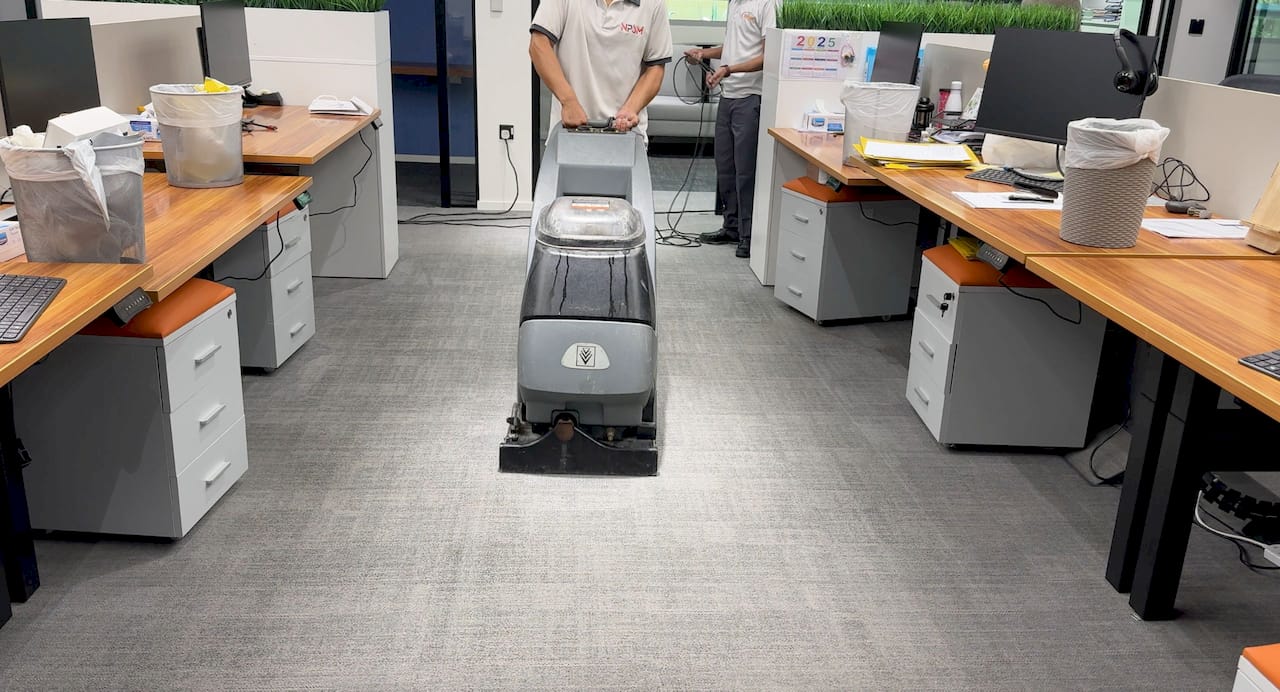
Encapsulation carpet cleaning is a low moisture maintenance method that uses polymer chemistry to trap soils for rapid drying and vacuum removal. It works best as interim upkeep for carpets that need a fast return to service, not as a replacement for periodic deep extraction. Homeowners and facility managers choosing between encapsulation and restorative cleaning get the speed benefit without the downtime, as long as they plan for extraction on a regular cycle.
TL;DR:
Encapsulation works best for routine maintenance in busy areas where quick drying and minimal downtime are priorities, but it cannot thoroughly remove deep-seated soil or grease.
The process relies on polymer solutions that crystallize upon drying, enabling effective vacuum removal of soil without leaving excess moisture or sticky residue.
Proper agitation with orbital or counter-rotating brushes improves soil lift, and solution dilution must follow manufacturer instructions to ensure optimal results.
Routine encapsulation should be scheduled monthly or quarterly in high-traffic spaces, with a deep extraction planned when odors, persistent stains, or embedded grit appear.
Successful long-term carpet care combines regular encapsulation with periodic restorative cleaning and expert equipment, avoiding reliance on encapsulation alone for heavily soiled carpets.
Specializedcleaning
Keep Your Carpets Ready for Use
Specializedcleaning combines experienced professionals and specialized equipment for residential and commercial cleaning challenges in Dubai.
Encapsulation relies on polymer formulas that surround soil particles and leftover detergent residue, then harden them into brittle crystals as the carpet dries. Once crystallized, the residue no longer clings to carpet fibers, so a standard vacuum pass lifts it away instead of grinding it back in. This is the same chemistry referenced in industry guidance on encapsulation cleaning, which positions the method as a low moisture way to extend the time between restorative cleanings.
The mechanical sequence follows a consistent pattern across most jobs:
Pre-vacuum the carpet to remove loose dry soil before any liquid touches the fiber.
Apply the diluted encapsulating solution evenly across the treatment zone.
Agitate the surface with a brush or pad to work the solution into the pile and lift soils.
Dry the carpet, which typically happens quickly because minimal water is used.
Vacuum again once the polymer has crystallized to remove the trapped residue.
Because the process uses a fraction of the water found in steam or shampoo methods, less moisture soaks into the carpet backing and pad. That matters because residue left behind in wetter methods tends to attract new soil quickly, a problem commonly linked to bonnet cleaning when it is confused with true encapsulation, as one trade explainer notes when distinguishing the two approaches.
When encapsulation makes sense, and when it does not
Encapsulation earns its keep in settings where appearance and uptime matter more than deep soil extraction on any given day. Offices, retail floors, hotel corridors and other busy spaces benefit from a method that dries fast and lets staff or guests back on the carpet within the hour.
It is the wrong tool, though, when soils have worked their way deep into the pile or backing. Watch for these signals that the carpet needs extraction instead:
Greasy or oily stains that feel tacky even after a dry pass.
Persistent odor that lingers after vacuuming, suggesting contamination below the surface.
Visible embedded grit that resists normal foot traffic and light agitation.
Carpet that has not been deep cleaned in over a year, which raises the odds of buildup polymers cannot reach.
The chemistry only works as well as the machine and formulation behind it. Entry-level jobs often rely on simple low-speed floor machines, but counter-rotating brush machines agitate more evenly and lift more soil from the base of the fiber. Orbital agitators sit at the top of that range and tend to produce the most consistent appearance results, a point echoed in manufacturer guidance on low moisture encapsulation.
Solution choice matters just as much as the machine. Concentrated polymer encapsulants form the base of most programs, while peroxide-fortified versions add deodorizing power and help lift beverage stains during the same pass. Dilution rates should follow the manufacturer’s label exactly, since over-diluting weakens the crystallization effect and under-diluting can leave sticky residue.
Check the carpet manufacturer’s warranty terms before applying any encapsulant.
Test the solution in a hidden area to confirm colorfastness and compatibility.
Pro Tip:Run a small test patch and let it dry fully before treating the whole room, since some fiber types react differently to concentrated polymer formulas.
A practical step-by-step workflow
A well-run encapsulation job follows a predictable rhythm from prep to finish. This sequence works whether a facility team handles it in-house or a professional crew is brought in.
Vacuum thoroughly and pre-treat any visible spots with a spotting solution before the main application.
Divide the space into zones so no section dries unevenly or gets missed during agitation.
Apply the diluted solution in a light, even spray pattern, avoiding oversaturation.
Let it dwell briefly so the polymer can start bonding with soil before agitation begins.
Agitate with the chosen machine, making enough passes to work the solution through the pile without leaving streaks.
Allow the carpet to dry, which typically takes between 30 and 60 minutes under normal airflow conditions.
Run air movers in larger or less ventilated rooms to speed that window further.
Vacuum once more after the polymer has crystallized to pull up the trapped soil.
This procedural flow matches the standard workflow documented by trade sources, which also note that quick return to service is the main reason facilities choose this method over wetter alternatives.
Pro Tip:Open windows or run HVAC fans during the drying phase. Faster airflow shortens the wait before the space can reopen.
Benefits and limits compared to other methods
Encapsulation’s biggest advantage is speed. Low water use means short dry times, minimal downtime, and lower short-term labor costs compared with wetter restorative methods. The trade-off is depth of clean: encapsulation lifts surface and near-surface soil well but cannot remove what has settled into the backing or padding below.
Encapsulation: fastest dry time, lowest water use, best for surface-level maintenance, limited on embedded soil.
Hot water extraction: slower dry time, higher soil removal from deep in the pile, better for periodic restorative cleaning.
Bonnet cleaning: fast but prone to redistributing rather than removing soil, with a higher resoiling risk if used repeatedly.
Choosing the right method comes down to matching the tool to the job. A carpet that only needs refreshing between scheduled deep cleans is a good encapsulation candidate. One that has not seen extraction in a year or more is better served by a full carpet shampooing or extraction visit.
How often to schedule encapsulation cleaning
Frequency depends heavily on foot traffic. High-traffic commercial spaces, such as lobbies and main corridors, typically benefit from encapsulation on a monthly to quarterly basis. Lower-traffic commercial areas can usually stretch that to quarterly, while residential carpets often only need it as needed or seasonally.
Even a well-run encapsulation program does not replace extraction indefinitely. Watch for these triggers that signal it is time for a deeper clean:
Odor that returns shortly after an encapsulation pass.
Visible grit or staining that does not lift with normal vacuuming.
Rising foot traffic that outpaces the current cleaning interval.
Used correctly, encapsulation stretches the gap between restorative extractions, which keeps carpets looking presentable without constant heavy cleaning. Pairing it with a broader janitorial maintenance program keeps both the interim appearance and the deeper clean on a predictable schedule.
What field experience shows about encapsulation results
In practice, encapsulation performs best when technicians match machine agitation to the carpet’s condition rather than relying on one setting for every job. Crews working across offices, retail units and residential properties typically see the fastest, most consistent appearance improvement when pre-vacuuming is thorough and dwell time is respected rather than rushed.
Licensed technicians and dedicated equipment support professional carpet maintenance work, with consultations available for facility managers who need a quick assessment before committing to a method. That combination of trained staff and the right machine tier is often the difference between a carpet that looks refreshed for weeks and one that resoils within days.
What I recommend for a long-term carpet care plan
Use encapsulation regularly to keep carpets looking sharp between deeper cleans, but put extraction on a fixed calendar rather than waiting for visible problems. Before booking anyone, ask what equipment and solution they plan to use. The answer tells you more about expected results than the price quote does.
— Qadir
How Specialized Cleaning supports your carpet maintenance program
Specialized Cleaning handles both the interim maintenance and the restorative side of carpet care, so you are not stuck coordinating two separate vendors. Staff, consultations and scheduling options enable quick carpet assessment and treatment without a long wait.
Carpet shampooing for deeper, restorative cleaning when soils have built up.
Deep cleaning services for offices, move-outs and post-construction spaces.
Office janitorial contracts that fold carpet maintenance into a broader cleaning schedule.
Yes, for surface and near-surface soil, encapsulation lifts soil effectively once the polymer crystallizes and the carpet is vacuumed again. It works best as interim maintenance and is not meant to replace periodic deep extraction for embedded soil.
What does encapsulation mean in carpet cleaning?
Encapsulation refers to a cleaning method that uses polymer-based solutions to surround and harden soil particles so they can be vacuumed away instead of staying trapped in the fiber. It is a low moisture approach, distinct from steam or shampoo methods that use much more water.
What is the best encapsulating carpet cleaner?
The best results come from matching a concentrated polymer encapsulant to the correct dilution rate and pairing it with adequate agitation, whether from a counter-rotating brush or an orbital machine. Peroxide-fortified formulas add deodorizing benefits where odor is a concern, as noted in manufacturer product guidance.
How much does it cost to have carpets cleaned in Dubai?
Pricing depends on carpet size, condition and the method chosen, so an accurate figure comes from a site assessment rather than a flat rate. Specialized Cleaning offers a free consultation to provide an exact quote based on your space.