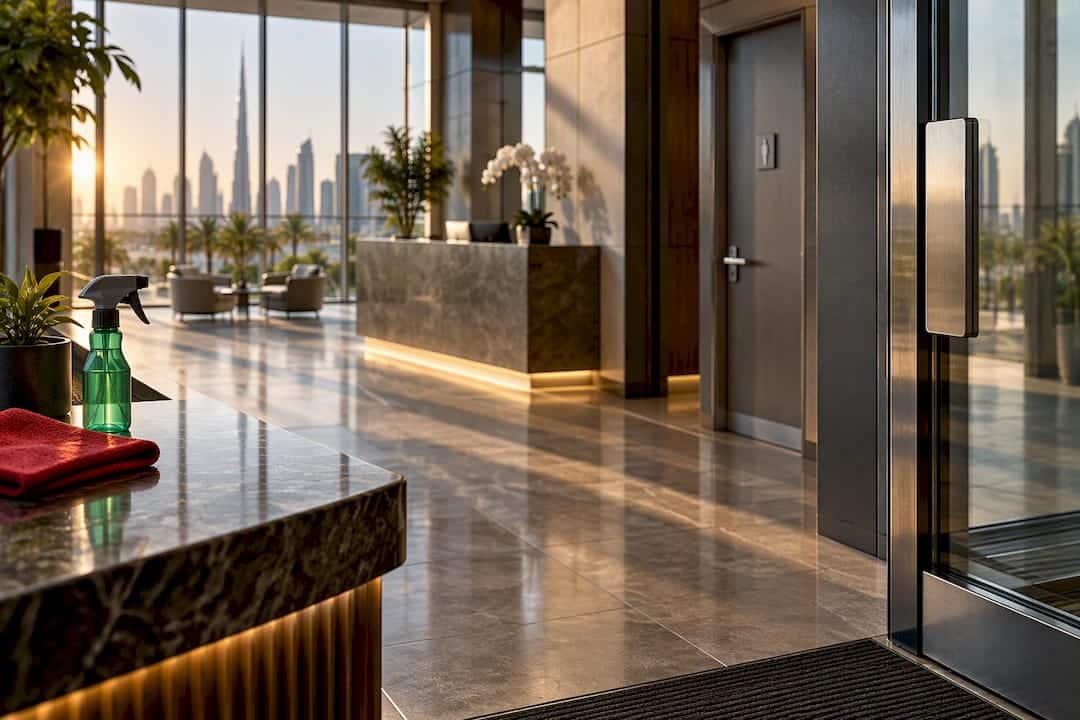
Ten spots drive most of the germ transfer in any office: door handles, light switches, elevator buttons, stair railings, reception counters, shared electronics, kitchen touchpoints, restroom fixtures, phones and conferencing gear, and desks. The baseline rule is simple: clean these daily, disinfect when illness or heavy foot traffic is present, and use only Dubai Municipality approved biocides for any commercial disinfection step.
TL;DR:
Disinfect high-touch surfaces like door handles, elevator buttons, and restroom fixtures daily, increasing frequency during peak traffic or illness outbreaks.
Use approved biocides from the Dubai Municipality list, following manufacturer guidance on contact time and surface compatibility to ensure effective disinfection.
Prioritize cleaning methods based on surface type, such as alcohol wipes for electronics and detergent plus disinfectant for metal fixtures, avoiding spray and excess moisture.
Implement a risk-based cleaning schedule that adjusts frequency according to zone contact volume, occupancy, and seasonal factors like Dubai’s humidity and dust levels.
Hire licensed professional cleaners with documented procedures, proper training, and certified products to ensure compliance and thorough disinfection for office environments.
Specializedcleaning
Keep Your Dubai Office Hygienic
Specializedcleaning provides professional commercial cleaning solutions for Dubai offices, using experts and specialized equipment for complex cleaning challenges.
Doors, Handles and Push Plates: Tasks, Materials and Frequency
Doorknobs, pull handles, and push plates absorb more hand contact per square inch than almost any other surface in a Dubai office tower, especially near lobbies, fire exits, and shared meeting rooms. The CDC’s cleaning and disinfecting guidance names doorknobs specifically as a priority surface, and the two-step method matters more than the product you grab off the shelf.
Wipe with a neutral detergent solution first to lift oils, dust, and grime before any disinfectant goes on.
Follow with an approved disinfectant only where required, matching the agent to the finish (avoid harsh acids on brushed metal or painted plates).
Let the disinfectant sit for its full labeled contact time rather than wiping it dry immediately.
Clean once daily at minimum; push through multiple wipe downs per shift on main entry doors, lobby glass doors, and washroom doors during peak occupancy.
Light Switches, Thermostats and Control Panels: Safe Methods and Timing
Electronics behind a wall plate do not forgive a soaking wet cloth, so the method here differs from doors and rails. A light switch touched by forty employees a day still needs attention, but the wrong product can crack plastic housings or short a thermostat’s internal sensor.
Use pre-moistened alcohol wipes or a barely damp microfiber cloth, never a spray applied directly to the surface.
Check the manufacturer’s guidance before disinfecting smart thermostats or building management control panels; some tolerate only dry wiping.
Private office switches used by one person can move to a weekly cadence unless visitors rotate through frequently.
Elevator Buttons and Interior Panels: Quick-Wipe Tactics and Scheduling
Elevator buttons rank among the most-touched surfaces in any multi-tenant Dubai building because every rider presses one, often with a bare finger, regardless of floor count. Both the car buttons and the landing call buttons need coverage, along with interior panels and any handrail mounted inside the cab.
Run a quick wipe pass during morning and lunchtime peaks when ridership spikes.
Schedule one deeper clean per day covering the full panel, handrail, and door edges.
Coordinate timing with building operations or the concierge desk so cars stay in rotation and tenants are not stuck waiting.
Facility teams that manage full building portfolios sometimes fold this into a broader building cleaning services contract that also covers common corridors and lobbies.
Stair Railings and Handrails: Material-Specific Care and Safety
A stairwell handrail gets gripped, not just touched, which means sweat and hand oils build up faster than on a light switch. Wood, powder-coated steel, and stainless steel each react differently to disinfectants, so matching the agent to the finish protects both the surface and your budget.
Clean with detergent first, then disinfect using a product compatible with the rail’s finish (avoid bleach on unsealed wood).
Run multiple cleanings per day in stairwells that double as the main vertical route between floors.
Once-daily cleaning is usually enough for a lightly used emergency stairwell.
Allow full drying time and post a wet-surface sign before mopping stair treads to prevent slips.
Reception Counters and Visitor Touchpoints: Minimizing Cross-Transmission
Reception is the first contact point for every visitor, courier, and job candidate who walks into your building, and it concentrates several high-touch items in one small footprint: card readers, shared pens, sign-in kiosks, and the counter edge itself.
Disinfect card readers, kiosks, pens, and the counter surface between visitor groups, not just once at the end of the day.
Run a full deep-clean each morning before the first appointment, with spot wipes throughout the day as traffic dictates.
Place hand sanitizer at the desk for visitors and staff.
Add barriers, contactless check-in where possible, and a visible cleaning log so visitors see the standard being maintained.
Shared Electronics: Keyboards, Mice, Printers and Photocopiers
Shared devices circulate germs between departments faster than almost any other office surface because dozens of hands rotate through the same keyboard or printer touchscreen in a single day. The peer-reviewed review on targeted disinfection practices stresses that electronics need a gentler protocol than a doorknob, since excess moisture damages circuitry.
Power down the device where feasible, then wipe with 70% alcohol or a manufacturer-approved wipe, keeping the cloth just damp.
Skip bleach and ammonia-based products entirely on screens and touchpads; they degrade coatings over time.
Use disposable keyboard covers or assign single-user devices in roles where hygiene risk is higher.
Clean shared devices daily, with an extra wipe between users in meeting rooms and hot-desk zones.
Pro Tip:Keep a small tray of alcohol wipes clipped to each shared printer station. Staff are far more likely to wipe down a device between uses when the supply is within arm’s reach rather than stored in a supply closet down the hall.
Kitchen and Breakroom Touchpoints: Food-Safe Practice and Scheduling
A breakroom mixes food contact with shared equipment, so the products used matter as much as the frequency. Fridge handles, microwave keypads, and kettle switches get touched with hands that just handled lunch, coffee, or a courier package.
Use food-safe disinfectants on any surface that contacts food or dishware, and keep a separate cloth for kitchen tasks versus general office wiping.
Wipe fridge handles, microwave buttons, and kettle or coffee machine switches daily at minimum.
Clean spills the moment they happen rather than leaving them for the evening janitorial pass.
Promote a clean-as-you-go culture and keep sanitizing wipes stocked next to the sink.
Restroom Fixtures: Faucets, Flush Handles and Dispensers
Restroom fixtures carry the highest bacterial load of any office zone, and the CDC’s facility guidance lists them among the top-priority surfaces for any commercial cleaning program. Cleaning removes visible soil; disinfection is what actually reduces the microbial count on faucets, flush handles, and dispenser buttons.
Clean to remove soil first, then apply an approved disinfectant to faucets, flush handles, and dispenser touchpoints, giving it the full labeled contact time.
Restrooms serving high headcounts need multiple cleanings per day, not one.
Restock soap, paper towels, and sanitizer during every check, and log the visit with a timestamp.
Cleaning staff should wear gloves and confirm ventilation is adequate, and used materials should go into designated waste streams rather than general office bins.
Phones, Conferencing Gear and Remotes: Between-Meeting Protocols
A shared conference phone or a boardroom remote passes through more hands in a single day than most desks do in a week, yet it is one of the most commonly skipped items on a standard cleaning round.
Stock alcohol wipes inside every meeting room, not just at the front desk.
Disinfect handsets, video conferencing consoles, and remotes between back-to-back meetings, not just at day’s end.
For high-risk meetings (interviews, large external groups), consider disposable covers or a dedicated device set aside for visitor use.
Store cleaning supplies within the room itself and add a wipe-down step to the standard meeting-room checklist so it does not depend on memory.
Desks, Workstations and Chairs: Daily Routines and Hot-Desk Protocols
Assigned desks and hot-desk stations need different playbooks. A single-owner desk mainly needs a daily wipe; a hot-desk station needs disinfection every time a new person sits down.
Wipe desk surfaces, armrests, and chair adjustment levers daily as part of the standard janitorial round.
Clean keyboards and mice with the same alcohol-wipe protocol used for shared electronics elsewhere in the office.
Sanitize hot-desk stations between users, and keep wipes and instructions stocked directly at each hot-desk zone.
Encourage personal-device hygiene and a clear-desk policy, which makes evening cleaning faster and more thorough.
How to Prioritize Frequency and Build a Risk-Based Cleaning Checklist
A rigid calendar rarely matches how an office actually gets used. One insight worth building into any program: cleaning frequency should flex with occupancy and usage rather than follow a fixed schedule, since a stairwell empty on Fridays and packed on Mondays does not need identical treatment both days. Mapping each of the ten zones by contact frequency and headcount gives you a working risk tier instead of guesswork.
Map zones by risk. Rank each of the ten areas by daily contact volume and occupancy, then assign daily, twice-daily, or multiple-times-per-day tasks accordingly. Reception counters and restrooms in a 200-person office earn a different tier than a private director’s office.
Check equipment compatibility. Confirm any disinfectant is safe for the specific surface, especially for electronics, wood finishes, and painted panels, before it goes into wide use.
Build a sign-off checklist. A usable checklist has a time-stamped column for each zone, a named cleaner, and a supervisor sign-off, not just a box to tick.
Plan for escalation. Define what changes when someone reports illness in the office: which zones jump to multiple daily disinfections, and for how long.
Verify supplier approval. Any biocide entering the building should sit on the Dubai Municipality’s approved list, and vendors should be able to produce a Material Safety Data Sheet on request.
Recordkeeping matters as much as the cleaning itself, since a signed log is what you show during a lease audit, a health inspection, or a tenant complaint.
Keep daily sign-off sheets for at least 90 days, longer if your lease or insurer requires it.
Log which product and dilution was used per zone, not just that “cleaning” happened.
Review the ISSA Clean Standard or a similar performance framework periodically to benchmark your program against industry norms.
Why Hire a Licensed Professional and What to Expect From a Commercial Vendor
Fifteen-plus years of running cleaning contracts across Dubai’s commercial towers teaches you one thing fast: the gap between a decent cleaning crew and a genuinely rigorous one shows up in the details most tenants never see, like contact time discipline and documented biocide sourcing. A licensed professional cleaning provider executes rigorous office and building programs combining trained staff with equipment suited to complex jobs like HVAC duct work and data center cleaning, where a generic mop-and-wipe approach falls short.
When vetting any commercial vendor for your own building, ask for:
Proof of insurance and licensing specific to commercial cleaning in the UAE.
A written method statement describing exactly how each of the ten high-touch zones gets cleaned and how often.
Confirmation that every biocide used appears on the Dubai Municipality approved list, with MSDS sheets available on request.
Training records showing staff understand PPE use and contact-time requirements, not just mop technique.
Pro Tip:Before signing a contract, ask the vendor to walk you through their checklist for one zone, say, reception, and time how long they say disinfectant needs to sit before wiping. If the answer is vague or instant, keep looking.
Waste Disposal Procedures for Used Cleaning Materials According to Dubai Regulations
Used wipes, empty chemical containers, and disposable PPE do not belong in a standard office bin once they have been in contact with disinfectants, and Dubai’s municipal framework treats commercial cleaning waste as a category that needs proper segregation. Facility teams should separate general office waste from cleaning-chemical waste at the point of generation, using clearly labeled bins in janitor closets rather than mixing streams at the loading dock.
Empty containers that held approved biocides should be rinsed where the product label allows it and disposed of through the same municipal commercial waste channels used for other office refuse, while any concentrated chemical residue or unused product should never go down a sink or floor drain. Buildings that generate larger volumes, think full-floor deep cleans or post-construction jobs, often need a licensed waste hauler rather than standard municipal collection, since Dubai treats certain chemical waste streams as requiring documented handling from generation to disposal.
The safest practice for any facility manager is to ask your cleaning vendor directly how they dispose of spent chemicals and PPE, and to get that answer in writing as part of the service contract. A vendor sourcing biocides from the Dubai Municipality approved list should also be able to describe their waste handling process without hesitation, since the two obligations tend to sit with the same compliance team. If your building runs a monthly janitorial contract, folding a waste disposal clause into that agreement removes the ambiguity before it becomes a problem during an inspection.
Use of Eco-Friendly or Green Cleaning Products and Their Benefits in Office Environments
Green cleaning products reduce a specific problem that daily touchpoint cleaning creates on its own: chemical buildup in enclosed office air. Offices that clean the same ten high-touch zones every day, sometimes several times a day, expose staff to repeated low-level chemical off-gassing, and buildings with limited fresh-air exchange can trap those compounds longer than expected. Switching daily-use products (not disinfectants used for outbreak response) to certified low-VOC or biodegradable formulas cuts that exposure without weakening the cleaning step itself.
The practical benefit shows up most clearly in offices with open-plan layouts, where dozens of employees sit near whatever surface just got wiped. A green detergent used for the daily clean-first step on desks, doors, and kitchen counters still lifts soil effectively; it simply carries fewer harsh solvents into the air while doing it. Disinfection steps, particularly in restrooms or during illness response, still call for products with proven efficacy, which sometimes means sticking with an approved chlorine or alcohol-based solution rather than a green alternative for that specific task.
Cost is the usual objection, and it is a fair one: certified green products often carry a modest price premium over conventional detergents. Many Dubai facility managers offset that by using green products for the high-frequency, low-risk daily wipe-downs (desks, switches, kitchen touchpoints) and reserving Dubai Municipality approved disinfectants for the fixtures that actually need microbial kill, like restroom hardware and reception touchpoints after visitor turnover. That split keeps compliance intact while trimming the chemical load employees breathe in every day.
Impact of Climate and Humidity Specific to Dubai on Cleaning Frequency and Methods
Dubai’s climate changes the cleaning math in ways that offices in temperate cities never have to consider. Summer humidity spikes combined with near-constant air conditioning create condensation on metal fixtures, door hardware, and window frames, which gives bacteria and mold a damper surface to cling to than in a dry climate. That alone is a reason to hold the daily baseline firm through summer rather than relaxing it, since a cooler-feeling office does not mean a cleaner one.
Air conditioning systems running at near-full capacity for eight or nine months a year also concentrate dust and recirculated particles faster than in milder climates, which settles disproportionately on high-touch horizontal surfaces like reception counters and desks. That is one reason HVAC duct condition matters as much as surface wiping. A duct system pulling dust through the building undoes some of the value of a rigorous touchpoint program, and a periodic HVAC duct cleaning service complements the daily wipe-down routine rather than replacing it. Coordinating AC zoning with cleaning schedules, an approach detailed in general office air conditioning design guidance, also helps reduce the condensation buildup that drives bacterial growth on metal surfaces near vents.
Sand and outdoor dust tracked in through lobby doors add another layer that offices in less arid climates rarely deal with at the same scale. Entry doors, push plates, and reception counters near main entrances typically need more frequent wiping in Dubai than the same fixtures would in a humid but sand-free city, simply because grit accelerates surface wear and gives bacteria more texture to hide in.
Health and Safety Considerations for Cleaning Staff (Proper PPE Use, Training)
Cleaning staff face real chemical and biological exposure risk, and a program that protects office occupants without protecting the people doing the cleaning is only half built. Gloves are non-negotiable for any restroom fixture work or disinfectant handling, and staff should switch glove pairs between zones rather than carrying restroom-grade contamination to a kitchen counter.
Training needs to go beyond “wipe this surface” instructions. Staff should understand why detergent comes before disinfectant, what contact time actually means for the specific product they are using, and how to read a Material Safety Data Sheet well enough to know what they are handling. This same contact-time discipline applies whether the surface is a stair railing or a restroom flush handle, since skipping it on either undermines the disinfection step entirely.
Ventilation matters just as much as PPE. Restrooms and small enclosed rooms need adequate airflow when disinfectants are in use, particularly chlorine-based products, since fumes concentrate quickly in tight spaces. Facility managers should confirm exhaust fans work before assigning a cleaner to a small windowless restroom, not after a complaint comes in.
Finally, staff need clear instruction on waste segregation, since cleaning teams are the ones generating the used wipes, empty containers, and spent PPE that later need proper disposal. Building this into initial onboarding, rather than assuming it is obvious, closes a gap that shows up in compliance audits more often than facility managers expect.
Cleaning First vs Disinfection: Steps and Contact-Time Importance
Cleaning and disinfecting are not the same action, and treating them as interchangeable is the single most common mistake in office hygiene programs. Cleaning removes visible soil, dust, and organic matter using detergent and physical friction. Disinfection kills or inactivates microorganisms on an already-clean surface, and it only works as intended when the surface was cleaned first, since soil physically blocks disinfectants from reaching the microbes underneath.
The peer-reviewed review on targeted disinfection practices makes a point facility managers often miss: routine daily cleaning with a detergent is often sufficient outside outbreak conditions, and escalating straight to disinfectant on every surface every time can be both unnecessary and wasteful. Reserve full disinfection for high-touch fixtures (restroom hardware, door handles, reception touchpoints) and for any zone where someone reported illness.
Contact time is the step almost everyone rushes. A disinfectant wiped on and immediately wiped off has not done its job, regardless of how strong the label claims it is. The WHO’s guidance on 70–90% alcohol or 0.1% sodium hypochlorite solutions assumes the product stays wet on the surface for its full labeled duration, typically one to several minutes depending on the formulation. Building that wait time into staff training, rather than leaving it to individual judgment, is what separates a program that looks thorough from one that actually is.
What I’ve Learned Running Touchpoint Programs Across Dubai Offices
The biggest failure point in touchpoint cleaning is not the schedule, it is the follow-through. Facility managers build a beautiful checklist, then watch it decay within a month because nobody checks whether the disinfectant actually sat for its full contact time or whether the hot-desk wipe-down happened between every user. A checklist without verification is a wish list.
Start with one zone, not ten. Pick reception or restrooms, get the frequency and contact-time discipline right there, then expand outward. ATP swab testing, cheap and available through most commercial cleaning suppliers, gives you an objective read on whether a “cleaned” surface is actually clean, and running spot checks monthly catches drift before it becomes a pattern. Programs that never measure anything tend to quietly slide back to whatever the cleaning crew finds easiest.
One more thing worth saying plainly: Dubai’s approved biocide list exists because not every disinfectant sold locally has been vetted for commercial use, and skipping that check to save a few dirhams on chemicals is a bad trade against liability.
— Qadir
Turn This Checklist Into a Working Program With Specializedcleaning
Licensed professional cleaning providers execute ten-zone checklists as standing services rather than a one-time favor, backed by extensive experience running commercial cleaning contracts across Dubai. That is the real difference from piecing together ad hoc cleaning through in-house staff who juggle other duties: a documented, sign-off-ready program with staff trained on contact time and Dubai Municipality approved biocides from day one.
The service lineup maps directly onto what this article covers. An office janitorial cleaning contract handles the daily touchpoint rounds, desks, doors, and restrooms, while periodic deep cleaning services cover the escalation tier when illness spikes or after heavy visitor traffic. Offices with server rooms can add data center cleaning to protect sensitive electronics without risking moisture damage, and buildings dealing with Dubai’s dust load benefit from pairing touchpoint work with HVAC duct cleaning.
Specializedcleaning offers a free consultation to audit your current cleaning coverage against these ten zones. Request a quote through the office cleaning services page and get a same-day response on scheduling.
Dubai has a wide mix of licensed commercial cleaning providers, ranging from large facility management firms to specialized operators. Look for companies with insurance, a documented method statement, and use of biocides from the Dubai Municipality approved list rather than relying on rankings alone. Some licensed providers have extensive commercial experience across office janitorial, deep cleaning, and specialized services like HVAC duct and data center cleaning.
Why Is Cleaning High-Touch Areas Essential in Hotel Rooms and Offices?
High-touch surfaces like door handles, light switches, and remotes concentrate hand contact from many different people, which makes them a primary transfer point for germs. The CDC identifies these same surface types as priority cleaning zones in any shared facility, hotel room or office alike, because the risk mechanism is identical: repeated hand contact on a surface that is not frequently disinfected.
Where Are the Best Areas to Locate an Office in Dubai?
This depends on your business type. DIFC suits financial and professional services firms, Business Bay and Downtown suit corporate headquarters, and free zones like JLT or Dubai Silicon Oasis suit companies wanting cost efficiency with full ownership. Whatever the location, the same ten high-touch cleaning zones apply regardless of the building or district, and Specializedcleaning services buildings across DIFC and other major Dubai commercial districts.
How Much Does an Office Cleaner Cost Per Hour in Dubai?
Hourly office cleaning rates in Dubai vary based on scope, contract length, and whether you need daily janitorial staff versus periodic deep cleaning. Specializedcleaning does not publish flat hourly rates online; current pricing is available through a free consultation request based on your building size and service frequency.
How Often Should High-Touch Surfaces Be Cleaned in an Office?
Daily cleaning is the baseline for all ten high-touch zones, with disinfection added when someone reports illness or when a zone sees heavy foot traffic. High-occupancy areas like restrooms, reception counters, and elevator buttons often need multiple cleanings per day, following the risk-based approach the CDC recommends for community and commercial facilities.