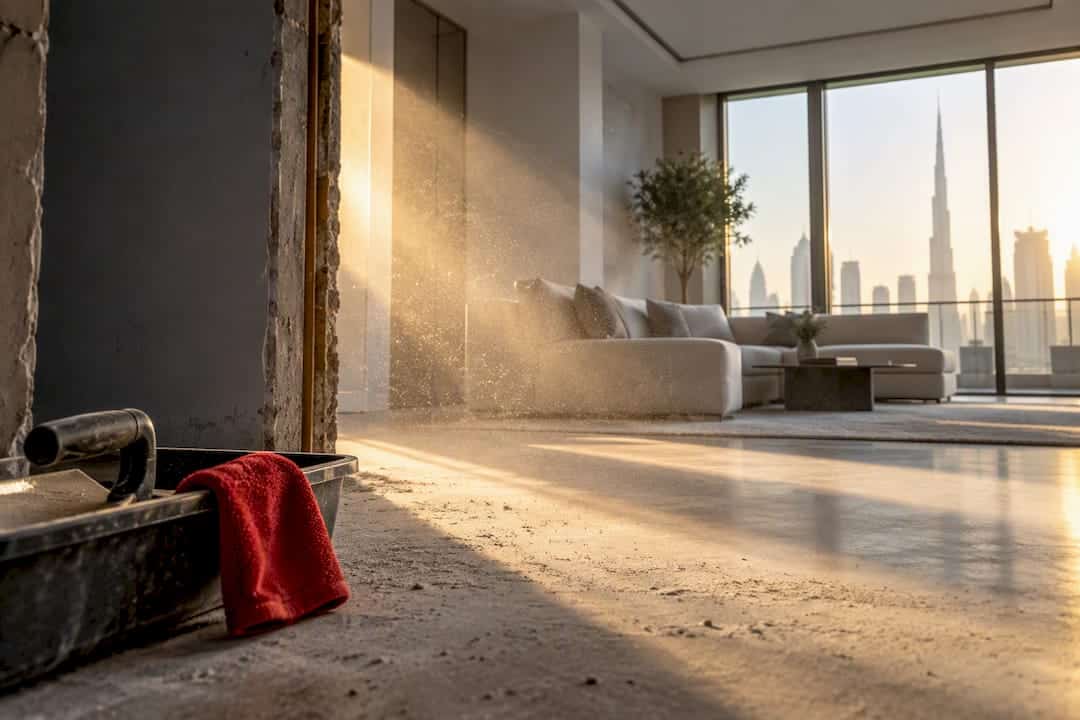
Construction dust comes back after cleaning because its finest particles stay airborne or hide inside vents, curtains, and carpets long after the visible mess disappears. Regular sweeping and dry dusting only redistribute those particles. Stopping the cycle takes air filtration, a proper top-to-bottom cleaning order, and attention to the HVAC system, not just a second pass with a rag.
TL;DR:
HEPA vacuums and air scrubbers are essential for removing construction dust effectively, capturing 99.97% of particles at 0.3 microns.
Waiting at least two days after dusty work finishes improves the likelihood of removing settled particles, as fine dust can stay airborne for 48 to 72 hours or longer.
A staged cleaning process that starts with rough cleaning, allows settling time, then follows with top-to-bottom HEPA-based methods yields better results than a single aggressive pass.
HVAC duct cleaning is crucial because dust often accumulates inside vents and ducts, which can recirculate particles back into cleaned spaces.
Preventing dust re-accumulation involves regular filter replacement, sealing gaps, controlling indoor humidity, and routine vacuuming with HEPA tools.
Specializedcleaning
Clear Construction Dust Thoroughly
Specializedcleaning combines experienced staff and specialized equipment for post-construction cleaning in Dubai, including complex dust challenges.
What Construction Dust Actually Is and Why It Behaves Differently
Construction dust is not the same substance as the household dust you wipe off a bookshelf. It’s a mix of drywall and gypsum powder, cement and masonry fines, sawdust, and silica particles released by cutting, sanding, and demolition. Many of these particles are very fine, smaller than a strand of hair, which lets them slip past casual cleaning and stay suspended in the air rather than settling quickly.
That size difference explains why cleaning that works fine on ordinary dust barely dents construction dust. According to Hilti’s technical guidance on dust behavior, particles this fine can remain airborne for 48 to 72 hours or longer, especially indoors where there’s little air exchange.
A few key distinctions matter for how you clean:
Household dust is largely made of skin cells, fabric fibers, and pet hair. It’s heavier and settles faster.
Construction dust includes mineral and silica particles that are lighter, sharper-edged, and slower to fall.
Construction dust penetrates fabric weaves and HVAC filters more easily, which is why it lingers in curtains, sofas, and vents long after floors look clean.
How Long Does Construction Dust Stay Airborne?
The 48 to 72 hour window is the baseline most professionals plan around, but it’s a starting point, not a guarantee. Low indoor humidity, a running HVAC system, or ongoing work nearby can stretch that timeline considerably, since the particles simply have more chances to get lifted back into the air before they settle for good.
That’s why experienced cleaning crews rarely do a single final pass immediately after construction wraps. A staged cleaning workflow that includes a rough clean, a settling period, and a final HEPA-based pass tends to outperform one aggressive cleaning session. As a practical rule for homeowners: if you can wait at least two full days after the last dusty task before your final clean, you’ll capture far more settled particulate and far less that’s still floating.
What Professionals Do Differently to Stop Recontamination
Professional-grade cleaning isn’t just “more thorough.” It uses different tools built specifically to trap particles that regular vacuums and cloths let escape.
HEPA vacuums and air scrubbers are the backbone of post-construction cleaning. A true HEPA filter captures 99.97% of particles at 0.3 microns, according to EPA standards for renovation cleanup, which covers the smallest and most persistent construction dust.
Containment and staged cleaning control the sequence: rough clean first, allow settling time, then a HEPA vacuum and damp wipe pass, followed by filter replacement.
Negative pressurization during active work, standard on higher-hygiene projects per Dubai Health Authority renovation guidelines, keeps dust from spreading into already-cleaned zones in the first place.
Duct cleaning matters more than most homeowners expect. Fine dust gets pulled into return vents during construction and coats the inside of the ductwork itself. Once that’s happened, running the HVAC system just blows it back into rooms you’ve already cleaned, which is why a guide to HVAC duct cleaning services is often the missing step after a renovation.
Pro Tip:If dust seems to reappear specifically near vents within hours of cleaning, that’s a strong sign the ducts themselves are contaminated, not just the room.
A Step-by-Step Plan to Stop Dust From Coming Back
Follow this sequence rather than jumping straight to vacuuming. Order matters as much as the tools you use.
Wait for major settling. Wait at least a couple of days after the dustiest work finishes before doing your final clean.
Start at the top. Clean ceilings, light fixtures, and crown molding first, since anything you dislodge up there will fall onto surfaces you clean later.
Move to vents and fixtures. Wipe down supply and return vents, wall-mounted fixtures, and window frames.
Address textiles. Vacuum curtains, upholstery, and rugs with a HEPA-equipped vacuum rather than shaking or beating them.
Finish with floors. Use damp microfiber mopping, not dry sweeping, for the final floor pass.
Run an air scrubber or purifier throughout. Keeping filtration active while you clean catches particles you stir up in real time instead of letting them resettle elsewhere.
Replace HVAC filters immediately after. A used filter loaded with construction dust keeps recirculating it; upgrading to a higher-efficiency MERV filter or a HEPA-compatible filter cuts that recirculation significantly.
Pro Tip:A rented HEPA air scrubber for a single day of deep cleaning usually costs far less than redoing the entire clean a week later once the dust resettles.
If vents are visibly blowing dust, or the project involved heavy drywall sanding or demolition, that’s the point to call in a post-construction deep cleaning service rather than continuing with DIY passes.
Keeping Dust From Building Up Again
Stopping recontamination once is only half the job. Keeping it from returning over the following weeks takes a maintenance routine, not another one-time clean.
Replace HVAC filters on a regular cycle, and check MERV 13+ filters monthly during any nearby dusty work, per EPA filter guidance.
Seal gaps around doors and windows, and weatherstrip where drafts let outdoor particles in.
Cover or seal registers and vents if any future work is planned nearby.
Target indoor humidity between 40 and 50 percent. Too dry and fine dust stays airborne longer; too humid and you invite dust mites and mold instead.
Keep a routine vacuuming and textile-cleaning schedule rather than waiting until dust becomes visible again.
Post-Renovation Dust Checklist
Wait at least 48 hours for heavy settling before the final clean whenever the schedule allows it.
Run an air scrubber or purifier during the entire cleaning session.
Clean top to bottom: ceilings and fixtures, then vents, then textiles, then floors, using damp methods and a HEPA vacuum throughout.
Replace HVAC filters right after the final pass.
Book a professional follow-up if vents keep blowing dust or if anyone in the home develops allergy symptoms after the “final” clean.
Why a Process, Not a Product, Actually Solves This
Most homeowners buy a better vacuum or a stronger cleaner when dust keeps returning. The real fix is sequence and filtration working together. Skip the staged approach, and even good tools just move dust around instead of removing it.
— Qadir
When It’s Time to Call In a Professional Post-Construction Clean
Some renovation jobs are simple enough to handle with a weekend of careful cleaning. Others, especially anything involving drywall sanding, demolition, or a full villa renovation, leave dust embedded in places a mop and a regular vacuum can’t reach. If vents are visibly blowing dust, allergy symptoms are flaring up, or you simply don’t have two or three days to dedicate to a proper staged clean, that’s the point to bring in a professional.
NPSM Specialized Cleaning Services LLC approaches post-construction cleanup the way this article describes it should be done: as a staged process, not a single sweep-and-mop visit. A professional post-construction clean typically involves multi-stage HEPA-based cleaning, portable air scrubbers running throughout the job, a duct inspection to check whether fine particles have already worked their way into your HVAC system, and a filter replacement once the job is finished. For renovations that included heavy sanding or drywall work, pairing a deep clean with HVAC duct cleaning addresses both the visible mess and the hidden reservoir feeding it back into your rooms. If you’re in Dubai and just finished a renovation, request a free consultation and quote through the post-construction deep cleaning page to get a same-day scheduling option and a licensed team handling the staged process from start to finish.
Sources
If you’ve vacuumed and wiped every surface and the dust is back within a day, the problem usually isn’t your cleaning effort. It’s where the dust was actually hiding and what’s still stirring it up.
Air movement is the biggest culprit. Every time your HVAC system cycles on, it pushes air through the house, and any dust that settled on ledges, in corners, or on top of cabinets gets lifted back into circulation. Ceiling fans and even foot traffic do the same thing on a smaller scale.
Ducts, vents, and filters store dust and recirculate it. Fine particles get pulled into return vents during and after construction, coating the inside of ductwork. A standard filter with a low MERV rating can’t stop that recirculation on its own, according to the EPA’s guidance on filter ratings.
Wrong cleaning order re-aerosolizes particles. Dry sweeping or dusting doesn’t remove fine dust. It launches it back into the air, where it eventually resettles somewhere else.
Soft furnishings and crevices act as reservoirs. Curtains, upholstery, rugs, and gaps behind trim hold dust and release it gradually every time they’re disturbed, a pattern Panasonic’s indoor air quality research points to as a major reason homes stay dusty long after visible construction ends.
Outdoor ingress keeps adding to the problem. Open windows, gaps around doors, and nearby renovation work or dust storms bring in fresh particles even after you’ve cleaned everything inside.
Fine construction particles under 10 microns often stay airborne for 48 to 72 hours or longer, according to Hilti’s dust research, so cleaning too soon or in the wrong order just resettles them elsewhere. Dust also hides in HVAC ducts, vents, and soft furnishings, releasing back into the air every time the system cycles or a cushion gets disturbed.
How Do You Prevent Dust From Coming Back?
Replace or upgrade HVAC filters to MERV 13 or higher, seal gaps around doors and windows, and keep indoor humidity between 40 and 50 percent. Combine that with a regular HEPA vacuuming and damp-wiping schedule instead of waiting until dust becomes visible again.
How Do You Eliminate Construction Dust?
Use a staged approach: let heavy dust settle first, then clean top to bottom with a HEPA vacuum and damp microfiber, running an air scrubber throughout. HEPA filtration captures 99.97% of particles at 0.3 microns, per EPA standards, which is why HEPA equipment outperforms standard vacuums and dry dusting for this type of debris.
How Long Does It Take for Construction Dust to Settle?
Most construction dust settles within 48 to 72 hours under normal conditions, though low humidity or a running HVAC system can extend that window. Professionals often schedule a rough clean, a settling period, and a final HEPA-based pass rather than relying on one cleaning session immediately after the work ends.
Does Specializedcleaning Handle Duct Cleaning After Renovations?
Yes, NPSM Specialized Cleaning Services LLC offers HVAC duct cleaning as part of its post-construction services in Dubai, addressing dust that has already settled inside ductwork. Pricing is available on request through a free consultation on the service page.